
I want to begin with the fig, because the fig deserves to be begun with.
A ripe fig is one of the most astonishing things in the produce world—not because it is rare or expensive or difficult to find in the right season, but because of what it is when you cut it open. The exterior is unassuming: a small, soft, dusty-skinned fruit in green or purple or deep brown depending on variety, yielding under gentle pressure, suggesting something sweet inside without revealing how extraordinary that something will be. Cut it open, and what you find is a cross-section of deep crimson and pink and ivory—the interior packed with tiny seeds surrounded by soft, sweet, almost jam-like flesh that smells of honey and warm wood and something faintly floral that I have never been able to name precisely, only recognize immediately as specifically fig.
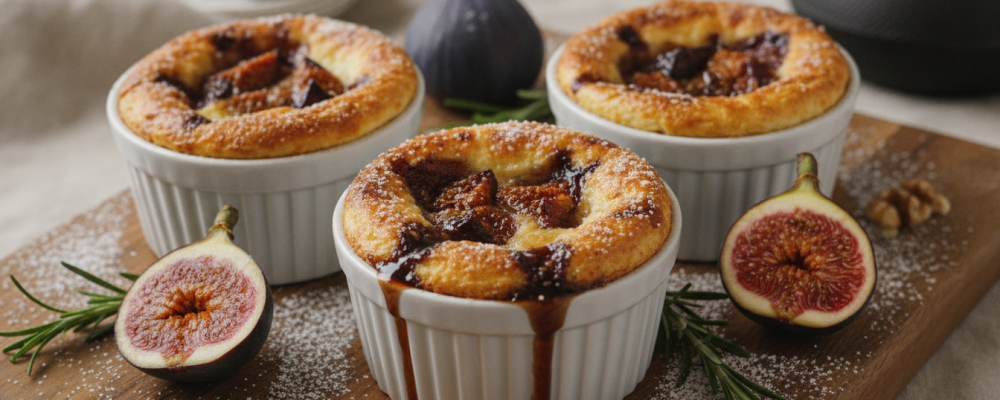
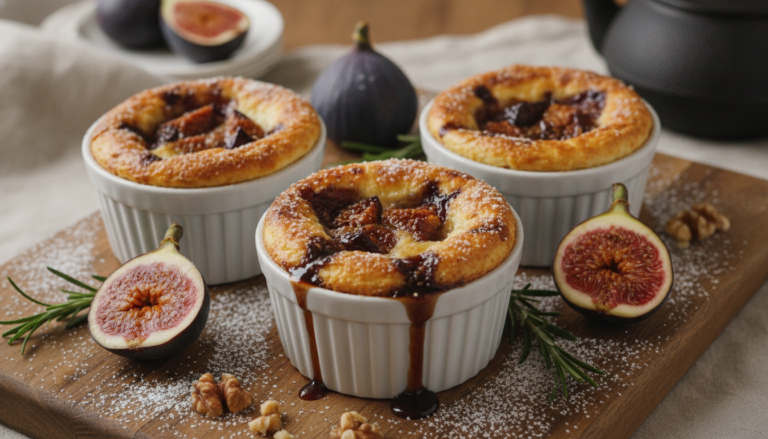
In a baked preparation, figs do something that no other fruit quite manages: they soften into themselves rather than breaking down and disappearing. At 350°F over twenty-five to thirty minutes, a chopped fig develops a jammy, concentrated sweetness at its cut surfaces where the sugars caramelize against the surrounding batter, while its interior remains soft and yielding and specifically figgy in a way that baked apple or baked pear—which dissolve more completely—doesn’t achieve. The result, in this cup, is visible pockets of deep amber-and-crimson fig at the cup’s surface and distributed through the crumb—jewel-like, jammy, and beautiful in the specific way that a cross-section of a perfectly baked fig always is.
Brown sugar was chosen alongside the fig specifically because it belongs there. Fig and caramelized sugar have been paired in pastry preparations since the earliest documented uses of both ingredients—the brown sugar’s molasses depth amplifies the fig’s natural honey-like sweetness in a way that white sugar cannot, and the combination produces a warmth in the finished cup that feels earned rather than applied.
─────────────────────────────────────────
The Inspiration Behind This Recipe
The inspiration was a fig tart. Specifically: a fig tart I encountered at a small bakery years ago that I have been attempting to reverse-engineer in various formats ever since—the filling was creamy and slightly tangy, the figs were halved and pressed into the surface so their cut faces caramelized in the oven, and the whole thing tasted of brown sugar and vanilla and something floral that I later identified as the fig itself. It was one of those pastry moments where you stop and acknowledge that something quite specific and quite extraordinary has just happened in your mouth.
The baked cottage cheese cup format was the translation that brought that tart’s essential qualities into a meal prep context. Cottage cheese’s mild tanginess mirrors the cream cheese or ricotta filling in the original tart’s character; its protein content provides the structural stability that allows these cups to be stored, reheated, and eaten across four days without losing the quality that makes them worth making; and its moisture-retaining properties keep the fig’s texture supple through the storage window rather than drying out the way a lower-moisture base would allow.
The cinnamon is the spice detail that completes the flavor logic. Fig and cinnamon have a long and well-established compatibility in the pastry world—the spice’s warming, slightly sweet depth amplifies the fig’s own warmth without competing with it, in the same way that cardamom lifts pear or vanilla deepens chocolate. A cup with fig and without cinnamon is pleasant; a cup with fig and cinnamon is specifically, memorably of something. The distinction is worth the fraction of a teaspoon.
─────────────────────────────────────────
A Brief History of Fig in Baking
The fig is among the oldest cultivated fruits in human history—evidence of fig cultivation in the ancient Near East predates the cultivation of wheat and barley, suggesting that figs may have been among the very first crops deliberately grown by human agricultural communities. In ancient Mediterranean cultures—Greek, Roman, Egyptian, Hebrew—the fig was a staple of everyday eating and a symbol of abundance, peace, and sweetness that appears throughout the religious texts and literature of multiple civilizations. Homer’s Odyssey references figs; the Old Testament’s fig tree appears in the Garden of Eden; Roman agricultural writers documented the cultivation and drying of figs with the same practical detail they applied to olives and grapes.
In Mediterranean and Middle Eastern pastry specifically, fig has been a central ingredient in sweetened preparations for as long as those traditions have existed—dried figs stuffed with almonds and spices appear in ancient Greek higos preparations; fig and honey combinations anchor North African pastry traditions; and fresh fig tarts and galettes represent one of the simplest and most enduring preparations in contemporary French and Italian baking, where the fruit’s natural sweetness and self-sufficient flavor make it an ideal candidate for preparations that ask very little of the baker beyond not interfering.
Brown sugar’s pairing with fig reflects the fruit’s historical association with caramelized sweeteners—honey and molasses have accompanied fig preparations since the earliest documented recipes, because the dark, slightly bitter complexity of caramelized sugars amplifies the fig’s natural sweetness in a way that refined white sugar cannot. The cottage cheese base is the contemporary element that brings this ancient fruit pairing into a format suited to modern meal prep—the fresh dairy cheese tradition that stretches back through Central European and Mediterranean cooking history finding a new and practical expression in a muffin tin on a Sunday morning.
─────────────────────────────────────────
Why This Cooking Method Works for Meal Prep
The cottage cheese base behaves fundamentally differently from a standard muffin batter during baking, and understanding that difference explains both the cup’s texture and its meal prep stability. Cottage cheese’s protein coagulates during baking in a way that produces a softer, more yielding crumb than flour-dominated batter—similar to the texture of a well-set custard or a light cheesecake—with a moisture content that the cottage cheese’s whey proteins continue to bind within the crumb during refrigerator storage. The result is a cup that remains moist through day four in a way that a butter-and-flour equivalent would not, because the cottage cheese is actively retaining moisture rather than simply trapping it between starch granules.
Folding the chopped figs into the batter gently—rather than mixing them through—is the technique that produces the distinct fig pockets visible in the finished cup rather than a uniformly fig-flavored crumb. Chopped figs mixed aggressively break down and bleed their juice through the entire batter before it bakes, producing a consistently fig-colored cup with no visible fruit. Gently folded figs remain largely intact through mixing and the first minutes of baking—setting in the surrounding batter as defined, jammy pockets rather than dispersing through it. The visual result is specifically beautiful; the textural result—the occasional bite that encounters a concentrated pocket of warm, jammy fig—is the best argument for the technique.
The whole wheat flour is the structural decision that makes these cups hold together as a portable, meal-prep-viable preparation rather than simply a set custard. Whole wheat flour’s fiber and protein content provides the scaffolding that allows the cup to be removed cleanly from the tin, stored without crumbling, and reheated without collapsing—a structural contribution that white flour would provide with less nutritional return and that no flour at all would leave the cup too fragile to function outside the tin it was baked in.
─────────────────────────────────────────
Flavor Profile: What to Expect
These cups are warmly sweet, faintly spiced, and specifically figgy in the best possible sense:
- Jammy, honey-sweet fig – The defining flavor: concentrated, slightly floral, faintly seeded, and present in both specific pockets of fruit and as a background sweetness distributed through the surrounding crumb—unmistakably and specifically of fig in a way that no other fruit achieves
- Caramel-toned brown sugar – The sweetener whose molasses complexity was made for fig: richer and more specific than white sugar, with a faint toffee depth that makes the fig’s natural sweetness taste more layered and more interesting by comparison
- Warm cinnamon spice – The aromatic bridge that connects fig’s floral sweetness and brown sugar’s caramel depth into something cohesive and specifically warm—present as a background warmth in every bite
- Soft vanilla – The bakery-adjacent aromatic that rounds every other flavor into something comforting and complete—most perceptible in the cup’s fragrance rather than its direct flavor
- Mild, tangy cottage cheese – The base’s quiet character: slightly tangy, faintly sweet, and primarily present as the textural quality that makes the cup yielding and moist rather than dry and crumbly
- Nutty whole wheat depth – The flour’s mild, slightly grassy whole grain character that grounds the cup’s sweeter flavors and gives each bite a satisfying, substantive quality
The brown sugar and fig flavors deepen and integrate through the first day of refrigerator storage as the caramelized sugar compounds continue to distribute through the cottage cheese crumb. A cup eaten the morning after baking is noticeably more cohesive in flavor than one eaten warm from the oven—the fig more evenly present, the brown sugar more forward, the cinnamon more integrated.
─────────────────────────────────────────
Tips for Making the Best Brown Sugar Fig Baked Cottage Cheese Cups
Precision with the fig preparation and gentleness in the folding step are the two most critical technique considerations:
- Use ripe, soft figs – An underripe fig has little of the flavor complexity that makes this cup worth making. A properly ripe fig yields immediately under gentle pressure, smells noticeably sweet and floral, and has flesh that is deep crimson at the interior. Underripe figs bake into tough, flavorless pieces; ripe figs bake into the jammy, concentrated pockets this recipe is built around.
- Chop figs into pieces that will be visible – Quarters or sixths are the correct size—large enough to form distinct pockets in the baked cup, small enough to distribute reasonably through the batter. Smaller pieces disappear into the crumb; larger pieces are too heavy to be supported by the batter and sink to the base.
- Use full-fat cottage cheese – Lower-fat cottage cheese has a higher water content that makes the batter too loose and produces a cup that is difficult to set cleanly. Full-fat cottage cheese’s higher protein-to-water ratio produces a more cohesive batter and a better-structured finished cup.
- Fold figs in last, with minimum turns – Four to five folds with a spatula is the maximum. Under-mixed is always better than over-mixed for any fruit folded into a batter; the goal is distribution rather than incorporation. Pieces of fig sitting visibly at the batter’s surface after folding will bake into the most beautiful caramelized pockets.
- Don’t overbake – The cups are done when the surface is set and golden and a toothpick inserted into the center comes out with moist crumbs but no wet batter. The cottage cheese base sets at a lower internal temperature than a flour-dominant batter; overbaking dries the interior and toughens the protein structure. Pull them at the lower end of the time range if uncertain.
- Cool in the muffin tin – These cups need ten minutes of rest in the tin before removal. The cottage cheese protein structure is still fragile when warm and requires time to firm before the cup can be released cleanly.
Optional: A small amount of additional brown sugar pressed onto the surface of each cup before baking caramelizes in the oven into a thin, slightly crisp sugar crust that makes the first bite particularly wonderful—the crunch of caramelized sugar against the soft, figgy interior is one of those small pastry contrasts that elevates a home-baked cup into something genuinely special.
─────────────────────────────────────────
Portioning and Container Suggestions
This recipe produces four individual cups—one per day across a four-day breakfast or dessert rotation, or two for a more generous serving. The cups are compact enough to stack in a standard airtight container with a piece of parchment paper between each one, though their slight moisture content means parchment separation is essential for preventing the surfaces from adhering to each other during storage.
The visual of these cups—golden-domed surfaces with the deep amber and crimson of fig pockets visible through the surface, occasionally a caramelized fig edge where the fruit was close to the cup’s top—is one of the most naturally beautiful baked things in this collection. A container of four of these in the refrigerator, their surfaces visible through a glass lid, is a sight that makes the week feel specifically and genuinely well-prepared-for.
For a particularly composed serving presentation—these cups belong on a weekend brunch table as much as in a weekday breakfast rotation—plate one cup on a small dessert plate alongside a thin drizzle of good honey, a halved fresh fig if in season, and a dusting of cinnamon over the surface. The composition is simple, takes thirty seconds, and produces something that looks as though it arrived from a very good patisserie. The fig and the brown sugar will have done most of the work. You are simply providing the stage.
─────────────────────────────────────────
Storage, Reheating, and Shelf Life Tips
- Refrigerator storage: Keeps in an airtight container for up to 4 days. The fig and brown sugar flavors integrate more fully through days two and three—the peak flavor window. The cottage cheese keeps the crumb moist throughout the storage window.
- Freezer storage: Freeze well for up to 2 months. Cool completely before wrapping each cup individually in plastic wrap and transferring to a labeled freezer bag. The cottage cheese protein structure is freeze-stable; the figs retain their jammy quality after thawing.
- Oven reheating (recommended): Place cups on a baking sheet at 300°F for 8–10 minutes from refrigerated. This method warms the crumb gently and releases the fig and cinnamon aromatics in a way that transforms a refrigerator cup into something that smells as good as it did when first baked.
- Microwave reheating: Wrap in a damp paper towel and microwave at 50% power for 45–60 seconds. Lower power preserves the cottage cheese’s protein texture; full power toughens it noticeably. The damp towel prevents the surface from drying under microwave heat.
- Room temperature serving: These cups are genuinely beautiful at room temperature—the fig flavor is most forward and the brown sugar’s caramel depth is most perceptible without refrigerator suppression. A cup brought to room temperature twenty minutes before eating is, in many respects, the ideal serving state.
- Fresh fig note: Fresh figs have a shorter baking stability window than dried fruit—by day four, the fig pockets in the cup will be softer and more jammy than on day one. Both states are delicious; the progression is one of deepening concentration rather than deterioration.
─────────────────────────────────────────
Why This Recipe Deserves a Spot in Your Meal Prep Rotation
I want to make a case that goes beyond the practical, though the practical case is sound: four days of refrigerator stability, meaningful protein from the cottage cheese, fiber from the figs and whole wheat flour, and a preparation time of thirty minutes. Those qualities are real and they matter. But they are not the reason to make this cup every week.
The reason to make this cup every week is the fig. There are very few ingredients in a home baker’s repertoire that are as immediately, specifically beautiful as a ripe fig—that produce a baked result as visually striking and as specifically flavored as what happens when fig meets brown sugar and cinnamon in a warm oven and softens into something jammy and jewel-toned and concentrated in a way that makes you stop and notice that something quite beautiful has happened. Those moments—the moments when a very simple preparation using excellent ingredients produces something that briefly exceeds all reasonable expectations of what a thirty-minute baked cup has any right to be—are the moments that make cooking worthwhile.
This cup produces that moment, reliably, every Sunday it’s made. That is more than enough reason to keep it on the list.
─────────────────────────────────────────
Meal Prep Pairing Suggestions
Brown Sugar Fig Baked Cottage Cheese Cups pair most naturally with sweet baked cup preparations that share the fresh-dairy-cheese base or the warm, fruit-forward character while offering genuine contrast in flavor profile. Our Lemon Poppy Seed Cottage Cheese Baked Cups are the natural companion within the cottage-cheese-based baked cup category—both use the same moisture-retaining fresh dairy base and produce a cup that is protein-rich and durable through the storage window, but lemon-poppy’s bright, citrusy vivacity is the tonal opposite of these cups’ warm, caramelized, fig-dark depth. Together they give the cottage cheese cup format two entirely different seasonal and flavor identities across the same week.
For a complete three-breakfast sweet baked rotation, our Cardamom Pear Baked Ricotta Cups round out the collection with a third fresh-dairy-cheese baked cup in a warmly spiced, soft-fruit direction—ricotta rather than cottage cheese, pear rather than fig, cardamom rather than cinnamon. Three baked cups, three fresh dairy bases, three fruit-and-spice combinations covering the full range of what warm, fruit-forward, dairy-enriched baking can achieve when each ingredient is specifically and thoughtfully chosen. A week of mornings with any of these cups waiting in the refrigerator is a week of mornings that begins with something genuinely worth waking up for. A week with all three is, quite simply, the best possible version of what Sunday baking can do for a person.
Brown Sugar Fig Baked Cottage Cheese Cups
These Brown Sugar Fig Baked Cottage Cheese Cups are a warmly elegant baked breakfast built on caramelized brown sugar, cottage cheese’s moisture-retaining creaminess, and the extraordinary fig—a fruit so beautiful and so specific in flavor that it elevates everything it touches.
4
servings15
minutes30
minutes180
kcal45
minutesIngredients
1 cup cottage cheese
2 tablespoons brown sugar
1 cup figs, chopped
1 teaspoon vanilla extract
1 unit egg
1/2 teaspoon cinnamon
1/4 teaspoon salt
1/4 cup whole wheat flour
Directions
- Preheat oven to 350°F (175°C).
- In a bowl, mix cottage cheese, brown sugar, and vanilla extract.
- Add egg, cinnamon, and salt, mix well.
- Fold in figs and whole wheat flour gently.
- Divide mixture into 4 muffin cups.
- Bake for 25-30 minutes until set and golden.
- Let cool slightly before serving.
Nutrition Facts
- Total number of serves: 4
- Calories: 180kcal
About This Author

Benjamin Brown
Recipe Developer
Benjamin is our flavor engineer. A classically trained chef turned recipe developer, he’s obsessed with balancing taste, texture, and creativity. He ensures that every recipe we publish is not only delicious but also reliable, approachable, and repeatable — even for beginners.
Favorite dish: Slow-braised short ribs with red wine reduction.
Kitchen motto: “Cooking is part science, part soul.”