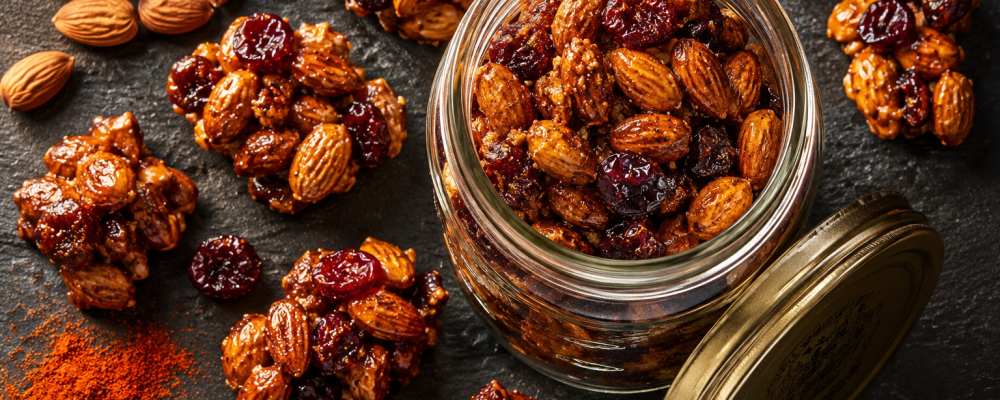

There are snacks that exist because hunger demanded something quickly, and there are snacks that exist because someone—you, on a Sunday, with a bowl and a baking sheet and twenty minutes of unhurried attention—decided the week deserved something genuinely considered. These clusters are the second kind. They are the snack I make when I want to feel, on a Tuesday afternoon when the day has gone long and the afternoon still has hours in it, like someone took care to make sure that moment would be good.
The combination of smoked paprika and dried cherry is one of those flavor pairings that shouldn’t be as instantly right as it is, and then you taste it and it makes complete sense. The paprika’s dry, warm smokiness—that specific, slightly sweet, slightly earthy heat that no other spice produces—makes the cherry’s tartness taste brighter. The cherry’s tartness makes the paprika’s warmth taste deeper. The honey holds everything together in a golden, slightly sticky cluster that looks, when you open the container, like something from a very good specialty food shop. It is not from a very good specialty food shop. It is from your kitchen, on a Sunday, and the fact of that makes it taste even better.
I think often about what it means to take care of yourself through cooking—not in the aspirational, optimized sense, but in the simple, honest sense of making something with your hands that you will reach for later with genuine pleasure. These clusters are that thing. They are small and specific and deeply satisfying, and every time I eat one in the middle of an ordinary afternoon, I feel grateful to the version of me that made them.
─────────────────────────────────────────
The Inspiration Behind This Recipe
This recipe was born from an observation I make every time I put together a cheese board: the dried fruit and the roasted nut always disappear before anything else. Before the cheeses, before the crackers, before the fancy condiments—the salted, slightly smoky almonds and the tart dried cherries are gone, eaten together in that instinctive combination that every hand on the board reaches for without being told to. There is something about that specific pairing—smoky and savory against sweet and tart—that the palate understands immediately as correct.
What this recipe does is simply honor that instinct by making it a prepared thing rather than an accidental one—by roasting the almonds with the smoked paprika and honey they deserve, and then bringing the cherries into the cluster at the end so that every bite contains both components in the ratio that makes the combination so compelling. The cluster format is what makes it a snack rather than a board element: something you can grab as a unit, something that travels without requiring a small plate and a careful arrangement, something that delivers the complete experience—smoky nut, tart fruit, sweet honey—in a single, self-contained piece.
The smoked paprika specifically, rather than sweet or hot paprika, was the choice that gives this recipe its character. Sweet paprika is pleasant; hot paprika adds heat that competes with the cherry’s tartness rather than complementing it; smoked paprika delivers the dry, complex, slightly charred character that makes the almond taste like something genuinely special rather than simply something spiced. It is the difference between a cluster that is enjoyable and one that is memorable, and memorable is worth the extra step of making sure it’s the smoked variety in the spice jar.
─────────────────────────────────────────
A Brief History of Nut and Dried Fruit Pairings
The combination of roasted or salted nuts with dried fruit is one of the oldest and most universally understood snack combinations in culinary history—appearing in the trail mix and travelling provisions of ancient cultures across the Middle East, Central Asia, and the Mediterranean, where nuts and dried fruits were among the most portable, calorie-dense, and shelf-stable foods available to travelers, merchants, and soldiers who needed sustenance without the weight of fresh ingredients.
Persian cooking traditions—among the most sophisticated in the ancient world—developed the nut-and-dried-fruit combination into an art form that has influenced cuisines from Morocco to India to the Levant: almonds and dried apricots in khoresht preparations, pistachios and dried cherries in pilaf, walnuts and raisins in slow-cooked fesenjan. The instinct to balance the fat and protein of a nut with the acidity and sugar of a dried fruit reflects a flavor logic that has been understood and relied upon across cultures for millennia.
Smoked paprika arrives at this recipe from a specifically Spanish tradition—pimentón de la Vera, the smoke-dried pepper of the Extremadura region, which has been produced and traded since the 16th century and which became central to the Spanish culinary identity in preparations from chorizo to patatas bravas to the simply seasoned roasted almonds that appear across Spanish tapas culture. Applied to almonds with honey, it is a contemporary expression of that tradition’s instinct to season nuts with smoke and fat-soluble spice—a tradition with centuries of proof behind its flavor logic and a result that honors every one of those centuries.
─────────────────────────────────────────
Why This Cooking Method Works for Meal Prep
Roasting the almonds before combining them with the dried cherries is the technique sequence that produces the best cluster structure and the most balanced flavor across the storage window. Almonds roasted without the cherries develop a properly caramelized honey coating and a toasted interior without subjecting the dried cherries to direct oven heat—dried fruit exposed to oven temperatures above 325°F loses its moisture rapidly and becomes leathery and brittle rather than chewy and yielding, which destroys the textural contrast between the roasted nut and the soft dried fruit that makes each cluster interesting throughout the eating.
The cooling step between the oven and the cherry combination is what allows the honey’s caramelized sugars to reach a semi-set state before the cherries are folded in. Warm, fully liquid caramelized honey cannot hold the cluster structure—the cherries would slide away from the almonds as the mixture cools rather than bonding to them. At a slightly cooled temperature—warm to the touch but no longer steaming—the honey is thick and pliable enough to act as an adhesive that bonds the cherries to the almond surface during the final cluster-forming step.
The hand-formed cluster technique—pressing small amounts of the mixture gently into irregular pieces rather than breaking a cooled sheet—produces a more cohesive cluster with better textural integration than the sheet-breaking method. The warmth of the hands during forming helps the honey’s residual liquid phase redistribute around each cherry, creating bonds between the fruit and the nut that hold more reliably through handling and refrigerator storage than clusters formed from a fully cooled and set sheet.
─────────────────────────────────────────
Flavor Profile: What to Expect
These clusters are warmly complex and deeply satisfying—a flavor profile built on the productive tension between four distinct registers:
- Dry, aromatic smoked paprika – The defining flavor signature: warm, slightly charred, with an earthy sweetness that is specific to smoke-dried pepper and present throughout every bite as a warmth that builds gently rather than arriving all at once
- Caramelized honey sweetness – The binding layer: slightly bitter at the edges where the sugar has most fully caramelized, floral and warm at the center, and present as the thread that connects every other flavor into a unified cluster
- Toasted almond richness – The nut’s deep, slightly bitter roasted character—nutty, slightly woody, and satisfying in the way that only a properly toasted almond is—carrying the paprika and honey into every bite
- Tart dried cherry brightness – The essential counterpoint: sweet at the center, tartly acidic at the surface, with a concentrated, jammy fruit depth that makes every bite containing a cherry piece taste more vivid than the one before it
- Fruity olive oil undertone – Most perceptible at the cluster’s edges where the oil has concentrated during roasting—a quiet, slightly peppery richness that prevents the coating from reading as simply sweet
- Clean salt finish – The balance element that sharpens every other flavor and makes the sweet taste sweeter and the smoke taste more distinctly of smoke
The smoked paprika’s fat-soluble compounds continue distributing through the honey coating during the first day of storage at room temperature, producing a cluster that is more evenly and more deeply flavored by day two than on the day it was made. These clusters are worth making on Friday for the following week’s snacking—they are genuinely at their best after a day of rest.
─────────────────────────────────────────
Tips for Making the Best Smoked Paprika Roasted Almonds & Dried Cherry Clusters
A few specific habits produce a noticeably better cluster:
- Use smoked paprika — not sweet, not hot – The flavor distinction matters significantly. Sweet paprika produces a pleasant but generic nut preparation; smoked paprika produces the specific dry-smoke depth that makes this cluster taste like something. Check the label before adding to the bowl.
- Coat almonds thoroughly before spreading – Every almond surface needs contact with the honey-paprika-oil mixture before the pan goes into the oven. A thorough sixty-second toss in the bowl produces even coverage; spot-coated almonds roast unevenly and produce a batch with inconsistent flavor distribution.
- Let almonds cool to warm, not cold – The window for cherry incorporation is specific: when the almonds are warm enough that the honey is still pliable but cool enough that it’s beginning to thicken. Too hot and the clusters won’t hold; too cold and the cherries won’t bond to the almond surface. Five to eight minutes out of the oven is approximately correct.
- Use tart dried cherries, not sweet – Sweet dried cherries produce a cluster that reads as uniformly sweet; tart dried cherries provide the acidity that makes the smoky paprika taste more vivid and the honey taste more complex by contrast. Montmorency cherries are the preferred variety.
- Form clusters with gentle pressure – Press each cluster together with the fingertips rather than squeezing firmly. Heavy pressure compresses the cherries into the almond surfaces too aggressively and produces dense, compact pieces rather than loose, irregular clusters with visible cherry and almond components.
- Cool completely before storing – The honey’s caramelized sugars are still slightly pliable until the cluster has fully cooled to room temperature. Storing before full cooling produces clusters that stick together in the container and lose their individual form.
Optional: A very small pinch of dried thyme folded into the coating mixture before roasting adds an herbal, slightly Mediterranean note that deepens the smoked paprika’s complexity and makes the clusters taste specifically of a well-considered kitchen rather than simply of the ingredients listed. It is barely detectable as thyme; it is immediately detectable as something more interesting.
─────────────────────────────────────────
Portioning and Container Suggestions
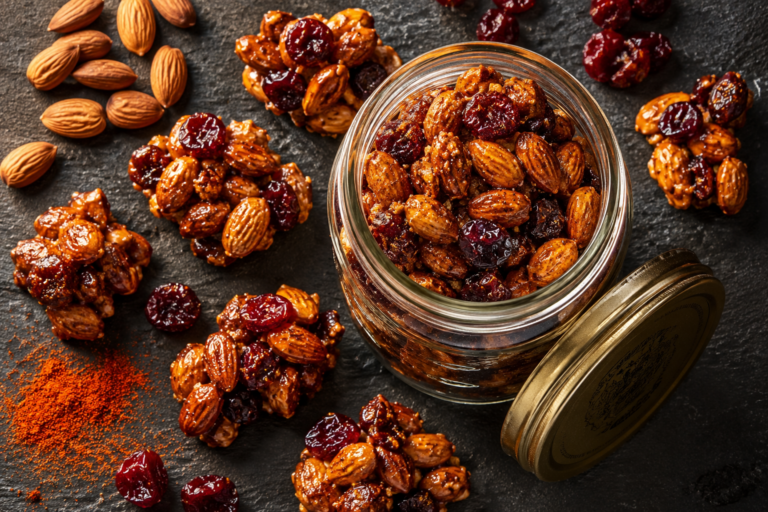
A standard batch yields approximately eight to ten clusters of varying size—three to four pieces per serving as a satisfying snack, or five to six as a more generous portion. The irregular, hand-formed size of each cluster is one of its most appealing qualities: no two are quite identical, and the visual of a collection of uneven, golden-and-red clusters in a glass jar is one of the most naturally beautiful snack presentations in the collection.
These clusters store best in a sealed glass jar at room temperature—where their visual appeal is fully displayed and their caramelized honey coating maintains its snap rather than softening in refrigerator humidity. A jar on a countertop or a pantry shelf, its contents visible through the glass, is both a practical storage solution and a genuinely attractive kitchen presence. It also has the practical advantage of making the clusters easy to reach for without opening a refrigerator, which increases the likelihood that they actually get eaten across the full week rather than being forgotten behind other containers.
For entertaining—and these clusters belong on any charcuterie or cheese board they encounter—arrange in a small bowl or ramekin alongside aged cheese (manchego or sharp cheddar are ideal complements to the smoked paprika), a small dish of good honey for drizzling, and a few additional dried cherries scattered around the surface. The effect is elegant without effort, and the combination of smoky almond cluster, aged cheese, and additional honey is one of those small flavor discoveries that guests tend to remember.
─────────────────────────────────────────
Storage, Reheating, and Shelf Life Tips
- Room temperature storage (preferred): Keeps in a sealed airtight container for up to 7 days. The smoked paprika flavor deepens and the honey caramelization becomes more cohesive through days two and three—the peak flavor window for this recipe.
- Refrigerator storage: Not recommended as a primary storage method—the refrigerator’s humidity softens the caramelized honey coating within twenty-four hours. If necessary in a very warm kitchen, allow clusters to return to full room temperature before eating for the best texture.
- Re-crisping: If clusters have softened due to humidity, spread on a parchment-lined baking sheet and warm at 300°F for 4–5 minutes. Cool completely before returning to storage—the honey matrix will re-firm as it cools.
- Freezer storage: Freeze well for up to 2 months in an airtight bag separated by parchment paper. Thaw at room temperature for fifteen to twenty minutes—the caramelized coating re-hardens completely within this window.
- No reheating required: These are a room-temperature snack. The smoked paprika’s aromatic compounds and the dried cherry’s flavor are both most vivid at room temperature rather than warm.
- Moisture tip: In humid climates, a small food-safe silica gel packet or folded paper towel inside the storage jar extends crispness through the full week by absorbing ambient moisture.
─────────────────────────────────────────
Why This Recipe Deserves a Spot in Your Meal Prep Rotation
I’ve been asked, in various forms, what makes a snack recipe worth making every week rather than occasionally. My honest answer is always the same: it’s whether the experience of eating it is genuinely good rather than generically acceptable—whether there is a specific pleasure to the thing that makes reaching for it feel like a choice rather than a default.
These clusters are that kind of snack. The combination of smoked paprika and dried cherry and honey-glazed almond produces a flavor experience that is warm and specific and slightly surprising—the kind of thing you eat once and then want again, reliably, at the same point in every afternoon. The act of making them—tossing the almonds with paprika and honey, watching them turn golden in the oven, pressing the warm clusters together with the cherries—is itself a small Sunday pleasure, the kind of cooking that takes very little and gives back considerably more than it should. And the clusters themselves, in their jar on the counter, are the kind of snack that makes a desk or a kitchen feel taken care of—a small, specific evidence of the fact that someone—you—showed up for the week before it even began. That is the best possible reason to make something. These are worth making every single Sunday.
─────────────────────────────────────────
Meal Prep Pairing Suggestions
Smoked Paprika Roasted Almonds & Dried Cherry Clusters pair most naturally with other roasted nut and seed preparations that offer genuine contrast in flavor intensity and heat character. Our Chili Honey Roasted Cashew Clusters make the natural companion—both are honey-glazed, oven-roasted nut clusters with a warm-spiced character, but the cashew clusters’ bolder, more direct chili heat is distinctly different in character from these clusters’ dry, fruit-balanced smokiness. The two cover the same snack occasion from genuinely different flavor positions, making them complementary rather than redundant and giving the week’s snacking genuine variety within the same satisfying format.
For a snack rotation that includes a milder, sweeter option alongside the bolder roasted clusters, our Honey Roasted Sunflower Seed Clusters provide the gentle, vanilla-scented counterpoint that rounds out the spread with something lighter in both heat and flavor intensity. Three snack options covering warm-smoky-fruity, bold-chili-sweet, and gentle-vanilla-caramelized means every snacking mood across the week has something waiting for it—something that was made with care on Sunday and earns that care back in small, specific pleasures every time it’s reached for. That is, in the most honest sense, what a good snack rotation is for.
Smoked Paprika Roasted Almonds & Dried Cherry Clusters
Smoked paprika roasted almonds and tart dried cherries clustered together with honey—the most sophisticated snack in your weekly lineup, and the simplest.
6
servings10
minutes20
minutes210
kcal30
minutesIngredients
1 cup almonds
0.5 cup dried cherries
2 tablespoons honey
1 teaspoon smoked paprika
0.5 teaspoon salt
1 tablespoon olive oil
Directions
- Preheat oven to 350°F (175°C) and line a baking sheet with parchment paper.
- In a bowl, combine almonds, olive oil, honey, smoked paprika, and salt; mix until almonds are evenly coated.
- Spread coated almonds on the baking sheet in a single layer.
- Roast for 15-20 minutes, stirring halfway through, until almonds are golden and fragrant.
- Allow almonds to cool slightly, then mix with dried cherries in a large bowl.
- Form small clusters with the mixture and allow to cool completely.
Nutrition Facts
- Total number of serves: 4
- Calories: 210kcal
- Cholesterol: 0mg
- Potassium: 400mg
- Sugar: 8g
- Protein: 6g
- Calcium: 60mg
- Iron: 2mg
About This Author

Amelia Grace
Editor-in-Chief & Culinary Director
The heart and guiding voice of Daily Dish, Amelia leads our editorial vision and recipe development. With a background in food journalism and over a decade spent in professional kitchens, she has a knack for blending gourmet technique with real-world accessibility. Her goal? To make every reader feel like a confident cook, one dish at a time.
Favorite dish: Creamy lemon risotto with a sprinkle of fresh thyme.
Kitchen motto: “Good food doesn’t have to be complicated — it just has to be made with heart.”