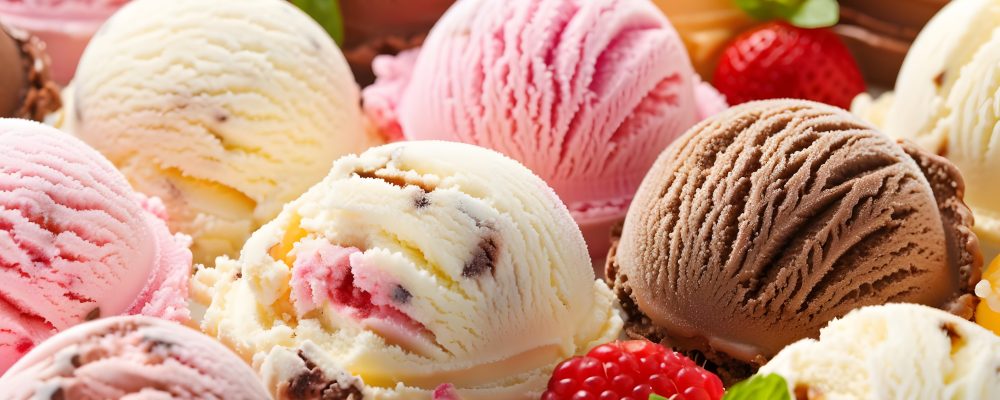

There is a moment that exists in the experience of almost every person alive regardless of their culinary sophistication, their dietary philosophy, or their relationship with sugar.
The moment of the perfect scoop.
The ice cream that is exactly the right temperature — cold enough to be firm but soft enough to yield to the spoon without requiring force, holding its shape on the cone or in the bowl for the specific duration that allows the eating to be attended to rather than rushed. The flavor that delivers, in the first contact with the tongue, exactly what was anticipated — the specific pleasure of expectation precisely met. The texture that is smooth rather than icy, that coats the tongue in the specific way that distinguishes genuinely well-made ice cream from its lesser alternatives.
This moment — so familiar, so universal, so apparently simple — is the product of a specific and sophisticated set of physical and chemical phenomena that food scientists have studied for decades without fully mapping every variable that produces it.
Ice cream is one of the most technically complex foods in common consumption. Its apparent simplicity — the cold, sweet, creamy thing that most people have eaten thousands of times without thinking about what produces the experience — conceals a specific and fascinating set of scientific principles that are worth understanding both for the knowledge itself and for what the knowledge reveals about pleasure and its conditions.
The Structure That Produces the Experience
Ice cream is, at its most fundamental, a system — a specific arrangement of multiple phases that coexist in a single product and that together produce the texture and the flavor experience that makes ice cream what it is.
It is simultaneously a foam, an emulsion, and a suspension of ice crystals in an unfrozen serum — three distinct physical structures occupying the same space and interacting with each other to produce the specific eating experience.
The foam component is the air incorporated during churning — the overrun that was discussed in the earlier ice cream article. This air, distributed throughout the ice cream in tiny bubbles surrounded by the fat-protein network, is responsible for the lightness of good ice cream. Without it, frozen cream and sugar would be a solid, dense mass that is difficult to scoop and slow to release its flavor. With it, the ice cream has a specific lightness and a specific melt rate that allows the flavor to release gradually rather than all at once.
The emulsion component is the fat — the cream and the egg yolk that form the base of most well-made ice creams — distributed in tiny droplets throughout the aqueous phase. These fat droplets carry fat-soluble flavor compounds and contribute the specific richness and coating sensation that distinguishes a genuinely creamy ice cream from a icy, lean alternative.
And the ice crystal suspension — the frozen water that makes ice cream cold and that gives it its structure — is the component most responsible for the specific texture experience. Small ice crystals, distributed evenly throughout the unfrozen serum, produce the smooth, barely-there texture of excellent ice cream. Large ice crystals, formed during slow freezing or during temperature fluctuation in storage, produce the grainy, icy texture that signals ice cream that has been made poorly or stored improperly.
These three components are not independent. They interact with each other in ways that affect all three simultaneously — which is why ice cream science is more complex than the science of any single-phase food, and why the perfect scoop is the product of getting multiple variables right simultaneously.
The Temperature Curve of Pleasure
The specific pleasure of ice cream is temperature-dependent in a way that makes the serving temperature one of the most important variables in the ice cream eating experience — and one of the most consistently mismanaged in home contexts.
Ice cream served directly from a home freezer at zero degrees Fahrenheit is too cold for the optimal eating experience. At this temperature, the fat is completely solidified, the ice crystals are at their hardest, and the volatile aromatic compounds that carry flavor are barely volatile at all — their low temperature reducing the rate at which they evaporate and reach the olfactory receptors that contribute most of what we experience as flavor.
The optimal serving temperature for most ice creams is between five and ten degrees Fahrenheit — a range in which the ice cream is cold enough to hold its shape and provide the refreshing temperature contrast that is part of ice cream’s appeal, but warm enough that the fat has softened slightly, the ice crystals have softened at their edges, and the flavor compounds are releasing at a rate that produces the full flavor experience.
This is why professional ice cream shops store their ice cream at a slightly warmer temperature than home freezers — and why the ice cream eaten at a shop often tastes better than the same ice cream purchased in a pint and served from a home freezer. It is not that the ice cream has changed. It is that it is being served at the temperature that allows its flavor and texture to be fully expressed.
The practical home adjustment is simple: remove the ice cream from the freezer five to ten minutes before serving, allowing it to warm slightly toward the optimal range before scooping.
The Flavor Science of Cold
The specific way that cold temperature affects flavor perception is worth understanding in more detail than the simple observation that cold reduces flavor — because the specific mechanism reveals something about how flavor works that applies beyond ice cream.
Flavor is primarily olfactory — the result of volatile aromatic compounds reaching the olfactory receptors at the top of the nasal cavity through both the nostrils and the retronasal pathway from the back of the mouth. These compounds must be volatile — must be in gas phase rather than liquid or solid phase — to reach the receptors.
The rate at which flavor compounds volatilize is temperature-dependent: warmer temperatures produce faster volatilization and more aromatic compounds reaching the receptors simultaneously, producing a more intense flavor perception. Colder temperatures slow volatilization and reduce the concentration of aromatic compounds reaching the receptors, producing a muted flavor perception.
This is why cold food generally tastes less flavorful than warm food — not because the flavor compounds are absent but because the temperature is slowing their volatilization to the point where fewer of them reach the receptors at any given moment.
For ice cream, this has specific implications. The ice cream flavor that is designed to be perceived at cold temperature must be formulated with enough flavor intensity to produce a satisfying experience at the reduced volatilization rate that cold produces. This is why professional ice cream makers flavor their bases more intensely than seems appropriate at room temperature — knowing that the cold serving temperature will reduce perceived intensity by a significant margin.
It also explains why vanilla ice cream is so much more satisfying than vanilla anything else made with the same amount of vanilla — because the cold temperature suppresses the vanilla flavor just enough to allow the other flavor compounds in the cream and the sugar to come forward, producing a complexity that the same vanilla in a warm preparation doesn’t have.
The Melt as a Feature, Not a Bug
The melt of ice cream — the specific rate at which it transitions from solid to liquid in the warmth of the mouth and the ambient temperature — is one of the most carefully engineered properties of commercial ice cream and one of the least understood pleasures of the eating experience.
The melt rate of ice cream is determined by the combination of its fat content, its overrun, its sugar concentration, and the specific stabilizers used in its formulation. High-fat ice cream melts more slowly than low-fat because the fat provides a thermal buffer — absorbing heat that would otherwise warm the ice crystal network. High-overrun ice cream melts faster because the air bubbles collapse quickly as the surrounding fat network softens, releasing liquid rapidly. High-sugar concentrations melt more slowly because the dissolved sugar lowers the freezing point of the unfrozen serum, keeping it liquid at temperatures where a lower-sugar mixture would freeze.
The specific pleasure of ice cream melt — the sensation of the cold solid transforming into a rich liquid on the tongue — is not incidental to the ice cream eating experience. It is one of its primary pleasures — the specific temporal dimension of the experience, the sequence from cold-solid to cold-liquid that plays out over the course of a bite and that is part of what distinguishes eating ice cream from drinking something cold and sweet.
The melt also releases flavor in a specific and satisfying sequence — the initial cold-solid contact releasing the fat-soluble flavor compounds, the subsequent melt releasing the water-soluble ones, the warmth of the mouth accelerating the volatilization of the aromatics that produce the full flavor perception. The complete ice cream eating experience is a sequence of flavor releases that unfolds over fifteen to thirty seconds of a single bite — and the specific pleasure of that sequence is part of what makes ice cream one of the most satisfying foods available in any season.
The Cone Versus the Bowl
The specific vessel in which ice cream is served is not merely a matter of preference — it affects the ice cream eating experience in ways that are physically and chemically specific.
The waffle cone — the crisp, slightly sweet container made from a baked batter — does something to the ice cream eating experience that the bowl cannot replicate. As the ice cream softens and the melt begins, the liquid that would pool in a bowl instead is absorbed into the cone, which softens progressively from the inside out. The cone that has been holding ice cream for five minutes is partially softened at its interior — providing a specific textural experience in which the crunch of the outer cone contrasts with the softened interior, and in which the cone itself has absorbed the flavor of the ice cream it was holding.
This progressive softening and flavor transfer — the cone becoming, over the course of the eating, a flavored and textured component of the eating experience rather than merely a vessel — is one of the most satisfying aspects of the cone format and one that the bowl eating experience cannot replicate.
The bowl, however, has its own specific advantage: the ability to collect the melt and eat it as a liquid component rather than losing it. The ice cream bowl that has been eaten at a leisurely pace produces, at its bottom, a quantity of melted, slightly diluted ice cream that is its own specific pleasure — the ice cream in its liquid form, warmer than it was at the beginning, with a different flavor profile because the melt has integrated the fat-soluble and water-soluble components that were separate in the solid.
The Seasonal Pleasure of Summer Ice Cream
The specific pleasure of ice cream in summer — in the heat of August, in the specific context of outdoor eating and warm evenings and the need for something cold — is different from the pleasure of ice cream in any other season.
Not because the ice cream has changed. Because the context has.
The contrast between the ambient heat and the cold of the ice cream is at its most dramatic in August — producing a temperature contrast that is greater than at any other time of year and that makes the coldness of the ice cream register more intensely as a physical pleasure rather than simply as the baseline temperature of the food.
The outdoor August ice cream — the cone eaten while walking, the bowl served on the back porch, the specific pleasure of something cold and sweet in warm evening air — is the ice cream eating experience at its most vivid and most complete. The heat that makes the ice cream melt faster also makes the coldness more pleasurable, the sweetness more welcome, the specific richness more satisfying against the backdrop of a summer day that has been hot and long.
This is the seasonal pleasure of ice cream — not a different product but the same product in conditions that make its specific qualities more vivid and more specifically appropriate.
The Takeaway
The perfect scoop is not an accident. It is the product of specific physical and chemical phenomena — the right ice crystal size, the right amount of incorporated air, the right serving temperature, the right melt rate — that together produce the specific eating experience that makes ice cream one of the most universally satisfying foods available in any culinary tradition.
Understanding the science doesn’t make the ice cream taste better. But it makes the experience of eating it more interesting — more connected to the specific physical reality of what is happening between the ice cream and the tongue and the nose and the temperature receptors that together produce the moment of the perfect scoop.
The moment is real. The pleasure is genuine.
The science is what makes both of them possible.