
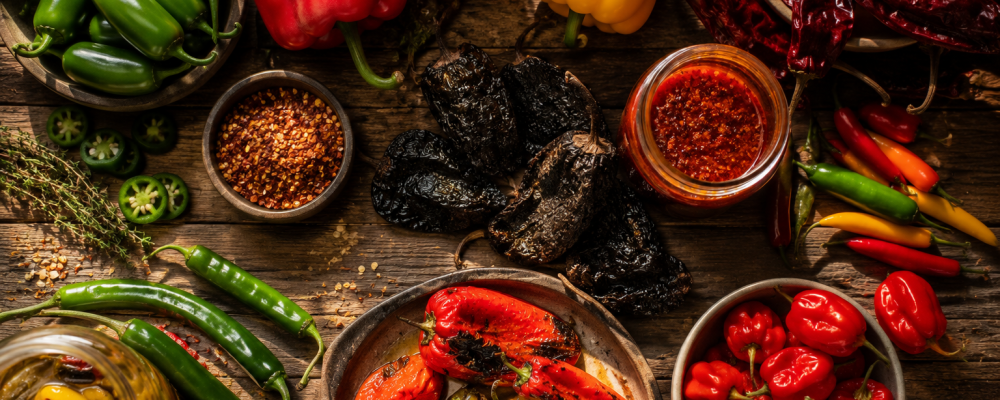

There is an ingredient that spans more culinary territory than almost any other in the summer kitchen.
Not the tomato, which is extraordinary but specific — best raw or cooked simply, most itself when least transformed. Not the eggplant, which requires cooking to become what it is and rewards only certain preparations. Not the corn, whose window of peak quality is brief and whose best form is its simplest.
The pepper.
The pepper family — from the mildest bell to the most incendiary habanero, from the sweet Italian frying pepper to the smoky dried ancho, from the fresh jalapeño to the fermented hot sauce that began as one — spans a range of flavor and heat and culinary application that no other single vegetable family approaches.
In August, when peppers of every variety are at their absolute peak — their skins taut and glossy, their flesh dense and sweet, their heat (where heat is present) at its most vivid — the cook who understands the full range of what the pepper can become has access to one of the most versatile and most rewarding ingredients of the summer kitchen.
The Sweet Pepper and What It Can Become
The sweet pepper — the bell pepper in its red, yellow, and orange forms, the Italian frying pepper, the Cubanelle, the pimento — is the entry point into the pepper family and the one whose full culinary range is most consistently underutilized.
The raw sweet pepper is the pepper most people know: crisp, slightly bitter at the white inner membrane, sweet in the flesh, with a fresh green quality in the unripe green form and a more developed sweetness in the red and yellow ripe ones. It is useful raw, in salads and crudités and salsas, but it is not at its best raw — because the specific sweetness and depth that the sweet pepper is capable of requires heat to develop.
The roasted sweet pepper is a different ingredient entirely.
Placed directly over a gas flame or under a broiler until completely blackened on all sides — the skin charred and blistered, the flesh beginning to collapse — and then sealed in a bag or a covered bowl for fifteen minutes to steam, the pepper emerges from this process as something transformed. The charred skin peels away to reveal flesh that is silky and yielding, sweet beyond what the raw pepper suggested was possible, with a specific smoky character from the charring that adds a dimension the raw fruit cannot produce.
This is the pepper that appears in the Spanish escalivada and the Italian peperonata and the Moroccan taktouka — in preparations across the Mediterranean world that understood centuries ago what the roasted pepper is capable of. The roasted pepper dressed with good olive oil and garlic and herbs, served at room temperature — this is one of the most perfect summer preparations in any culinary tradition, requiring nothing beyond the quality of the pepper and the patience to char it properly.
The roasted pepper also freezes beautifully — producing, from an afternoon of roasting in August, a supply of prepared peppers that serves through the months when fresh peppers are no longer at their best.
The Frying Pepper and the Italian Tradition
Of all the sweet pepper preparations in the culinary world, the Italian tradition of the fried pepper — the peperone fritto — is the one that most directly demonstrates what happens when a simple technique meets a peak-season ingredient.
The Italian frying pepper — the Cubanelle or the Jimmy Nardello or the padron when used in its sweet form — is sliced or left whole and cooked in generous olive oil over medium heat until completely softened and beginning to caramelize. The process takes fifteen to twenty minutes of patient cooking, during which the pepper’s water content evaporates, its sugars concentrate and begin to caramelize, and the olive oil absorbs the pepper’s flavor while the pepper absorbs the oil’s richness.
The result is one of the most satisfying and most honest summer preparations available — the pepper entirely itself, transformed by heat and fat into something richer and deeper than the raw ingredient suggested, requiring nothing beyond salt and perhaps a piece of bread to be a complete eating experience.
This preparation scales easily to the quantities that the August pepper harvest produces — a large batch made from the excess of the week’s market shopping, stored in the refrigerator in its own oil, serving across multiple meals as a component in sandwiches, alongside eggs, over pasta, or simply eaten at room temperature as an antipasto.
The Hot Pepper and the Science of Capsaicin
The hot pepper — the jalapeño, the serrano, the cayenne, the habanero, the ghost pepper and its increasingly extreme relatives — is a fundamentally different culinary tool from the sweet pepper, and its specific qualities are worth understanding at the level of science rather than simply at the level of heat tolerance.
The heat of a hot pepper is produced by capsaicin — the compound discussed in an earlier issue in the context of the flavor dimensions that the five basic tastes don’t capture. Capsaicin’s concentration in a pepper is measured in Scoville heat units — a scale that runs from zero for bell peppers to over two million for the most intensely hot varieties.
But the Scoville number tells only part of the story. The specific character of the heat — where in the mouth it registers, how quickly it builds, how long it persists — varies significantly between pepper varieties in ways that the Scoville number doesn’t capture.
The jalapeño’s heat is immediate and front-of-mouth — it registers quickly and dissipates relatively quickly, making it the most manageable and most broadly useful of the hot peppers in terms of its culinary range. The habanero’s heat is slower to build and longer-lasting — it arrives at the back of the throat and persists through the meal in a way that the jalapeño’s heat does not. The serrano sits between the two in intensity, with a specific clean, bright heat that makes it particularly useful in fresh preparations.
The concentration of capsaicin is highest in the white inner membrane — the placenta — and the seeds that are attached to it. The flesh of the pepper contains less capsaicin than the membrane. This is the scientific basis for the cooking technique of removing the seeds and membrane to reduce heat while retaining the pepper’s flavor — a technique that works because it removes the highest-capsaicin parts while leaving the lower-capsaicin flesh intact.
The Dried Pepper and the Transformation That Time and Air Produce
The fresh pepper and the dried pepper share a name and a genetic identity and almost nothing else in terms of culinary application.
The dried pepper — the ancho, the guajillo, the mulato, the pasilla, the chipotle, the cascabel, the dozens of regional varieties that define the specific flavor profiles of different Mexican regional cuisines — is the result of a transformation that drying produces in the pepper’s flavor compounds.
When a fresh pepper is dried — whether in the sun or in a dehydrator or over smoke — the water that constitutes the majority of its weight evaporates, concentrating everything that remains. The sugars concentrate and caramelize. The capsaicin concentrates. And the specific aromatic compounds that were present in low concentrations in the fresh pepper become present in high concentrations in the dried one — producing flavor profiles that the fresh pepper only hinted at.
The ancho — the dried form of the fresh poblano — has a specific dark, slightly sweet, raisin-like quality with notes of chocolate and dried fruit that the fresh poblano doesn’t contain in the same form. The guajillo has a specific bright, slightly tannic quality with notes of cranberry and tea. The chipotle — the smoked and dried jalapeño — has the specific combination of the jalapeño’s heat and a deep, rounded smokiness that no fresh pepper provides.
Each of these is a distinct ingredient with a distinct culinary application — not an alternative to a fresh pepper but a completely different tool with a completely different set of flavors.
The cook who understands dried peppers has access to one of the deepest and most complex flavor palettes in any culinary tradition — the specific depth that Mexican mole sauces achieve, the specific richness of a dried-pepper-based braise, the specific complexity of a chile-infused oil — that the fresh pepper can suggest but cannot produce in the same form.
The Fermented Pepper and What Preservation Adds
Between the fresh pepper and the dried pepper sits a third transformation — one that is less well known outside of specific culinary traditions but that produces results as distinctive and as useful as either of the other forms.
Fermented pepper preparations — the kimchi that uses gochugaru, the harissa that uses fermented and dried peppers, the Louisiana hot sauce that is nothing more than fermented peppers and salt processed into a liquid — represent the transformation that lactic acid fermentation applies to the pepper’s flavor compounds.
The lactic acid fermentation process — the same process that produces kimchi and sauerkraut and yogurt — converts the sugars in the pepper into lactic acid while the existing flavor compounds interact with the acids and the other products of fermentation to produce new flavor compounds that the fresh pepper doesn’t contain.
The result is a pepper preparation with both the pepper’s original flavor character and an additional layer of fermented depth — a brightness and a complexity that the fresh pepper or the dried pepper alone doesn’t achieve.
The simplest home fermented pepper preparation — whole fresh peppers packed in a two percent salt brine and left at room temperature for three to five days until they have developed a specific tangy, slightly effervescent quality — produces a preserved pepper with the fresh pepper’s flavor plus the specific brightness of lactic acid fermentation.
This fermented pepper can be eaten as is, blended into a hot sauce, or used as a component in any preparation where the combination of pepper flavor and fermented brightness is appropriate — which, in August, is an extraordinarily wide range of preparations.
The Pepper as a Vessel
Of all the culinary applications of the sweet pepper, the one that is most dramatically different from its use as a flavoring or a component is its use as a vessel — the pepper stuffed with a filling and cooked until the pepper is soft and the filling is heated through and the two have melded into something that is simultaneously the pepper and what is inside it.
The stuffed pepper appears in some form in virtually every culinary tradition that has access to sweet peppers — the Italian peperone ripieno, the Greek gemista, the Mexican chile relleno, the Turkish biber dolması, the Spanish pimientos rellenos. Each uses the pepper’s specific structure — its hollow interior surrounded by thick, sweet flesh — as the container for a filling that ranges from grain and herb combinations to meat and rice to cheese and egg.
What each of these preparations shares is the specific relationship between the pepper’s sweetness and whatever fills it — the way the pepper’s flavor permeates the filling during cooking and the way the filling’s flavors permeate the pepper, so that the finished dish is more integrated and more complex than either component would be separately.
The August stuffed pepper — made from peak-season peppers with a simple filling of cooked grain and summer herbs and whatever cheese is available, roasted until the pepper is soft and slightly caramelized at the edges — is one of the most satisfying and most complete summer preparations available. It uses the pepper in its most complete form, as both the vehicle and the primary flavor, and produces a meal that is more than the sum of its parts.
The Takeaway
The pepper family — in all its forms from mild to incendiary, from fresh to dried to fermented — is the summer kitchen’s most versatile ingredient.
Roast the sweet peppers while they are at their peak. Make a batch of peperonata from the Italian frying peppers. Keep dried peppers in several varieties and understand what each one contributes. Ferment a jar of fresh hot peppers for hot sauce. Stuff and roast the season’s best bells while their flesh is thickest and their flavor most complete.
Each of these is a different encounter with the same remarkable plant family at the height of its season — and each reveals something about what the pepper can become that the others don’t.
The pepper deserves more than the crudité platter.
August is the time to discover what it is actually capable of.














