
Most stir-fry sauces are liquid-dominant preparations: soy sauce, rice vinegar, sesame oil, and various flavoring agents combined in a thin medium that coats ingredients during the brief, high-heat cooking window and then largely runs off into the bottom of the pan. These sauces produce dishes that are well-seasoned but not particularly rich—the flavor is present but the coating is thin, and in a meal prep context, a thin coating tends to absorb entirely into the grain or noodle base overnight, leaving the protein and vegetables undersauced by day two.
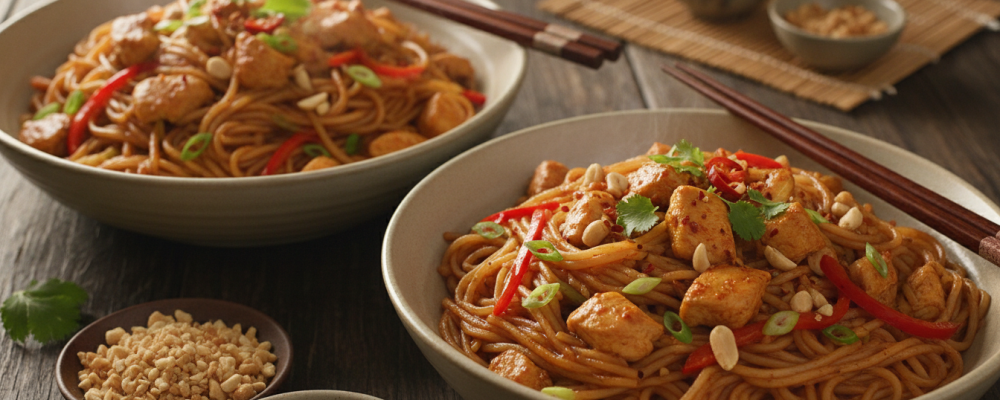
Peanut butter changes this equation structurally. Peanut butter is an emulsified preparation—oil suspended in a protein and starch matrix—and when it is introduced into a hot pan alongside soy sauce and Szechuan sauce, it does not simply add peanut flavor. It changes the sauce’s rheology: its proteins and starches thicken the liquid phase, its fat content increases the sauce’s overall viscosity, and its emulsified structure allows it to form a stable coating on the chicken and noodle surfaces that resists the absorptive drainage that thinner sauces undergo in refrigerator storage. The sauce clings rather than runs, coats rather than pools, and remains present on every component across multiple days rather than migrating to the container base overnight.
This is why peanut-based noodle preparations are among the most meal-prep-stable sauce formats available. The peanut butter’s emulsified structure does not break during refrigeration in the way that oil-water sauce separations do, and it does not thin as dramatically when reheated with a small amount of added water. The bowl you portion on Sunday arrives at Thursday in better shape than most sauce-based preparations—still richly coated, still deeply flavored, still genuinely worth eating. That outcome is not accidental. It is the direct consequence of what peanut butter is, at a physical and chemical level, doing in this sauce.
─────────────────────────────────────────
The Inspiration Behind This Recipe
The design objective for this version of the Szechuan peanut noodle bowl was efficiency without compromise—the shortest possible ingredient list and the fewest possible preparation steps that still produce a bowl with genuine flavor depth and meal-prep durability. The answer was a sauce built on three primary ingredients: Szechuan sauce for heat and complexity, soy sauce for the umami foundation, and peanut butter for richness, coating weight, and the structural stability described above. Each of the three is doing specific work; none is redundant.
The simplification of the aromatic base to garlic alone—rather than a garlic-and-ginger combination—was a deliberate calibration rather than an omission. Garlic sautéed briefly in vegetable oil before the chicken is added provides the foundational allium depth that anchors the sauce’s bolder flavors without adding the citrus-adjacent brightness that ginger introduces. In a preparation where the Szechuan sauce is carrying a complex heat and the peanut butter is carrying richness, ginger’s brightness can compete rather than complement; garlic’s straightforward savory depth integrates cleanly and allows the sauce’s primary flavor notes—Szechuan, peanut, soy—to come forward without competition.
The bell pepper is not simply a vegetable component in this bowl—it is a flavor counterpoint. Bell pepper’s natural sweetness and water content provide contrast against the sauce’s density, adding a clean, slightly juicy crunch that prevents every bite from being uniformly rich. In a peanut butter-based sauce that has the potential to feel heavy if every component is dense, bell pepper’s lightness keeps the eating experience dynamic from the first bite to the last.
─────────────────────────────────────────
A Brief History of Peanut Sauce in Asian Cooking
Peanut-based sauces occupy a central role in the culinary traditions of several Asian cooking cultures, despite peanuts being a South American crop that arrived in Asia only through post-Columbian trade routes. The peanut’s rapid adoption into Asian cooking—particularly in Southeast Asian and Chinese cuisines—reflects the ingredient’s extraordinary compatibility with the existing flavor vocabularies of those traditions: its fat content carried soy-based and chili-based aromatics efficiently, its mild earthiness integrated with fermented and spiced preparations seamlessly, and its roasted nuttiness added a dimension that no native Asian ingredient quite replicated.
In Chinese cooking, the peanut-and-soy combination appears most canonically in the Sichuan tradition’s bang bang chicken and dan dan noodle preparations—both of which feature a sauce built on sesame or peanut paste, chili oil, soy, and vinegar applied to cold noodles or poached chicken. These preparations are among the oldest documented peanut sauce applications in Chinese culinary history, and their essential structure—fat-based richness, chili heat, soy umami, applied to a neutral protein and noodle base—is the direct ancestor of the contemporary Szechuan peanut noodle bowl format.
The peanut sauce tradition in Southeast Asian cooking—most visibly in Indonesian satay preparations and Thai peanut dipping sauces—developed in parallel with the Chinese tradition but through different ingredient logic: coconut milk rather than soy sauce, palm sugar rather than sesame oil, and a spice base built on lemongrass and galangal rather than Szechuan pepper and chili. The convergence of these two traditions in contemporary fusion cooking has produced the wide range of peanut-sauce preparations that contemporary home cooks encounter today—each one a variation on the same foundational insight that peanut fat plus salt plus heat equals something deeply satisfying.
─────────────────────────────────────────
Why This Cooking Method Works for Meal Prep
The sequence of building the sauce in the pan rather than combining it separately and adding it at once is the technique decision that produces the most integrated, most evenly distributed sauce in the finished bowl. Adding Szechuan sauce, soy sauce, and peanut butter to a pan that already contains browned chicken, garlic, and vegetables produces a sauce that is simultaneously deglazed from the fond left by the chicken’s browning, warmed by the residual pan heat, and immediately distributed across the surfaces of every ingredient in contact with the pan. A sauce built separately and poured over the assembled bowl coats only the top layer of ingredients; a sauce built in the pan during the cooking process coats every ingredient uniformly as it forms.
The browning step for the chicken—medium heat, undisturbed contact with the pan surface, all sides browned before the bell pepper is added—is the technique that most determines the bowl’s quality across the storage window. Browned chicken has a drier, more structured surface with more concentrated flavor than un-browned chicken; it absorbs the peanut sauce as a coating rather than as a soak, and it retains a distinct textural identity through refrigeration rather than softening uniformly with the sauce around it. The four to five minutes required to properly brown the chicken produces a measurably better result at every subsequent meal.
Tossing the cooked rice noodles with the finished sauce and chicken in the pan—rather than plating separately—ensures that every strand receives the same coating weight of the peanut sauce before portioning. Plated separately and combined at the table, the sauce concentrates unevenly across the noodle mass; combined in the pan, the mechanical action of tossing distributes the sauce across every surface with a consistency that holds through storage and reheating.
─────────────────────────────────────────
Flavor Profile: What to Expect
This bowl is rich, bold, and coating—a flavor profile built on the specific combination of fat-based richness and compound heat:
- Rich, nutty peanut butter depth – The sauce’s foundational flavor: warm, roasted, slightly sweet, and distributed throughout every component as a coating rather than an accent—present in every bite as both a flavor and a textural quality
- Szechuan complexity – The sauce’s heat and complexity provider: delivering its characteristic compound sensation—fruity, fermented, slightly numbing—through the peanut butter’s fat phase, which carries its flavor compounds efficiently and durably
- Savory soy foundation – The umami anchor that balances the peanut butter’s richness and amplifies every other flavor around it—the element that keeps the bowl tasting specifically seasoned rather than simply rich
- Garlic aromatic warmth – Sautéed until fragrant before the chicken arrives, the garlic provides the allium base that makes the sauce taste constructed and deep rather than simply combined
- Sweet bell pepper contrast – Bell pepper’s natural sweetness and clean crunch provide the essential counterpoint to the sauce’s richness—every bite that includes a bell pepper piece tastes lighter and more dynamic
- Whole peanut crunch – The garnish delivers the peanut flavor at a completely different textural register than the sauce—concentrated, crunchy, and roasted-specific in a way the smooth sauce cannot replicate
- Fresh green onion finish – Clean, mild allium brightness at the surface that lifts the bowl’s denser sauce flavors and provides the color contrast that makes the assembled bowl visually complete
The peanut butter’s emulsified fat phase integrates more fully with the Szechuan sauce’s compounds overnight, producing a sauce that is more cohesive and more uniformly distributed through the bowl’s components by day two. This is one of the most reliable day-two improvement recipes in the collection.
─────────────────────────────────────────
Tips for Making the Best Szechuan Peanut Chicken & Rice Noodle Bowls
Execution at the browning and sauce-building stages determines the quality of the finished bowl:
- Use natural peanut butter – Natural peanut butter (just peanuts and salt) produces a sauce that is cleaner, more peanut-forward, and less sweet than stabilized commercial varieties. Stir the oil back into the jar thoroughly before measuring to ensure consistent fat distribution in the sauce.
- Brown the chicken in batches if needed – A pan with too many chicken pieces drops its surface temperature and steams rather than sears. Brown in a single layer with space between pieces; two batches produces a significantly better result than one crowded batch.
- Add peanut butter to the sauce off peak heat – Peanut butter’s proteins can seize and clump if introduced to a very high-heat pan without adequate liquid already present. Add the peanut butter after the Szechuan sauce and soy sauce have been added and the heat reduced to medium—the liquid phase provides the medium for the peanut butter to dissolve into evenly.
- Rinse rice noodles in cold water – Cold water stops cooking and removes surface starch that would cause clumping in storage. This step is non-negotiable for any rice noodle preparation intended for meal prep use.
- Adjust sauce consistency with hot water – If the peanut sauce seems too thick to coat the noodles evenly, whisk in one to two tablespoons of hot water before adding the noodles. Peanut butter sauce thins readily with hot water without losing flavor; the target consistency is thick enough to coat a spoon but thin enough to flow through the noodles when tossed.
- Store peanuts separately – Whole peanuts absorb moisture from the sauce overnight and soften significantly by day two. A small separate container of peanuts, added to each day’s portion at serving, maintains the textural contrast across the full week.
Optional: A tablespoon of rice vinegar or lime juice whisked into the sauce before the noodles are added introduces a bright acidity that balances the peanut butter’s richness and keeps the bowl from tasting heavy—a small addition that makes a meaningful difference in the overall flavor balance, particularly in portions eaten cold.
─────────────────────────────────────────
Portioning and Container Suggestions
This recipe produces four generous bowls from a single batch—one per day across a four-day lunch or dinner rotation. The peanut sauce’s coating structure means that the noodles, chicken, and vegetables can be stored together in a single container without significant quality degradation—unlike thinner sauces that pool at the base and leave the top layers unsauced, the peanut sauce maintains its coating weight across the full storage window.
Wide, flat glass containers work best for this preparation—they allow the noodles to rest in an even layer rather than compressing into a dense ball at the base of a deep container, and they distribute reheating heat more evenly than tall containers, which can produce overheated edges and cold centers in a preparation as thick as peanut noodles.
Whole peanuts and sliced green onions stored in separate small containers or bags and added at serving maintain the bowl’s intended textural range—smooth sauce coating, chewy noodle, crisp peanut, fresh green onion. Two minutes of assembly investment at serving time produces a bowl that is noticeably better than one stored fully assembled, and the separate component storage adds no meaningful refrigerator space burden given the compact size of each addition.
─────────────────────────────────────────
Storage, Reheating, and Shelf Life Tips
- Refrigerator storage: Assembled bowl (without peanut garnish) keeps in an airtight container for up to 4 days. The peanut sauce becomes more deeply integrated and more cohesive through days two and three—reliably the flavor peak of this preparation.
- Sauce thickening in storage: Peanut butter-based sauces thicken significantly in the refrigerator as the fat phase solidifies. Add 1–2 tablespoons of water to the container before reheating and stir through—the sauce will loosen to its original consistency as it warms.
- Reheating: Microwave at full power for 90 seconds to 2 minutes, stirring once halfway through. The added water prevents the sauce from over-concentrating and the noodles from drying out under microwave heat. Alternatively, toss in a skillet over medium-low heat with a splash of water for 3–4 minutes.
- Peanut garnish: Store separately at room temperature for up to one week. Add fresh to each serving immediately before eating.
- Green onions: Store refrigerated in a sealed bag. Add fresh at serving.
- Freezer storage: Not recommended for assembled bowls. Rice noodles do not freeze and thaw cleanly. The chicken in sauce can be frozen for up to 2 months with fresh noodles cooked when needed.
- Cold serving option: This bowl is excellent at room temperature or slightly chilled—peanut noodles are a classic cold preparation in the Chinese culinary tradition, and the sauce’s fat-based coating maintains its character without heat. Add a splash of soy sauce or a few drops of rice vinegar to brighten the cold version if the flavors seem muted.
─────────────────────────────────────────
Why This Recipe Deserves a Spot in Your Meal Prep Rotation
The efficiency case for this bowl is unusually clean: a sauce built from three pantry ingredients, a stir-fry completed in a single pan in under twenty minutes, and four generous servings from a preparation that stores better than most noodle bowls in the collection. The peanut butter’s emulsified structure is the practical advantage that carries every other quality forward—it is why the sauce is still present on the noodles by day four rather than pooled at the container base, and it is why each reheated serving arrives tasting as richly sauced as the freshly made version.
The deeper case is that peanut noodles occupy a specific and irreplaceable satisfaction register—the combination of rich, coating fat and bold, layered spice that produces the particular contentment of a bowl you knew was going to be good before you opened the container. A rotation that includes this bowl has something in it that is specifically, consistently wanted rather than merely adequate. That quality—the specific desire for a particular preparation rather than the general need for any lunch—is what keeps a recipe on the Sunday prep list past the first week and into the months that follow.
─────────────────────────────────────────
Meal Prep Pairing Suggestions
Szechuan Peanut Chicken & Rice Noodle Bowls pair most effectively with noodle and rice bowl formats that offer genuine contrast in sauce richness and heat level. Our Miso Ginger Chicken & Soba Noodle Bowls are the natural weekly companion—both are chicken-based noodle preparations, but miso-ginger’s gentle, fermented warmth and lighter soba base provide genuine tonal contrast to the peanut bowl’s dense, spicy richness. A week that alternates between the two never returns to the same flavor register, which is the most reliable way to maintain enthusiasm for a meal prep rotation across the full five days.
For a complete three-bowl spread, our Gochujang Glazed Tofu & Jasmine Rice Bowls round out the week with a plant-based protein option and a distinctly different chili heat tradition—Korean gochujang’s sweet, fermented spice character where this bowl delivers Szechuan’s numbing-and-peanut complexity. Three bowls, three sauce philosophies, three distinct eating experiences—assembled from one Sunday session and delivering the kind of culinary range that makes a well-planned prep week feel like a series of considered choices rather than repetitions of a single decision.
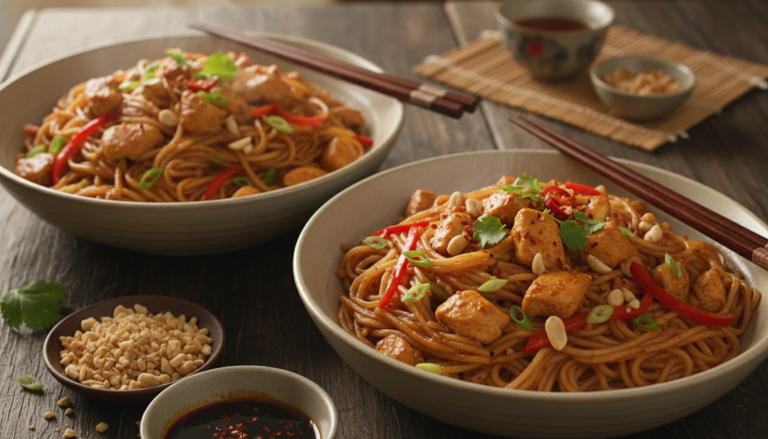
Szechuan Peanut Chicken & Rice Noodle Bowls
These Szechuan Peanut Chicken & Rice Noodle Bowls build a rich, clinging peanut-Szechuan sauce around tender chicken and rice noodles—a deeply flavored, pantry-driven bowl that comes together in under thirty minutes and earns better reviews every day it’s in the refrigerator.
4
servings20
minutes25
minutes600
kcal45
minutesIngredients
200 g chicken breast
200 g rice noodles
2 tbsp soy sauce
2 tbsp peanut butter
1 tbsp Szechuan sauce
1 tbsp vegetable oil
1 clove garlic
1 cup bell pepper
2 tbsp green onions
50 g peanuts
Directions
- Cook rice noodles according to package instructions, then set aside.
- Cut chicken into bite-sized pieces.
- In a pan, heat vegetable oil over medium heat.
- Add garlic and sauté briefly, then add chicken.
- Cook chicken until browned on all sides.
- Add bell pepper and stir-fry until tender.
- Mix in Szechuan sauce, soy sauce, and peanut butter.
- Combine noodles with chicken mixture and toss well.
- Garnish with green onions and peanuts before serving.
Nutrition Facts
- Total number of serves: 4
- Calories: 600kcal
- Cholesterol: 0mg
- Sodium: 620mg
- Potassium: 400mg
- Sugar: 8g
- Protein: 6g
- Calcium: 60mg
- Iron: 2mg
About This Author

Benjamin Brown
Recipe Developer
Benjamin is our flavor engineer. A classically trained chef turned recipe developer, he’s obsessed with balancing taste, texture, and creativity. He ensures that every recipe we publish is not only delicious but also reliable, approachable, and repeatable — even for beginners.
Favorite dish: Slow-braised short ribs with red wine reduction.
Kitchen motto: “Cooking is part science, part soul.”