
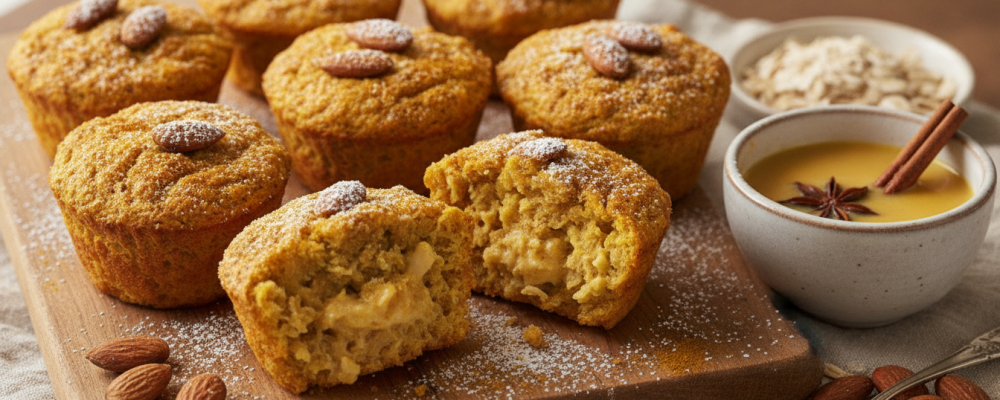

I want to begin with the color, because the color is exceptional and it deserves the first paragraph.
When a Golden Milk Baked Oat Cup comes out of the oven correctly—when the turmeric has done its full chromatic work through the oat batter over the course of twenty-five minutes at 350°F—the result is a specific, saturated, extraordinary shade of gold that does not appear naturally in any other baked good I can think of. It is not the pale gold of a vanilla muffin or the amber gold of a browned butter preparation. It is a vivid, warm, almost luminescent yellow-gold that belongs entirely to turmeric—the same color that appears in saffron rice and marigold petals and the robes of Buddhist monks, a color so specific and so saturated that it looks, in a muffin tin, as though someone has engineered something visually spectacular on purpose.
And then the sliced almonds: toasted to a pale, creamy gold by the same oven heat, scattered over the surface of each cup in a pattern that is both random and beautiful, catching the light along their curved surfaces in a way that makes the finished tray look like it was arranged by someone who cared very much about what it looked like. It wasn’t. It’s just what happens when sliced almonds toast over a golden batter, and it’s wonderful every single time.
All of this is happening in a muffin tin on a Sunday morning while you do something else. That remains, to me, one of the quiet marvels of baked oat preparations: the oven produces something beautiful without you watching it. You simply open the door.
─────────────────────────────────────────
The Inspiration Behind This Recipe
This recipe was inspired by golden milk—the ancient Ayurvedic beverage of warm milk, turmeric, cinnamon, and honey that has been prepared and consumed across South Asian cultures for thousands of years and that arrived in Western wellness culture approximately a decade ago to considerable and well-deserved enthusiasm. The flavor profile of golden milk is immediately appealing: warm and slightly earthy from the turmeric, sweet and aromatic from the cinnamon, rounded by vanilla and a natural sweetener. It tastes nourishing in the way that very few things do—the way that makes you feel, after drinking it, that something good and considered has happened.
The translation of that flavor into a baked oat cup was driven by the same question I bring to most recipe development: what format best serves this flavor combination for a meal prep context? A golden milk latte is wonderful; it is also not portable, not storable, and requires active preparation at the moment you want to drink it. A baked oat cup delivers the same turmeric-cinnamon-vanilla warmth in a self-contained, reheatable, grab-and-go format that can be made Sunday and eaten through Thursday—the golden milk tradition transformed from a morning ritual into a morning rescue.
The almonds were chosen as the textural element not for their flavor contribution alone but for their visual one. Sliced almonds baked into the top of a golden oat cup create the most beautiful baked surface in the collection—pale gold against deep gold, each almond slice curved in a way that catches and scatters light differently depending on the angle. From a pastry perspective, the toasted sliced almond is one of the most aesthetically reliable garnishes available: it does exactly what you need it to do, every time, without any arrangement skill required.
─────────────────────────────────────────
A Brief History of Golden Milk
Golden milk—haldi doodh in Hindi, or turmeric milk—is one of the oldest and most widely prepared therapeutic beverages in the Ayurvedic tradition, with documented use in South Asian medicine and daily life stretching back at least three thousand years. Turmeric’s role in Ayurveda extends far beyond culinary use: it has been employed as an anti-inflammatory, an antiseptic, a digestive aid, and a treatment for respiratory complaints across millennia of traditional medical practice in India, Southeast Asia, and beyond. The combination of turmeric with warm milk and sweetener was originally prepared as a remedy—for colds, for joint pain, for inflammation, for the general category of ailments that benefit from warmth and nourishment—before becoming embedded in everyday wellness practice as a preventive preparation rather than a curative one.
Cinnamon’s inclusion alongside turmeric in golden milk reflects the Ayurvedic principle of combining spices for synergistic effect rather than flavor alone—cinnamon’s warming, circulation-supporting properties complementing turmeric’s anti-inflammatory action in a preparation designed to address multiple wellness objectives simultaneously. The addition of fat to the preparation—traditionally ghee, adapted to milk fat, adapted here to almond milk and the oat’s own fat content—reflects the understanding, confirmed by contemporary food science, that curcumin’s bioavailability improves significantly in the presence of dietary fat.
Golden milk’s transition from an Ayurvedic health preparation to a global café staple and eventually to a baked oat cup reflects the broader pattern by which traditional wellness ingredients move through contemporary food culture: first as a medical preparation, then as a specialty beverage, then as a flavoring in baked and prepared foods as the palate expands to embrace its distinctive earthiness and warmth. Each translation honors the original while extending it into new contexts, and the baked oat cup is, in the most straightforward sense, golden milk in a form you can hold in one hand on a Tuesday morning. That is not a diminishment. It is an extremely practical continuation.
─────────────────────────────────────────
Why This Cooking Method Works for Meal Prep
The baked oat cup format—mixed batter poured into a greased muffin tin and baked until set—is the preparation method that suits this specific flavor profile most completely. Golden milk’s defining character comes from turmeric’s fat-soluble curcumin compounds, and baking in a muffin tin subjects the oat-and-turmeric mixture to uniform, extended heat that drives those compounds more deeply through the oat matrix than soaking or stovetop preparation could achieve. The oven’s dry heat also develops the turmeric’s flavor in a way that heat without fat exposure cannot: the combination of fat from the almond milk and sustained oven heat activates curcumin’s aromatic volatiles, producing a fragrance in the finished cup that is warmer and more complex than turmeric in a cold preparation.
Stirring half the sliced almonds into the batter before baking and reserving the other half for the surface is the technique decision that maximizes the almonds’ contribution in both flavor and visual dimensions. Almonds baked into the batter interior toast gently in the oat’s moisture environment, softening slightly and contributing a subtle nutty note throughout the cup without the textural crunch that surface-baked almonds provide. Almonds on the surface bake in direct dry heat, toasting fully to a crisp, golden finish that contrasts with the tender oat interior. The two populations of almonds are producing different things—interior flavor depth and surface textural contrast—and both are necessary for the cup to deliver on its full potential.
The twenty-five minute baking time is calibrated specifically for the moisture content of this batter, which is higher than a standard muffin batter due to the almond milk-to-oat ratio required to produce a tender, baked-through cup rather than a dense, undercooked one. The edges should be visibly golden—not pale gold, but a deep, toasted amber—before the cups are removed. A pale edge indicates under-baking and produces a cup that is too soft to hold its shape when removed from the tin; a properly golden edge indicates that the oat matrix has fully set and the cup will release cleanly.
─────────────────────────────────────────
Flavor Profile: What to Expect
These cups are warm, gently sweet, and deeply aromatic—a flavor profile that is both comforting and distinctive:
- Earthy, vivid turmeric – The defining flavor and color note of the cup: warm, faintly bitter, and intensely aromatic—present in every bite as both a taste and a fragrance that makes these cups immediately recognizable as something specifically golden-milk-inspired
- Warm cinnamon sweetness – Cinnamon adds a familiar, bakery-warm depth that softens turmeric’s earthiness into something more approachable and more rounded—the two spices in productive, complementary tension throughout every cup
- Caramel-toned maple – Maple syrup provides a rounded, slightly caramel sweetness with its characteristic depth—more interesting than plain sugar and more compatible with turmeric’s earthy profile than honey’s florality
- Soft vanilla warmth – Vanilla extract threads through the spice combination with a bakery-like softness that ties every other flavor into a cohesive, warm whole—most perceptible as a fragrance in the cup’s first minutes out of the oven
- Nutty, toasted almond contrast – Surface almonds provide a crisp, slightly bitter toasted nuttiness that contrasts with the tender oat interior and adds the textural distinction that makes each bite interesting from the first to the last
- Wholesome oat body – Rolled oats provide the mild, grassy, substantial base that carries all the aromatic spices without competing with any of them
The turmeric and cinnamon deepen and integrate more fully overnight as their compounds continue to distribute through the oat matrix. Day-two cups are measurably more aromatic and more cohesive than freshly baked ones—a pattern consistent across every spice-forward baked oat preparation.
─────────────────────────────────────────
Tips for Making the Best Golden Milk Baked Oat & Almond Cups
A few deliberate choices will produce a noticeably better cup at every stage:
- Use good-quality turmeric – Turmeric quality varies considerably between brands. Fresh, high-quality turmeric is deeply orange-gold in color and intensely aromatic when opened. Aged or low-quality turmeric is pale and flat-smelling and produces a cup with significantly less color and flavor impact. The turmeric is the entire visual and aromatic premise of this recipe—quality matters here more than in almost any other spice context.
- Whisk the wet ingredients before adding dry – Turmeric and cinnamon have a tendency to clump when added to liquid. Whisking the almond milk, maple syrup, vanilla, and salt together before adding the oats and spices produces a more uniform distribution of both sweetener and spice through the batter.
- Grease the muffin tin generously – This is not a batter with a high fat content, which means it has more tendency to stick than a standard muffin. A thorough coating of butter, coconut oil, or cooking spray on every surface of each cup—base, walls, and rim—ensures clean release after cooling.
- Don’t skip the cooling period – The oat matrix needs time to fully set after removing from the oven before the cups can be released cleanly. Five to ten minutes in the tin, then a gentle run of a thin spatula or knife around each cup’s edge, produces the cleanest release. Removing too early compresses the cup’s base.
- Reserve exactly half the almonds for the top – The visual impact of the surface almond layer depends on adequate coverage. Too few almonds on top produces a sparse, under-garnished appearance; the half-and-half split produces the full, covered golden surface that makes the finished cup look as beautiful as it tastes.
- Bake until the edges are genuinely golden – Not pale, not light gold—genuinely golden and slightly crisped at the rim. This is the visual indicator that the cup has fully set and will hold its shape.
Optional: A very light dusting of additional ground turmeric or cinnamon over the almond-topped cups immediately before baking deepens the color contrast between the golden surface and the pale almond slices, producing a finished cup with more visual drama and a slightly more intense spice fragrance at the surface.
─────────────────────────────────────────
Portioning and Container Suggestions
A standard 12-cup muffin tin produces twelve individual cups—two to three cups per serving as a breakfast portion, yielding four to six complete servings from a single batch. Two cups with a piece of fresh fruit or a small yogurt constitutes a nutritionally complete morning meal; three cups is appropriate for higher energy demands or more demanding mornings.
Once fully cooled, the cups stack efficiently in a wide, flat airtight container with parchment paper between layers—essential for protecting the toasted almond surface from compression damage and preventing the cups from sticking to each other at the edges. The golden color of the cups is visible through the parchment and through the container sides in a way that makes this one of the most visually appealing meal prep refrigerator arrangements in the collection: a row of golden cups, each one with its pale almond crown, stacked in careful layers and waiting for the week ahead.
For grab-and-go ease, individual daily portions of two or three cups in a small parchment-wrapped bundle or flat container make the morning retrieval entirely effortless. These cups travel exceptionally well—their dense, set oat structure makes them resistant to compression during transport and allows them to be eaten by hand without crumbling, which makes them one of the most genuinely portable warm breakfast options in the collection.
─────────────────────────────────────────
Storage, Reheating, and Shelf Life Tips
- Refrigerator storage: Baked cups keep in an airtight container for up to 5 days. The turmeric and cinnamon continue to bloom through the oat matrix during refrigeration—peak flavor is at days two and three.
- Freezer storage: These cups freeze exceptionally well for up to 2 months. Cool completely, wrap each cup individually in plastic wrap, and transfer to a labeled freezer bag. The oat matrix and spice compounds are highly freeze-stable with no significant texture or flavor change after thawing.
- Oven reheating (recommended): Place cups on a baking sheet at 325°F for 8–10 minutes from refrigerated. This method restores the toasted crispness of the surface almonds and the slight textural contrast between the golden edges and the tender interior—significantly better than microwave reheating for texture quality.
- Microwave reheating: Wrap in a damp paper towel and microwave at 50% power for 45–60 seconds. Full power toughens the oat structure and can cause the almond surface to steam rather than stay crisp. Low power preserves the tenderness of the cup’s interior.
- Room temperature serving: These cups are genuinely good at room temperature—the turmeric and cinnamon fragrance is most pronounced without refrigerator suppression, and the oat texture is at its most naturally tender. A valid no-heat option for mornings when reheating isn’t practical.
- Color note: The turmeric’s color deepens slightly during refrigerator storage as the curcumin compounds continue to oxidize mildly—a normal and expected development that produces an even more vivid gold by day three. It is purely cosmetic and indicates nothing about quality or freshness.
─────────────────────────────────────────
Why This Recipe Deserves a Spot in Your Meal Prep Rotation
Every baked oat preparation in a collection earns its place through a combination of practical and sensory qualities—and the Golden Milk cup earns both in a way that I find genuinely difficult to argue against. Practically: twelve cups from one batch, five-day refrigerator life, two-month freezer life, two minutes of reheating on any morning. Sensorially: one of the most beautiful, most aromatic, most specifically pleasurable breakfasts available to a home cook with a muffin tin and a spice rack.
The golden milk spice profile is the quality that keeps this cup in the rotation when other baked oat recipes come and go—because it is distinctive in a way that prevents the familiarity that can make even good recipes feel routine. A cup that smells of turmeric and cinnamon and vanilla as it warms is a cup that is doing something specific, something recognizable, something that occupies its own particular and irreplaceable place in a morning’s sensory landscape. That specificity is what makes a breakfast feel worth getting up for, week after week. This cup delivers it, in gold, every single morning. That is more than enough reason to make it every Sunday.
─────────────────────────────────────────
Meal Prep Pairing Suggestions
Golden Milk Baked Oat & Almond Cups pair most naturally with breakfast preparations that offer genuine contrast in spice character and temperature—ensuring that the week’s mornings feel varied rather than returning to the same warm, turmeric-spiced register every day. Our Maple Cardamom Baked Protein Oat Cups are the natural companion within the baked oat category—both are muffin-tin-baked, warmly spiced, and maple-sweetened, but cardamom’s floral, citrus-adjacent warmth is completely distinct in character from turmeric’s earthy, slightly bitter depth. Alternating between them across the week covers every warm-spiced morning breakfast mood with no flavor overlap.
For a complete three-breakfast rotation, our Peach Ginger Overnight Oat Jars provide the cool counterpoint that rounds out the morning spread—no-cook, fruit-forward, and served cold where these cups are warm and oven-baked. A week that moves between golden turmeric cups, cardamom oat cups, and peach ginger jars covers warm-spiced, warmly-floral, and cool-fruity in a rotation that is genuinely varied, genuinely oat-forward, and genuinely beautiful in three completely different ways. All three prepared on Sunday. All three waiting with their particular colors and fragrances—gold, pale ivory, peachy-pink—to make every morning of the week feel like something that was planned with care. Which, of course, it was.ing of the week feel like something that was planned with care. Which, of course, it was.
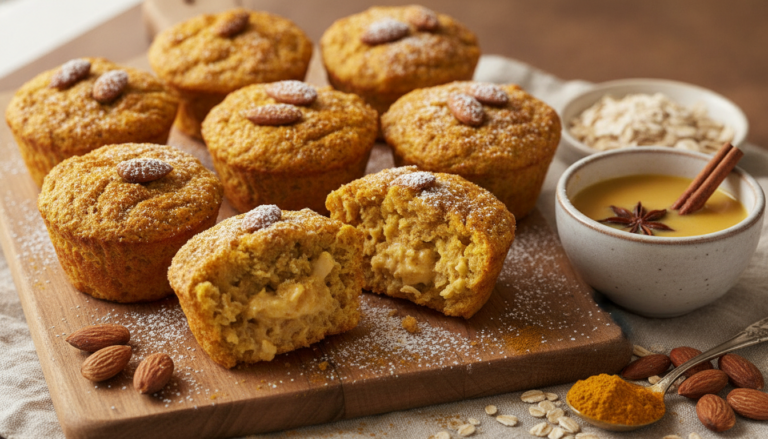
Golden Milk Baked Oat & Almond Cups
These Golden Milk Baked Oat & Almond Cups are a warmly spiced, oven-baked breakfast built on the ancient golden milk flavor tradition—turmeric, cinnamon, vanilla, and maple syrup baked into an oat cup that is as beautiful as it is nourishing.
6
servings15
minutes25
minutes220
kcal40
minutesIngredients
2 cups rolled oats
1 cup almond milk
1/4 cup maple syrup
1 teaspoon ground turmeric
1/2 teaspoon ground cinnamon
1 teaspoon vanilla extract
1 pinch salt
1/4 cup sliced almonds
Directions
- Preheat oven to 350°F (175°C) and grease a muffin tin.
- In a large bowl, mix oats, almond milk, maple syrup, turmeric, cinnamon, vanilla extract, and salt.
- Stir in half of the sliced almonds.
- Divide the mixture evenly among the muffin cups.
- Sprinkle remaining almonds on top of each cup.
- Bake for 25 minutes or until edges are golden brown.
- Let cool before removing from tin.
Nutrition Facts
- Total number of serves: 4
- Calories: 220kcal
- Cholesterol: 0mg
- Sodium: 620mg
- Potassium: 400mg
- Sugar: 8g
- Protein: 6g
- Calcium: 60mg
- Iron: 2mg
About This Author

Aurora Wright
Pastry Chef & Dessert Editor
Aurora is the sweet side of Daily Dish. A trained pastry chef and dessert stylist, she’s responsible for our mouth-watering cakes, cookies, and confections. She brings precision, artistry, and a touch of whimsy to every recipe she creates — and taste-tests more chocolate than she’ll admit.
Favorite dish: Flourless dark chocolate torte.
Kitchen motto: “Life’s too short to skip dessert.”















