
There is a preparation that appears at the beginning or end of almost every serious dinner party, that requires no cooking, no heat, and no special technique, and that is nevertheless consistently done in ways that undermine its potential.
The cheese board.
It arrives at tables across the country assembled according to a set of instincts that are not wrong exactly but that consistently fall short of what a cheese board can be — too many cheeses crowded together, sliced too far in advance, paired with accompaniments chosen more for their visual appeal than their culinary compatibility, served too cold to taste like anything, never allowed to become the conversation-worthy, genuinely delicious thing that a thoughtfully assembled board is capable of being.
The cheese board is not complicated. But it rewards the same quality of attention that any other preparation rewards — the specific thinking about what each element is doing, why it is there, and how it interacts with what surrounds it.
Understanding what makes a cheese board genuinely excellent rather than merely attractive changes every cheese board that follows.
Temperature Is the First and Most Important Consideration
Before any decision about which cheeses to include, which accompaniments to select, or how to arrange them on the board, there is one consideration that precedes all others and that most people consistently get wrong.
Temperature.
Cheese is served too cold in almost every home context where it appears. The cheese pulled from the refrigerator thirty minutes before guests arrive — or, worse, immediately before — is still cold enough that its fats have not fully softened and its aromatic compounds have not fully volatilized. The texture is firmer than it should be. The flavor is muted. The cheese is technically present but not tasting like what it actually is.
Cheese needs a minimum of one hour at room temperature before service — and for larger pieces, particularly dense aged cheeses, closer to ninety minutes or two hours. During this time, the fats that were solidified by refrigeration soften into a texture that expresses the cheese’s full character. The aromatic volatile compounds that were suppressed by the cold begin to release — which is why a properly tempered cheese has a smell that the same cheese straight from the refrigerator doesn’t have.
This is not a minor difference. A well-aged Cheddar served cold and the same cheese served at proper room temperature are measurably different flavor experiences — the cold version a fraction of what the tempered version can deliver.
The professional approach is simple: pull the cheese from the refrigerator well before it is needed, cover it loosely to prevent excessive drying, and allow it to come to temperature without rushing the process.
Selection: The Logic of Variety
The instinct that drives most cheese board construction is variety of type — a soft cheese, a semi-soft cheese, a hard cheese, a blue cheese. This instinct is sound as far as it goes, but it doesn’t go far enough to produce a board with genuine depth.
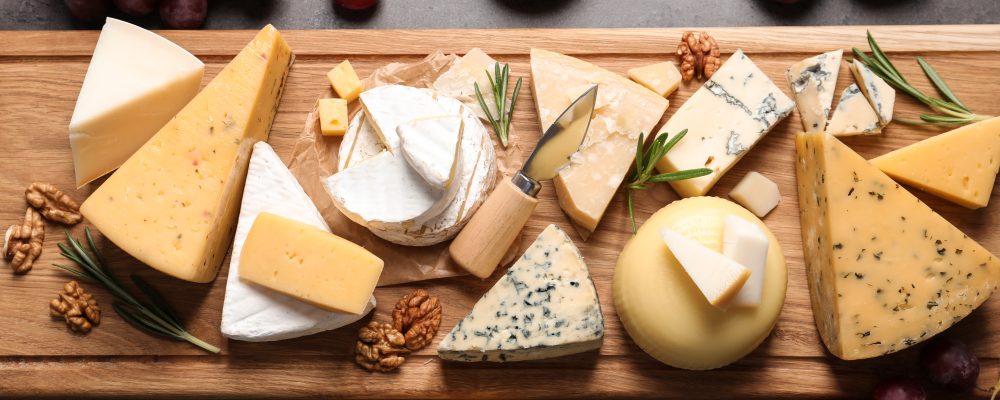
The more useful framework for cheese selection is variety across multiple dimensions simultaneously: variety of milk type (cow, sheep, goat, buffalo), variety of texture (fresh, young, aged, very aged), variety of flavor profile (mild, nutty, sharp, pungent, funky), and variety of rind character (bloomy, washed, natural, waxed).
Each of these dimensions contributes something distinct to the board. Milk type affects the fundamental flavor character — sheep’s milk cheeses have a specific lanolin-tinged richness that cow’s milk cheeses don’t have; goat’s milk cheeses have a characteristic brightness and acidity. Texture affects the eating experience — the yielding, creamy interior of a young Brie against the granular crunch of a very aged Parmigiano. Flavor intensity determines the order in which cheeses are best tasted — beginning with milder cheeses and progressing to more assertive ones, like a wine tasting.
The number of cheeses on a board matters less than the quality of the selection and the thought behind it. Three exceptional, varied cheeses properly tempered and thoughtfully paired produce a better experience than seven mediocre ones. The constraint of a smaller selection forces more careful thinking about each choice — and careful thinking produces a more intentional result.
The Accompaniments That Actually Help
The accompaniments on a cheese board are not decoration. They are there to do specific work — to provide contrast, to cleanse the palate, to bring out specific qualities in the cheeses they accompany.
The best accompaniments are selected with a specific cheese or category of cheese in mind rather than assembled from the standard roster of crackers, grapes, and honey because that is what cheese boards look like.
Honey — particularly a good, complex honey with character of its own, rather than a generic clover honey — does specific things to specific cheeses. Its sweetness contrasts beautifully with the salt and pungency of blue cheeses, softening their intensity without masking it. It complements the buttery richness of a good Brie. But it adds little to an already complex aged cheese whose flavor doesn’t benefit from sweetness.
Fruit — fresh or dried — interacts with cheese primarily through acid and sweetness. The acid in fresh grapes, in apple or pear slices, in fresh figs cuts through the fat of rich, creamy cheeses in ways that crackers and bread don’t. Dried fruits — apricots, dates, figs — contribute concentrated sweetness and a chewiness that contrasts with the crumble of aged cheeses.
Nuts — particularly walnuts and almonds, which have their own slight bitterness and specific fat content — complement aged cheeses in specific ways. The bitterness of a walnut against the nuttiness of a well-aged Gruyère is a pairing with a logic that goes beyond mere habit.
Pickled things — cornichons, pickled grapes, caper berries, preserved lemon — do the most specific work on a cheese board. Their acidity cuts through fat, resets the palate between rich cheeses, and provides the brightness that makes the next bite as vivid as the first. A cheese board without anything acidic tends to feel heavy and monotonous by the end — the palate fatigued by richness without relief.
Bread and crackers are the neutral base — the vehicle that delivers cheese to the mouth without competing with it. The quality of the bread matters more than most people acknowledge. A genuinely good sourdough or a well-made crackers with real flavor and appropriate texture elevates the cheese it carries. A mediocre cracker undermines it.
The Order of Tasting
The cheese board, unlike most food, invites the eater to construct their own experience from a set of options — and the specific order in which those options are experienced shapes the entire board’s impact.
The logic of tasting order on a cheese board follows the same principle as the logic of wine service: moving from lighter, more delicate flavors to richer, more assertive ones, so that each subsequent cheese can be perceived at its full intensity rather than against the backdrop of something more powerful that preceded it.
A mild, fresh chèvre tasted after a strongly flavored washed-rind cheese will seem almost flavorless — the palate’s sensitivity temporarily reduced by the preceding intensity. The same chèvre tasted first, before the more assertive cheeses, will be perceived at its full, clean, dairy brightness.
This sequencing is rarely communicated on a home cheese board — the board arrives and people eat from it randomly, in whatever order their hand finds. But placing mild cheeses at one end and more assertive ones at the other, or simply telling guests where to start and which direction to proceed, produces a noticeably more satisfying experience.
The pairing of specific accompaniments with specific cheeses — rather than scattering everything across the board indiscriminately — serves the same function. The honey next to the blue cheese. The fresh fruit near the bloomy rinds. The pickles near the richest, most aged selection. Each placement is a suggestion about how the board’s elements relate to each other.
Cutting and Presentation
Cheese is cut too early at most home cheese boards — sliced in advance and arranged on the board hours before service, where it dries and develops an unappetizing skin.
Cheese is best served in the piece — wheels, wedges, and blocks left intact until they reach the board, where guests cut them themselves. This is not a matter of laziness on the host’s part. It is a practical recognition that an uncut piece of cheese dries much more slowly than sliced pieces, that the texture and moisture of the interior is preserved until the moment of cutting, and that the specific experience of cutting one’s own piece from an intact cheese is more tactile and more engaging than selecting a pre-cut slice from a plate.
For cheeses that are difficult to cut — crumbly blues, very hard aged cheeses — providing the appropriate implement and inviting guests to cut for themselves is both more hospitable and more honest about the nature of the cheese than pre-slicing it.
Different cheeses benefit from different cutting approaches that preserve their structure and flavor distribution. A wheel of soft, bloomy rind cheese is best cut in wedges from the center, like a pie, so that each piece contains the same proportion of rind to interior. A hard cheese with a crystalline structure — aged Parmigiano, a well-aged Gouda — is better broken into irregular pieces along its natural grain than sliced cleanly, because the broken pieces expose more surface area and more of the crystalline texture.
The Board Itself
The surface on which cheese is served matters more than most people think.
Wood boards — particularly boards with significant surface area — provide a neutral, slightly rustic background that doesn’t compete with the visual interest of the cheeses and accompaniments. Slate boards offer a dramatic dark background that makes cheeses appear to great advantage and that can be written on with chalk for labeling.
Labeling is worth doing. The cheese board arrives at a table of people who often don’t know what they’re eating — and knowing what a cheese is, where it comes from, and something about its character changes the experience of eating it in ways that blank ignorance doesn’t allow. A simple label — the name of the cheese, the milk type, the origin — provides the context that makes the board a genuine learning experience rather than just a collection of things to eat.
This is the final consideration in cheese board construction — the decision to treat the board as a guided experience rather than a selection of options, to give the eater the information that allows them to engage with what they’re eating rather than consuming it without context.
The Takeaway
A great cheese board is not a question of buying the most impressive cheeses and arranging them attractively on a large board. It is a question of selecting with thought, tempering with patience, pairing with purpose, sequencing with intention, and presenting with enough information that the people eating can actually engage with what they’ve been given.
Pull the cheese from the refrigerator an hour before you need it. Select for variety across milk type, texture, and intensity. Pair accompaniments to specific cheeses rather than scattering them indiscriminately. Start with the mildest and progress toward the most assertive. Leave the cheese in the piece and provide good knives. Label what you’ve assembled.
The result — simple in its construction, attentive in its execution — is a board that does what a cheese board should do: start a conversation, sustain a table, and make people want to stay.