

There are recipes that require technique and patience and a well-stocked pantry, and then there are recipes that require nothing more than three good ingredients and the willingness to trust them completely. The Mango Tajín Fruit Cup is firmly, joyfully in that second category—and I think it is one of the most honest and pleasurable snacks in this entire collection, precisely because it asks so little and gives back so much.
I love this snack the way I love a perfect peach eaten over the kitchen sink, or a slice of good watermelon on a hot afternoon—the way you love something that is exactly what it is, without pretension or complexity, delivering a specific and irreplaceable kind of pleasure that more elaborate things often can’t match. The mango is sweet and golden and fragrant. The lime is sharp and bright and clarifying. The Tajín is warm and citrusy and just spicy enough to make the sweetness of the fruit come alive in a way it simply doesn’t without that contrast. Together they are something genuinely greater than the sum of their parts, and that alchemy—three ordinary ingredients producing an extraordinary result—is, to me, the purest form of cooking there is.
Making these at the start of the week and having them waiting in the refrigerator, already portioned into their cups, is one of those small acts of Sunday care that pays back generously every time you open the refrigerator and reach for one. There’s no assembly, no decision-making, no prep between you and the snack. Just a cup of something bright and beautiful and completely ready for you—which is exactly what a good snack should be.
─────────────────────────────────────────
The Inspiration Behind This Recipe
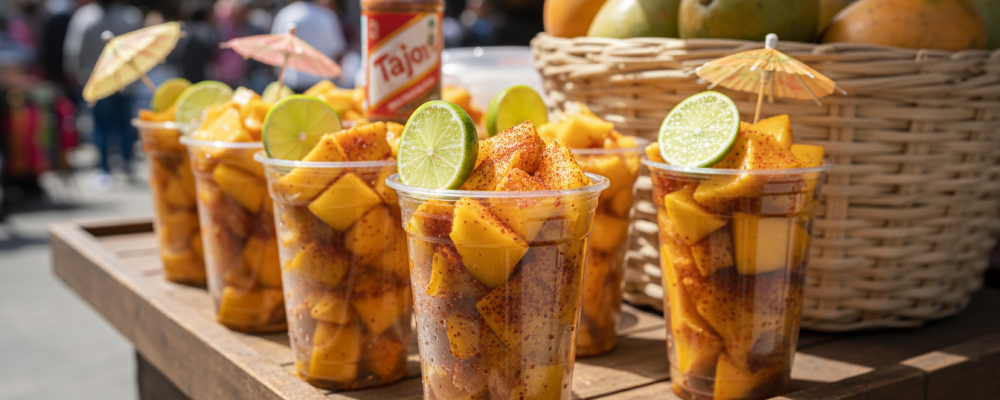
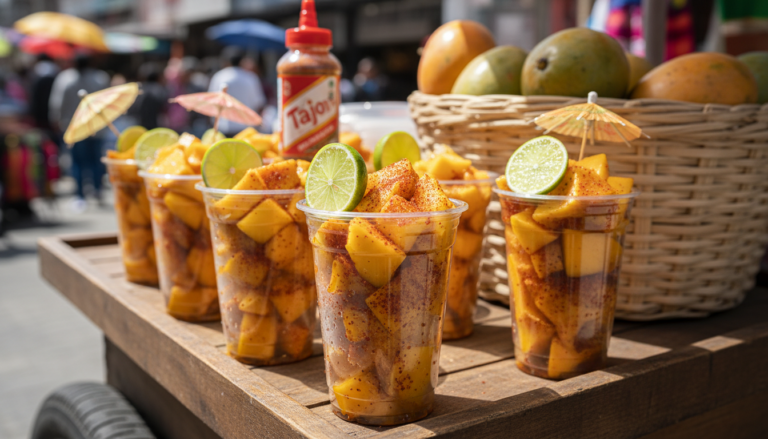
This recipe was inspired by a memory as much as a technique: the mango carts that line the streets of cities throughout Mexico, where vendors peel and cube fresh mango on the spot, dust it with Tajín, squeeze over a wedge of lime, and hand it to you in a cup or on a stick for the walk ahead. It is one of the most satisfying street food experiences imaginable—bold, refreshing, completely unpretentious—and it translates to a home prep context with almost no adaptation required. The cart vendor’s technique is already the recipe.
What makes this combination work so persistently and so universally is the flavor science behind it. Mango is rich in natural sugars and aromatic compounds that make it one of the most intensely flavored fruits available—but that sweetness, without anything to balance it, can tip toward cloying if eaten in quantity. Tajín provides the corrective: the chili gives warmth that makes the sweet taste sweeter by contrast, the lime salt sharpens and extends the fruit’s natural acidity, and the dried citrus in the seasoning deepens the lime juice’s brightness into something more complex and persistent. The result is a snack that you keep eating not just because it tastes good but because each bite resets the palate and makes the next one feel just as satisfying as the first.
For a meal prep context, the appeal is obvious: three ingredients, four portions, three minutes of prep. No cooking, no equipment beyond a knife and a cutting board, and a shelf life that covers most of the week comfortably. It is the rare snack recipe where the simplicity is not a compromise—it’s the entire point.
─────────────────────────────────────────
A Brief History of Tajín and Fruit
The pairing of fresh fruit with chili, salt, and citrus is one of the oldest and most beloved culinary traditions in Mexican culture, where the combination has been enjoyed for centuries across markets, street carts, and family tables from Oaxaca to Sinaloa to Mexico City. Fresh mango, watermelon, jicama, cucumber, and pineapple are among the most common fruits treated this way—each one transformed by the addition of chile powder and lime from a simple snack into something complex, layered, and deeply satisfying.
Tajín itself is a branded chili-lime seasoning blend that was developed in Jalisco, Mexico in the 1980s and has since become one of the most widely recognized condiments in Mexican and Mexican-American cooking. Its specific combination of mild chile peppers, dehydrated lime, and salt produces a seasoning that is simultaneously spicy, sour, and salty—a trifecta of flavors that activates the palate in a way that each element alone cannot. Its distinctive red-orange powder has become so associated with fruit preparation specifically that in many markets it is offered automatically alongside fresh fruit, as expected and essential as the fruit itself.
The global spread of Tajín beyond its Mexican origins reflects a broader recognition of what Mexican street food culture has understood intuitively for generations: that fresh fruit is made more of itself—not masked, not complicated, but genuinely deepened—by the addition of heat, acid, and salt in the right proportions. This recipe is a direct expression of that tradition, made accessible to a weekly meal prep routine without losing any of its essential character.
─────────────────────────────────────────
Why This Preparation Method Works for Meal Prep
The no-prep format of this recipe is its most significant advantage in a meal prep context, and the lime juice is the technical detail that makes it viable across several days of refrigerator storage. Fresh mango, once cut, begins to oxidize and soften at the exposed surfaces—a process driven by enzymatic activity and accelerated by contact with air. Lime juice, applied immediately after cutting, provides citric acid that inhibits those enzymes and slows the softening process significantly, preserving the mango’s color, texture, and fresh flavor for considerably longer than untreated cut mango would hold.
The Tajín, applied at assembly and optionally refreshed just before eating, is equally important to the recipe’s meal prep performance. Because it is a dry seasoning, it doesn’t dilute or wash off the mango the way a wet marinade might—it sits on the surface of the fruit, where it slowly draws in a small amount of moisture from the mango and the lime juice, deepening in flavor over time as it does. By day two, the Tajín has slightly bloomed into the surface of the mango, creating a more integrated flavor than the just-applied version—a subtle but perceptible improvement that makes day-two and day-three portions taste more cohesive than the freshly made cup.
Portioning into individual cups at assembly rather than storing in a single large container is both a practical and a flavor decision. Individual cups prevent the Tajín from migrating to the bottom of a shared container and leaving the top layers unseasoned—each cup gets its own even application that maintains the right seasoning ratio from the first piece of mango to the last.
─────────────────────────────────────────
Flavor Profile: What to Expect
This is a flavor profile built entirely on contrast—and contrast, applied correctly, is one of the most powerful tools in cooking:
- Intense tropical sweetness – Ripe mango leads with a deeply fragrant, honey-like sweetness that is the fullest expression of the fruit at its peak and the foundation every other flavor plays against
- Sharp citrus brightness – Fresh lime juice cuts through the mango’s richness with a clean, vivid acidity that resets the palate between bites and keeps the overall experience feeling light and refreshing
- Warm chili heat – Tajín’s mild chile pepper delivers a gentle, building warmth that arrives after the sweetness and the acid—never overwhelming, always present, making the fruit taste more intensely of itself
- Salty depth – The salt in the Tajín seasoning amplifies the sweetness of the mango in the same way a pinch of salt amplifies sweetness in any dessert preparation—quietly essential, immediately missed if absent
- Dried citrus complexity – Dehydrated lime in the Tajín adds a concentrated citrus note beneath the fresh lime juice that creates a layered, nuanced acidity rather than a single-dimensional sour hit
The flavor becomes more integrated over the first twenty-four hours as the lime juice and Tajín slowly permeate the surface of the mango cubes. A cup made Sunday tastes bright and fresh; a cup eaten Tuesday tastes bright, fresh, and noticeably more cohesive—a quietly rewarding development that makes this recipe genuinely enjoyable to eat across the full week.
─────────────────────────────────────────
Tips for Making the Best Mango Tajín Fruit Cups
Three ingredients means every choice matters more than it would in a longer recipe:
- Choose ripe but firm mangoes – Fully ripe mango has the deepest, most complex flavor, but if it’s too soft it will break down quickly in the refrigerator and the cubes won’t hold their shape through the week. Ripe but still slightly firm is the ideal state for meal prep—fragrant and sweet, but with enough structural integrity to hold up.
- Use fresh lime juice – Bottled lime juice is a pale substitute here. The volatile aromatic compounds in fresh lime juice—the ones that make it smell as good as it tastes—are largely absent from the pasteurized bottled version. Fresh lime juice is the right call for a recipe where it is one of only three ingredients.
- Season generously – Tajín is mild enough that under-seasoning is a more common mistake than over-seasoning. A generous, even dusting across the surface of each cup is the right approach—you should be able to see the orange-red powder clearly on the mango. A light sprinkle disappears into the fruit’s color and delivers a fraction of the intended flavor.
- Cut uniformly – Even, bite-sized cubes mean every piece has a similar ratio of surface area to volume, which means consistent seasoning on every bite. Irregular pieces season unevenly—larger chunks taste underdone, smaller pieces can taste overwhelmingly salty.
- Refrigerate before eating – While these can be eaten immediately, twenty minutes in the refrigerator allows the lime juice to work into the mango surface and the Tajín to bloom slightly. The result is noticeably more integrated than a room-temperature cup eaten on the spot.
Optional: A small amount of chamoy drizzled over the top of each cup before the Tajín adds a sweet, sour, mildly spiced complexity that is a beloved variation of this preparation in Mexican culinary tradition—and it makes the cups look, with their glossy dark drizzle and bright orange Tajín, genuinely beautiful.
─────────────────────────────────────────
Portioning and Container Suggestions
This recipe portions naturally and efficiently into four individual cups at assembly—one per serving day, each one already seasoned and ready to eat directly from the refrigerator. Small glass jars, individual snack cups with tight-fitting lids, or lidded 8-ounce food storage containers all work beautifully. The visual of golden mango cubes with their rust-orange Tajín dusting is genuinely appealing through a clear container—one of those small, daily pleasures of opening the refrigerator that is worth more than it might seem on a busy Wednesday.
For the most consistent seasoning across the week, apply Tajín to each cup individually at portioning time rather than tossing the entire batch together in a bowl. Tossing distributes the seasoning, but it also accelerates moisture release from the mango and causes the Tajín to dissolve more quickly into the liquid that collects at the base of the container. Individual cup seasoning preserves the texture of the Tajín on the mango surface for longer and keeps each day’s portion looking as freshly seasoned as the first.
If bringing these to the office or packing for on-the-go, a jar with a lid that seals securely enough to travel inverted is ideal—keeping the lime juice from pooling entirely at the base of the container and ensuring the mango at the top of the jar gets the same citrus treatment as the pieces at the bottom. A quick shake upon opening redistributes everything perfectly before eating.
─────────────────────────────────────────
Storage, Reheating, and Shelf Life Tips
- Refrigerator storage: Portioned cups keep in airtight containers in the refrigerator for up to 4 days. The mango softens slightly over time—still delicious at day four, with a flavor that is more integrated and deeply seasoned than day one, but with a softer texture that some prefer and others will want to account for.
- Texture management: If preserving maximum firmness is a priority, prep the mango in two-day batches—Sunday and Tuesday—rather than all at once. Each batch will be at its firmest and most vibrant within two days of cutting.
- Freezer storage: Not recommended for this preparation. Frozen and thawed mango becomes soft and watery, losing the firm texture that makes these cups satisfying. Frozen mango is better reserved for smoothies and blended preparations.
- No reheating required: Serve cold directly from the refrigerator. This is a snack designed to be cool, bright, and refreshing—room temperature is acceptable, but cold is optimal.
- Tajín refresh: If the Tajín seasoning has been fully absorbed by day three or four and the cups seem under-seasoned, a small additional dusting over the top immediately before eating restores the intended flavor balance in seconds.
- Lime juice tip: If the mango in the cups has released significant liquid over several days, draining a small amount of that liquid and adding a fresh squeeze of lime before eating refreshes the brightness considerably.
─────────────────────────────────────────
Why This Recipe Deserves a Spot in Your Meal Prep Rotation
In a collection full of recipes that demonstrate what careful technique and thoughtful seasoning can achieve, there’s something genuinely valuable about a recipe that demonstrates what simplicity alone can achieve. The Mango Tajín Fruit Cup requires nothing but ripe fruit, a good lime, and a jar of seasoning—and what it produces is a snack that is bright and bold and deeply satisfying in the specific way that only the freshest, most direct preparations can be. No cooking, no compromise, no complexity standing between you and something genuinely good.
It also fills a gap in a weekly prep plan that’s worth filling intentionally: the fresh, hydrating fruit snack that requires no preparation at the moment of eating and delivers genuine nutritional value alongside genuine pleasure. A rotation that has these cups waiting in the refrigerator alongside heartier snack options has something for every afternoon—something that feels light and refreshing on the days when that’s what’s needed most. And for three ingredients and three minutes of Sunday prep, that’s an extraordinarily good return.
─────────────────────────────────────────
Meal Prep Pairing Suggestions
Mango Tajín Fruit Cups pair most naturally with snack recipes that offer complementary flavors and contrasting textures—making the full weekly snack rotation feel genuinely varied rather than repetitive. Our Apple Slices with Cinnamon Almond Butter Dip provide the ideal sweet counterpart: both are fruit-forward and naturally sweetened, but where the mango cups are bold, spicy, and tropical, the apple and almond butter are warm, spiced, and grounding. Together they cover two completely different fruit snacking moods without any overlap in ingredient or seasoning tradition.
For a broader weekly snack spread, our Peanut Butter Oat Energy Squares add the substantial, chewy option that rounds out the rotation with protein and staying power—something to reach for on the afternoons when fruit alone isn’t quite enough. Three prepped snacks covering fresh-and-spicy, sweet-and-creamy, and chewy-and-indulgent means every snack craving across the week has something waiting for it, made with care on Sunday and ready without effort every day after. That kind of quiet, consistent abundance is, I think, the very best thing a well-planned snack rotation can offer.
Mango Tajín Fruit Cups
These Mango Tajín Fruit Cups are a three-ingredient, no-cook snack that delivers an irresistible hit of sweet, spicy, and tangy in every bite—prepped in minutes and ready to reach for all week long.
4
servings30
minutes40
minutes300
kcal1
hour10
minutesIngredients
2 large mangoes
2 tablespoons Tajín seasoning
4 tablespoons lime juice
Directions
- Peel and cube the mangoes into bite-sized pieces.
- Divide the mango cubes evenly into four serving cups.
- Drizzle lime juice over the mangoes in each cup.
- Sprinkle Tajín seasoning evenly over the tops.
- Serve immediately and enjoy the spicy-sweet flavors.
Nutrition Facts
- Total number of serves: 4
- Calories: 120kcal
- Cholesterol: 0mg
- Sodium: 620mg
- Potassium: 400mg
- Sugar: 8g
- Protein: 6g
- Calcium: 60mg
- Iron: 2mg
About This Author

Amelia Grace
Editor-in-Chief & Culinary Director
The heart and guiding voice of Daily Dish, Amelia leads our editorial vision and recipe development. With a background in food journalism and over a decade spent in professional kitchens, she has a knack for blending gourmet technique with real-world accessibility. Her goal? To make every reader feel like a confident cook, one dish at a time.
Favorite dish: Creamy lemon risotto with a sprinkle of fresh thyme.
Kitchen motto: “Good food doesn’t have to be complicated — it just has to be made with heart.”















