
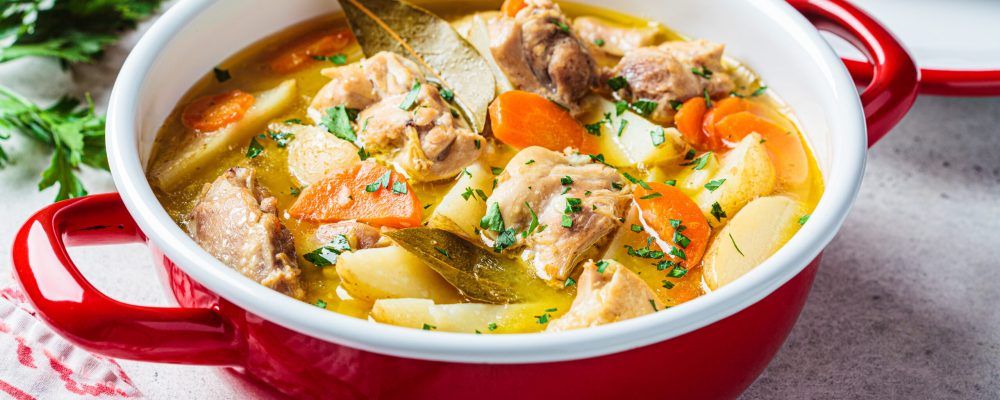

Soup seems like the most forgiving thing you can cook.
You put things in a pot. You add liquid. You apply heat. You wait.
And yet, if you’ve ever made soup at home and then ordered the same variety at a good restaurant, you’ve probably noticed the difference immediately. The restaurant version has a depth that yours doesn’t. A richness. A complexity that tastes like it took far longer than it did.
It didn’t happen by accident. And it didn’t come from a better recipe.
It came from what happened before the liquid ever entered the pot.
The Foundation Most Home Cooks Rush Past
In a professional kitchen, soup begins long before anyone reaches for a ladle.
It begins with stock.
Not the kind that comes in a cardboard carton from the grocery store shelf — though that has its place. Real, housemade stock: bones roasted until deeply browned, vegetables caramelized in a hot oven, the whole thing simmered low and slow for hours until the collagen from the bones has dissolved into the liquid and transformed it into something with body, flavor, and a natural richness that commercial stock simply cannot replicate.
The difference between a soup made with store-bought stock and one made with proper housemade stock is not a matter of preference. It’s structural. Housemade stock has gelatin. It has depth. It coats the back of a spoon in a way that carton stock never does. That quality carries through every element of the soup it becomes.
Professional kitchens make stock in enormous batches, constantly, because it is the literal foundation of nearly everything they cook. Home cooks, understandably, skip it — and then wonder why their soups taste thin.
Building Flavor Before the Liquid Arrives
Even when working with good stock, there’s a step that separates professional soup from home soup that most recipes gloss over entirely.
It’s called building the base — and it’s the difference between a soup that tastes assembled and one that tastes developed.
In restaurant kitchens, aromatics — onion, celery, carrot, garlic, leeks, or whatever the soup calls for — are never simply softened. They’re cooked until they’ve undergone a fundamental transformation. The onions don’t just turn translucent. They caramelize. The tomato paste gets added directly to the dry pan and cooked, stirred constantly, until it darkens from bright red to a deep, rust-colored brick. Spices are bloomed in fat before any liquid touches them.
Each of these steps does the same thing: it converts raw, sharp flavors into something rounder, deeper, and more complex through the application of heat and time.
Home cooks often soften their aromatics for three or four minutes and move on. Professional cooks stay with that step for ten, fifteen, even twenty minutes — because they know the soup can only be as good as the foundation beneath it.
The Role of Fat in Flavor Development
There’s a reason restaurant soups taste richer without necessarily being heavier — and it has everything to do with fat.
Fat is a flavor carrier. It picks up aromatic compounds from herbs, spices, and vegetables and distributes them throughout the dish in a way that water simply cannot. When a professional cook starts a soup by gently cooking aromatics in a generous amount of butter or good olive oil, they’re not being indulgent. They’re building a delivery system for every flavor that follows.
At home, the instinct is often to minimize fat — a quick spray of cooking oil, a pat of butter at most. The result is aromatics that cook in their own steam rather than in fat, which produces an entirely different — and significantly less flavorful — result.
The fix is not to drown everything in butter. It’s to use enough fat, at the right temperature, to actually do the work it’s meant to do.
Seasoning Is a Process, Not a Finishing Touch
One of the most consistent differences between a professional kitchen and a home kitchen is when and how seasoning happens.
At home, salt is something that gets added at the end — a pinch over the finished bowl, maybe an adjustment before it’s plated.
In a professional kitchen, seasoning is continuous. The aromatics get seasoned while they cook. The stock is tasted before it goes in. The soup is adjusted at every stage of development. By the time it reaches the bowl, it doesn’t need a finishing pinch because the flavor has been built and adjusted throughout the entire process.
This matters more than most home cooks realize. Salt added at the end sits on the surface of the food. Salt incorporated during cooking becomes part of its flavor structure. The soup that’s been seasoned in layers tastes fundamentally different from the one that was seasoned at the finish — even if the total amount of salt is identical.
The Last Five Minutes Are Not an Afterthought
Restaurant soups don’t get plated directly from the pot to the bowl without a final pass. That last stage of cooking is treated with the same attention as everything that came before it.
Acid — a squeeze of lemon, a splash of good vinegar — gets added at the very end to brighten the flavors and cut through any heaviness. Fresh herbs go in at the last moment, not at the beginning, so their volatile oils haven’t cooked off. A finish of good olive oil, a pat of cold butter whisked in off the heat — these are the moves that give a restaurant soup its final polish.
Home cooks often serve soup the moment it’s technically done. Professional cooks ask what the soup still needs before it leaves the kitchen — and then they provide it.
The Takeaway
Soup is not complicated. But great soup is intentional.
The gap between what comes out of a home pot and what comes out of a professional kitchen isn’t luck or talent. It’s a series of deliberate decisions — to make or source proper stock, to build the base with patience, to season throughout rather than at the end, to finish with acid and brightness before it hits the bowl.
None of these steps are beyond a home cook.
They just require knowing they exist.














