
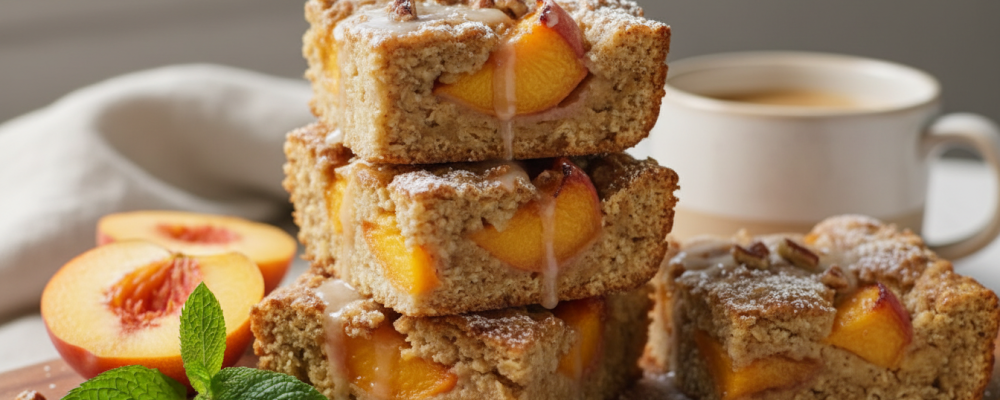

I want to talk about brown butter, because brown butter is the reason these squares exist and the reason they taste the way they do—and because brown butter is one of the most transformative and least respected techniques in a home baker’s repertoire, and I think that is a genuine injustice that deserves addressing.
Here is what happens when you brown butter: the milk solids in the butter—the proteins and sugars that separate out from the fat—undergo a Maillard reaction under heat. The same reaction that makes bread golden, steak delicious, and coffee roasted also happens, in miniature and in a saucepan, to those milk solids as the butter goes from melted to foaming to golden to deep amber. The result is a fat that tastes not just of butter but of toasted hazelnuts, of caramel, of something warm and slightly nutty and indefinably more complex than the ingredient you started with. It takes four to five minutes. It requires one saucepan and slightly more attention than melting. The flavor difference between a recipe made with melted butter and one made with browned butter is, in the technical parlance of my profession, enormous.
In these oat squares, the browned butter is not a finishing drizzle or a sauce—it is the foundational fat of the entire preparation, which means its flavor distributes through every square inch of every square. The oats toast in it. The flour absorbs it. The brown sugar caramelizes against it. And the fresh peaches, folded in at the end, release their juice into this buttery, nutty matrix as they bake, creating pockets of jammy sweetness throughout the square that make every piece a slightly different experience from the one before it. This is what I mean when I say that brown butter is not a small decision. It is the decision that makes the whole recipe.
─────────────────────────────────────────
The Inspiration Behind This Recipe
The genesis of this recipe was a question I ask myself whenever I develop something for a weekly prep format: what is the baked item that functions simultaneously as a breakfast and a snack without feeling like a compromise in either direction? Most baked oat preparations lean too far one way or the other—too sweet and dessert-adjacent to feel appropriate at eight in the morning, or too austere and health-forward to be genuinely satisfying at three in the afternoon.
Brown butter was the ingredient that resolved that tension. Its flavor is rich enough to make the squares feel indulgent—genuinely, satisfyingly indulgent in the way that a good pastry is—while remaining grounded in the wholesome, familiar character of oats and fruit that makes a breakfast feel appropriate. The result is a square that doesn’t ask you to decide what category of food it belongs to. It simply tastes good, at any hour, in any context, with any beverage.
Fresh peaches were the fruit choice for two specific reasons: their sugar content and their water release behavior during baking. Stone fruits with high sugar content—peaches, nectarines, apricots—produce particularly complex caramelized pockets when baked into a dense oat preparation, because their sugars concentrate as they release moisture rather than simply steaming into bland softness the way a lower-sugar fruit might. The peach pieces in these squares become something closer to a soft, jammy confection embedded in the oat matrix than simply chunks of cooked fruit—and it is that quality, that pocket of concentrated, caramelized peach against the nutty browned butter oat, that makes these squares as memorable to eat as they are to smell coming out of the oven.
─────────────────────────────────────────
A Brief History of Baked Oat Preparations
The oat bar—rolled oats bound with fat and sugar and pressed into a pan before baking—is a preparation with roots across multiple baking traditions, each arriving at a similar format from different culinary starting points. In Scotland, where oats have been a dietary staple for centuries, the flapjack—a dense, golden oat bar made with butter, sugar, and golden syrup—has been a household staple and a school lunch fixture for generations. The American oat bar tradition, which runs parallel through the mid-20th century, typically incorporates more flour and leavening than the British version, producing a slightly lighter, more cake-adjacent texture that falls somewhere between a bar cookie and a baked granola preparation.
Brown butter as a culinary technique has a longer and more geographically diverse history than its recent popularity in contemporary baking would suggest. Beurre noisette—hazelnut butter, named for the nutty aroma its milk solids develop during browning—is a foundational technique in classical French cooking, used in sauces, pastries, and finishing preparations since at least the 18th century. French pastry’s influence carried the technique into broader European and eventually American baking traditions, where it has experienced a particularly enthusiastic revival in contemporary recipe development as home bakers have discovered that it is both accessible and extraordinary in its flavor impact.
The pairing of browned butter with fresh stone fruit in a baked oat preparation is a distinctly modern innovation—a home baking convergence of the French beurre noisette tradition, the Anglo-American oat bar format, and the contemporary preference for recipes that use fresh, seasonal fruit as the primary flavor variable. The result is a preparation that is simultaneously rooted in long-standing baking traditions and genuinely of the moment: technically straightforward, deeply flavorful, and as good a reason to turn on the oven as any the weekly prep calendar offers.
─────────────────────────────────────────
Why This Cooking Method Works for Meal Prep
The crumbly-press method—mixing to a crumbly texture before pressing into the pan rather than producing a pourable batter—is the technique choice that makes these squares structurally reliable for meal prep storage and handling. A standard batter produces a uniform, cake-like texture that slices cleanly on day one but becomes increasingly soft and fragile as moisture redistributes through the refrigerated square over subsequent days. The pressed crumb method produces a denser, less homogeneous matrix with more structural integrity through the refrigeration cycle—the fat is less evenly emulsified, which means the squares hold their cut edges more consistently across the full week.
Brown butter contributes to this structural advantage specifically because browned butter has a lower water content than standard melted butter. The browning process drives off residual water from the butter as steam, leaving behind a fat that is more concentrated and produces a crisper, firmer matrix when used in a baked preparation. This is the same principle that makes brown butter cookies crisper and more snap-prone than standard butter cookies—the reduced water content produces a drier, less tender crumb structure. In an oat square intended to hold its shape through five days of refrigeration and handling, that additional structural integrity is a meaningful advantage.
Folding the peaches in last and gently—rather than mixing them with the fat and sugar from the beginning—preserves their structural integrity through the baking window. Peaches mixed into the batter early break down more completely during baking, producing a preparation that is uniformly peach-flavored but lacks the distinct, jammy pockets that make each bite of a properly assembled square interesting. Gently folded-in peach pieces retain their identity as distinct inclusions, caramelizing at their exposed surfaces while remaining slightly yielding at the center—producing the textural variation that is the signature quality of a well-made fruit bake.
─────────────────────────────────────────
Flavor Profile: What to Expect
These squares are warm, complex, and deeply satisfying—the flavor of a bakery item that clearly had thought put into it:
- Nutty, caramelized brown butter – The foundational flavor note of the entire square: toasted, slightly hazelnut-adjacent, warm in a way that plain butter is not and can never quite be—present in every bite as both a flavor and a fragrance
- Caramel-toned brown sugar depth – Brown sugar contributes a molasses-forward sweetness with more complexity and depth than plain white sugar—its slight bitterness complements the nuttiness of the browned butter in a way that feels almost inevitable
- Peach jamminess – Fresh peach pieces, caramelized at their edges during baking, provide pockets of concentrated, slightly syrupy sweetness throughout the square—floral, fruity, and intensely peachy in a way that fresh fruit in a baked preparation uniquely achieves
- Wholesome oat chew – Rolled oats contribute an earthy, slightly grassy body that keeps the square grounded in something wholesome beneath all the richness—the substance that makes this a breakfast as much as a treat
- Warm vanilla depth – Vanilla extract threads through the entire preparation with its characteristic bakery warmth, rounding every other flavor toward something more cohesive and complete
- Clean salt finish – Salt in the dry ingredients sharpens the sweetness of the brown sugar and the butter, making both taste more vivid and preventing the square from reading as cloying
The flavor deepens considerably overnight as the browned butter’s fat-soluble compounds continue to distribute through the oat matrix and the peach pockets release a small amount of additional juice into the surrounding crumb. Day-two and day-three squares are the peak—warmer, more cohesive, and more fragrant than the fresh-baked version.
─────────────────────────────────────────
Tips for Making the Best Brown Butter Peach Baked Oat Squares
The brown butter step is where this recipe rewards the most attention—and where the most common mistakes occur:
- Watch the butter closely and don’t walk away – Brown butter goes from perfect to burned in under sixty seconds. Stay at the stove, stir frequently, and pull the pan from heat the moment the foam subsides and the milk solids are deep golden-amber and smell unmistakably of toasted hazelnuts. If it smells bitter, it has gone too far.
- Use a light-colored saucepan if possible – Dark or non-stick pans make it difficult to see the color change of the milk solids, which is your primary visual indicator. A stainless steel or light-colored enamel saucepan allows you to monitor the browning accurately.
- Cool the brown butter slightly before adding it to the mixture – Very hot browned butter added to the dry ingredients can partially cook the egg and melt the sugar unevenly. Allow it to cool for five to seven minutes until still liquid but no longer steaming before incorporating.
- Choose ripe but firm peaches – As with any baked fruit preparation, overripe peaches contain too much moisture and break down completely during baking, producing wet pockets in the crumb rather than distinct jammy inclusions. Ripe-but-firm peaches caramelize cleanly and hold their identity through the bake.
- Press the mixture firmly and evenly – An evenly pressed base bakes uniformly; a loosely or unevenly pressed one produces squares with different textures across the pan. Use the flat base of a measuring cup or a piece of parchment paper pressed across the surface to achieve a consistent density.
- Cool completely before slicing – The oat matrix is still fragile when warm. Slicing a warm square produces crumbling at the cut edges; slicing a fully cooled square produces clean, confident cuts that hold through handling and stacking.
Optional: A light drizzle of browned butter—make a small additional batch—over the top of the pressed, unbaked mixture before it goes into the oven creates a burnished, golden surface on the finished squares that is as beautiful as it is delicious. It adds two minutes and transforms the presentation entirely.
─────────────────────────────────────────
Portioning and Container Suggestions
A 9×9 inch pan yields twelve generous squares or sixteen smaller ones, depending on the cut—three generous squares or four smaller ones per serving as a breakfast, or one to two as a snack portion. The squares cut most cleanly with a sharp knife wiped clean between cuts—residual oat crumb on the blade tends to drag and compress the edges of subsequent slices. A ruler or bench scraper used as a guide produces particularly uniform squares if visual consistency matters.
Once fully cooled and sliced, the squares stack beautifully in a wide, flat airtight container with parchment paper between layers—essential, because the peach’s residual moisture can cause squares to stick together at the surfaces where the jammy pockets are exposed. Individual daily portions pre-packaged in parchment or small containers make the morning grab entirely effortless and the squares arrive at the desk with their edges still intact and their surfaces uncompressed.
For a particularly beautiful presentation—these squares deserve one—arrange them on a wooden board dusted with a very light veil of powdered sugar immediately before serving. The golden, peach-studded tops against the white sugar dusting and the dark surface of the board is the kind of low-effort visual that makes people reach for their phones before they reach for the square. Which is, as these things go, a perfectly acceptable outcome.
─────────────────────────────────────────
Storage, Reheating, and Shelf Life Tips
- Room temperature storage: Squares keep well at room temperature in an airtight container for up to 2 days. In a cool kitchen, this is the preferred storage method—the browned butter fragrance is most pronounced without refrigerator suppression.
- Refrigerator storage: Keeps in an airtight container for up to 5 days. The squares firm slightly in the refrigerator—a pleasant textural change that makes them easier to handle and eat without crumbling. Flavor peaks at days two and three.
- Freezer storage: Freeze individually wrapped squares for up to 2 months. The oat matrix and browned butter structure are highly freeze-stable with no significant texture change after thawing. Thaw at room temperature for thirty to forty-five minutes or overnight in the refrigerator.
- Reheating: Microwave individual squares at 50% power for 20–30 seconds only—enough to take the refrigerator chill off and slightly soften the peach pockets without overheating. Alternatively, warm in a 300°F oven for 5–8 minutes, which restores the slight crispness of the exterior edges most satisfyingly.
- Room temperature serving: These squares are genuinely excellent at room temperature—arguably their best state—where the browned butter fragrance is fully forward and the texture is at its most ideal balance of crumbly exterior and tender interior.
- Peach moisture note: If squares have released some peach juice onto the parchment paper in storage, this is normal and does not indicate a problem with the preparation. The juice concentrates at the square’s base during refrigeration—the surface and interior remain intact and properly textured.
─────────────────────────────────────────
Why This Recipe Deserves a Spot in Your Meal Prep Rotation
There is a version of the weekly prep session that is entirely functional—proteins, grains, vegetables, portioned and sealed—and it is a fine thing to do for yourself. And then there is the version that also includes something baked, something golden, something that makes the kitchen smell extraordinary for thirty-five minutes on a Sunday afternoon and then waits in the refrigerator all week to be the best part of Tuesday morning. The Brown Butter Peach Baked Oat Square is that thing.
It earns its place in the rotation on practical grounds: straightforward preparation, a week-long shelf life, a format that functions as both breakfast and snack, and a per-serving cost that is genuinely low for the quality it delivers. But the real reason to keep it on the Sunday list is simpler and more honest than any of that. It is because a week that contains these squares in the refrigerator is a week that is slightly more enjoyable than one that doesn’t—because the smell of browned butter and peaches baking is one of the great sensory experiences a home kitchen can offer, and because the square you eat on Thursday morning, when the browned butter has had three days to bloom through the oat crumb and the peach pockets have caramelized to exactly the right jammy depth, tastes like something worth having planned ahead for. That is the standard I hold every recipe in this collection to. This one meets it beautifully.
─────────────────────────────────────────
Meal Prep Pairing Suggestions
Brown Butter Peach Baked Oat Squares pair most naturally with other baked or oat-based preparations that offer textural and flavor contrast within a cohesive snack and breakfast ecosystem. Our Raspberry Almond Baked French Toast Cups make the ideal oven-baked companion—both are warmly fragrant, fruit-forward baked preparations that function as breakfast or snack, but the custardy, egg-rich French toast cups are soft and yielding where these squares are crumbly and dense, and the raspberry-almond flavor profile is sharp and floral where this is warm and caramelized. Together they give the week’s baked breakfast rotation two genuinely different experiences that happen to share the same oven temperature and the same make-ahead convenience.
For a complete prep-ahead treat rotation, our Peanut Butter Oat Energy Squares provide the no-bake, protein-forward counterpart—chewy, richly peanut-and-honey flavored, and built around the same rolled oat base from an entirely different angle. Two oat squares—one baked and golden with browned butter and peach, one chilled and chewy with peanut butter and chocolate chips—covering every oat-based snacking texture and temperature is the kind of thoughtful, varied prep that keeps a rotation genuinely exciting rather than merely convenient. Both made on Sunday. Both waiting in the refrigerator. Both worth every minute of the effort they asked for.
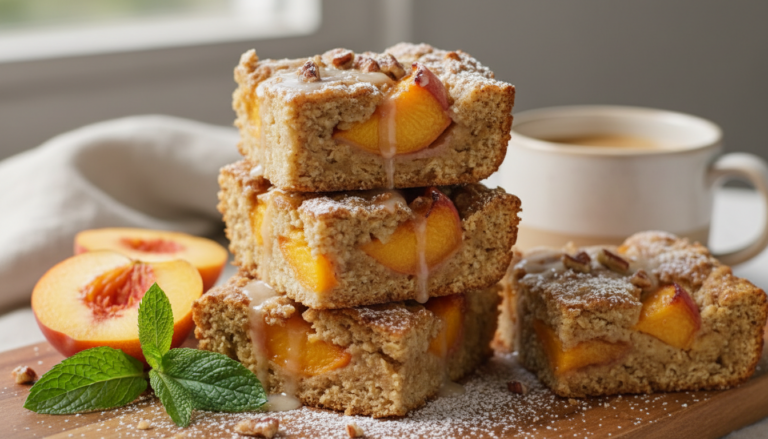
Brown Butter Peach Baked Oat Squares
These Brown Butter Peach Baked Oat Squares are a warmly fragrant, bakery-quality make-ahead treat built on nutty browned butter, hearty rolled oats, and fresh summer peaches—equally at home as a grab-and-go breakfast or a genuinely indulgent afternoon snack.
9
servings15
minutes35
minutes210
kcal50
minutesIngredients
1/2 cup unsalted butter
2 cups rolled oats
1 cup all-purpose flour
1 teaspoon baking powder
1/2 teaspoon baking soda
1/4 teaspoon salt
1/2 cup brown sugar
1 teaspoon vanilla extract
1 egg
2 cups diced fresh peaches
Directions
- Preheat the oven to 350°F (175°C) and grease a 9×9 inch baking pan.
- In a saucepan, melt the butter over medium heat until it turns golden brown, stirring frequently.
- In a large bowl, combine oats, flour, baking powder, baking soda, and salt.
- Mix in the brown sugar, vanilla extract, and browned butter until crumbly.
- Add the egg and mix until well combined.
- Gently fold in the diced peaches.
- Press the mixture evenly into the prepared baking pan.
- Bake for 30-35 minutes until golden and set.
- Allow to cool before slicing into squares.
Nutrition Facts
- Total number of serves: 4
- Calories: 210kcal
- Cholesterol: 0mg
- Sodium: 620mg
- Potassium: 400mg
- Sugar: 8g
- Protein: 6g
- Calcium: 60mg
- Iron: 2mg
About This Author

Aurora Wright
Pastry Chef & Dessert Editor
Aurora is the sweet side of Daily Dish. A trained pastry chef and dessert stylist, she’s responsible for our mouth-watering cakes, cookies, and confections. She brings precision, artistry, and a touch of whimsy to every recipe she creates — and taste-tests more chocolate than she’ll admit.
Favorite dish: Flourless dark chocolate torte.
Kitchen motto: “Life’s too short to skip dessert.”















