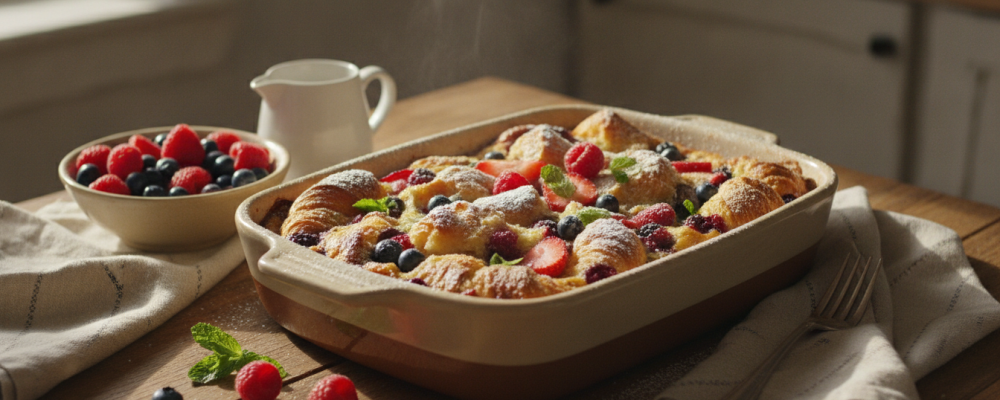

If I had to choose one recipe to represent everything I believe about beautiful, indulgent, joyful baking, it might honestly be this Berry Croissant Casserole Brunch Bake. It has everything: buttery, flaky pastry soaking up vanilla-scented cream custard until it becomes something halfway between bread pudding and French toast, jewel-bright berries that burst during baking and create little pockets of tart sweetness throughout, and a golden, slightly crispy top that gives way to the most lusciously soft, custardy interior you can imagine. It looks absolutely extraordinary, tastes even better than it looks, and takes maybe fifteen minutes of actual effort. This is my kind of baking.
What makes this casserole so special from a pastry perspective is the croissant itself. Regular bread in a bread pudding absorbs custard uniformly and becomes soft throughout—pleasant, but predictable. Croissants, with their laminated butter layers, absorb custard in a completely different way. Some layers soak through completely and become tender and custardy. Others maintain more structure and create slight chewiness. The exterior pieces that rise above the custard line develop a golden, almost crunchy quality that contrasts beautifully with the soft interior. The result has more textural complexity than any regular bread pudding could achieve, and the butter already built into those croissant layers adds richness that no amount of extra butter in the custard could replicate.
And then there are the berries. Oh, the berries. Mixed berries tucked between croissant pieces create these gorgeous pockets where the fruit releases its juices during baking, staining the surrounding custard the most beautiful shades of purple and red and creating concentrated bursts of sweet-tart flavor in every bite. It’s the kind of visual and flavor magic that makes you want to take approximately forty photographs before you even pick up a fork. Which, as someone who believes deeply that beautiful food is part of the joy of eating, I fully support.
─────────
The Inspiration Behind This Recipe
My inspiration for this bake came from two beloved French desserts that I’ve long wanted to marry: croissant bread pudding, which appears on bistro menus throughout Paris and always makes me deeply happy, and clafoutis, that gorgeous French baked custard studded with cherries or berries that sits so beautifully in that space between breakfast and dessert. I wanted to create something that captured the best qualities of both—the richness and texture of croissant bread pudding with the fresh, vibrant fruitiness of clafoutis.
The critical insight was that croissants don’t need overnight soaking to shine in this format. Unlike stale bread that requires extended time to fully absorb custard, croissant pieces with their porous, butter-rich layers absorb liquid beautifully within just ten minutes. This discovery was exciting because it meant I could create something with all the complexity and richness of a properly made bread pudding without any advance planning—just tear, scatter, whisk, pour, wait ten minutes, and bake.
The berry combination was equally deliberate. Mixed berries provide color variety, flavor complexity, and a beautiful visual result as different berries behave slightly differently during baking—blueberries hold their shape longest, raspberries soften and bleed into the custard most dramatically, blackberries caramelize slightly on top. This variety means every slice is slightly different and visually interesting in its own way, which is exactly the kind of beautiful unpredictability I love in baking.
─────────
A Brief History of Croissant Bread Puddings
Bread pudding itself has ancient roots across many European traditions, emerging as a practical solution for using stale bread by soaking it in a sweetened egg-milk custard and baking it into something new and delicious. The French version—pain perdu, or “lost bread”—became the template for countless variations, from simple home cooking to elaborate restaurant presentations. The fundamental concept of transforming bread with custard has proven enduringly popular precisely because it produces results that genuinely exceed their humble origins.
The croissant variation emerged more recently, as the croissant itself became widely available beyond France in the 20th century. Restaurant pastry chefs discovered that day-old croissants—which lose their crisp exterior but retain their butter-rich, layered interior—behaved exceptionally well in bread pudding preparations, contributing richness and textural complexity that plain bread couldn’t match. New Orleans, with its deep French culinary heritage, became particularly known for croissant bread pudding, where it appears on upscale brunch menus as a signature dish.
The berry variation represents the natural intersection of bread pudding tradition with the French clafoutis—another egg-custard bake featuring fresh fruit. This combination honors both traditions: the French technique of baking fruit with custard and the practical American tradition of making bread pudding into something celebratory and special. Today, fruit-studded croissant casseroles appear on brunch menus worldwide, celebrated for their beautiful presentation and the way they make simple ingredients taste genuinely luxurious.
─────────
Why This Cooking Method Works
Tearing croissants rather than cutting them creates irregular surfaces with more exposed interior layers. These rough, porous edges absorb custard more readily than clean-cut surfaces, ensuring full saturation throughout the bake. The irregular shapes also create varied heights and textures in the finished casserole—some pieces rise higher and develop more crust, others sit lower and stay more custardy—which contributes to the visual interest and textural complexity that makes this dish so satisfying.
The ten-minute soaking period before baking is carefully calibrated for croissants specifically. Unlike dense bread that needs hours to absorb custard fully, croissants’ open, butter-rich layers drink up liquid much more quickly. Ten minutes provides enough time for initial absorption while preserving some structural integrity—pieces that fully dissolve into custard would result in a dense, uniform pudding without the textural variety that makes this casserole special. You want some pieces to remain recognizable as croissant while others meld completely into the custard.
Baking at 350°F for 35-40 minutes creates the ideal progression of textures. The gentle heat allows the custard to set gradually and evenly, preventing the curdling that would occur at higher temperatures. The extended time ensures the center sets completely while the top develops that beautiful golden color. The berries release their juices during baking, which mingle with the surrounding custard and create flavor throughout rather than remaining isolated pockets of fruit. The butter used to grease the dish creates a slightly caramelized bottom layer—a hidden treat for whoever gets the corner pieces.
─────────
Flavor Profile: What to Expect
This casserole delivers layered sweetness with bright fruit contrast and rich, creamy depth:
- Buttery croissant richness – The pastry’s built-in butter adds luxury throughout every bite
- Vanilla custard warmth – Silky, aromatic, and gently sweet with that classic French dessert quality
- Burst berry sweetness – Jewel-bright fruit that ranges from tart to sweet depending on variety
- Berry juice staining – Where fruit releases its juices into surrounding custard, creating concentrated flavor pockets
- Golden crispy top – Caramelized croissant pieces that provide essential textural contrast
- Heavy cream richness – Luxuriously velvety custard that feels genuinely indulgent
- Caramelized sugar notes – Subtle, from both the baked custard and slightly caramelized berry edges
The overall experience is one of pure, uncomplicated luxury—this tastes like something that required genuine pastry skill and significant effort, which makes its simplicity feel almost delightfully sneaky. The contrast between the crispy golden top and the silky custard interior is extraordinary. When you hit a pocket of burst berry surrounded by vanilla-scented cream, it creates a moment of pure flavor happiness that keeps you reaching for another bite before you’ve finished the first.
─────────
Tips for Making the Best Berry Croissant Casserole Brunch Bake
Use day-old croissants if possible—they’ve lost some moisture, which allows them to absorb the custard even more effectively.
- Tear generously – Pieces should be substantial, about 1-2 inches, so they maintain texture after soaking
- Distribute berries throughout – Tuck some between croissant pieces, not just on top, for berries in every bite
- Press pieces down gently – After pouring custard, press lightly to ensure all pieces make contact with liquid
- Don’t skip the soaking time – Ten minutes makes a significant difference in texture and absorption
- Use quality vanilla extract – The custard is simple enough that vanilla quality is genuinely noticeable
- Check center for doneness – Insert a knife; it should come out with just a few moist crumbs, not wet custard
- Rest before serving – Five minutes out of the oven allows the structure to settle for cleaner serving
- Add fresh berries after baking – A handful of uncooked berries scattered over the warm bake adds beautiful color and freshness
For an extra-special presentation, dust the warm casserole with powdered sugar just before serving and add a few sprigs of fresh mint. A small pitcher of warm cream or crème anglaise alongside turns it into a genuinely restaurant-worthy dessert presentation.
─────────
Serving Suggestions and Side Pairings
This casserole is beautiful and rich enough to anchor an entire brunch spread on its own. Serve warm from the baking dish for rustic, communal charm, or portion carefully onto individual plates for more elegant presentation. A dollop of softly whipped cream or a small scoop of crème fraîche alongside adds cooling richness that complements the warm custard beautifully. Fresh berries scattered over the top just before serving add vibrant color and fresh-fruit contrast to the baked version.
For a complete brunch, balance this sweet centerpiece with lighter, savory accompaniments—a simple green salad, a platter of sliced prosciutto, or a vegetable frittata provide contrast without competing. The casserole’s richness means you want sides that refresh rather than add more indulgence. Fresh-squeezed juice or sparkling water with lemon between bites keeps the palate clean and ready for the next luxurious forkful.
This bake shines at Mother’s Day brunch, Easter breakfast, Valentine’s Day morning, or any celebration where you want to serve something genuinely impressive without heroic effort. It’s also particularly lovely for overnight guests—the aroma it creates while baking is enough to make anyone feel thoroughly pampered and welcome. Bring it to the table in its baking dish, golden and beautiful, and watch the room light up.
─────────
Storage, Reheating, and Make-Ahead Tips
- Assemble completely ahead: Build the entire casserole (including soaking) up to 24 hours ahead; refrigerate covered
- Bake from cold: Add 5-10 minutes to baking time if going directly from refrigerator to oven
- Store baked casserole: Cover and refrigerate for up to 3 days; the berries’ acidity keeps everything fresh
- Reheat gently: Cover with foil and warm at 300°F for 15-20 minutes to prevent drying
- Individual portions: Microwave single servings for 30-45 seconds for quick weekday enjoyment of leftovers
- Serve at room temperature: This casserole is genuinely beautiful eaten cool—almost like a set custard
- Don’t freeze: The delicate custard texture doesn’t survive freezing and thawing gracefully
- Refresh before serving: A few fresh berries and dusting of powdered sugar revive day-old portions beautifully
The make-ahead capability is one of this recipe’s most valuable qualities for entertaining. Assembling the night before not only saves morning effort but actually improves results—the extended soaking time creates even more uniform custard absorption throughout. This is genuinely a case where advance preparation produces better food.
─────────
Why This Recipe Deserves a Spot in Your Rotation
This recipe earns its place because it sits at that perfect intersection of effortless and extraordinary—the kind of dish that makes you feel like a brilliant baker while actually being wonderfully forgiving and simple. Once you understand how beautifully croissants behave in custard, you’ll find yourself making variations endlessly: different fruits with different seasons, different flavor additions in the custard, different garnishes for different occasions. The basic technique is a template for infinite beautiful results.
Beyond versatility, this casserole creates genuine wonder—the kind of food that makes people stop mid-bite and say something appreciative out loud. There’s real magic in how those torn croissant pieces and scattered berries transform in the oven into something golden and gorgeous and profoundly delicious. Food that creates that kind of spontaneous pleasure, that makes people feel genuinely cared for and celebrated, is always worth having in your repertoire. This Berry Croissant Casserole Brunch Bake does all of that beautifully, every single time, with a simplicity that feels almost like cheating—and that I absolutely refuse to apologize for.
─────────
Recommended Drink Pairing
The luxurious vanilla custard and jewel-bright berries of this casserole deserve beverages that honor their elegance. Champagne or prosecco is my absolute first choice—the bubbles cut through the rich custard beautifully while the wine’s acidity complements the berries in the most natural, lovely way. A Kir Royale (sparkling wine with a splash of crème de cassis) creates gorgeous color and flavor harmony with the berry-stained custard, making it feel like a truly considered pairing. For a non-alcoholic version, sparkling berry lemonade or elderflower fizz provides similar effervescence and fruit notes.
For coffee lovers, a light roast with bright, fruity notes—similar to what you’d find in a quality Ethiopian or Kenyan bean—provides acidity and subtle berry flavors that echo the casserole’s fruit without competing. A delicate flat white adds creamy texture that harmonizes with the custard’s richness while the espresso’s intensity provides welcome contrast. For tea, a fragrant Earl Grey brings bergamot’s citrus aromatics that play beautifully with both vanilla and berries, while a pot of properly brewed Darjeeling offers floral, muscatel notes that feel authentically French in spirit.
Fresh-squeezed orange juice provides bright, sweet-tart citrus that cuts through the richness and refreshes between bites—particularly lovely when the casserole is served warm and rich on a bright morning. Berry-infused water or a lavender lemonade adds gentle, floral sophistication for those wanting something light and beautiful. Whatever you pour, reach for something with brightness and elegance—this casserole is special enough to deserve a drink that rises to meet it.
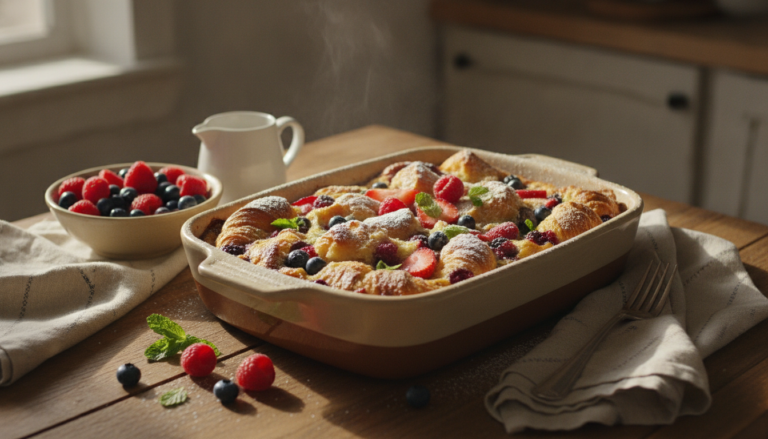
Berry Croissant Casserole Brunch Bake
This Berry Croissant Casserole Brunch Bake transforms buttery croissants and fresh mixed berries into a golden, custardy masterpiece—elegant enough for special occasions, simple enough to make any weekend morning feel like a celebration.
8
servings20
minutes40
minutes320
kcal1
hourIngredients
4 large croissants
1.5 cups mixed berries
1 cup milk
1 cup heavy cream
3 eggs
0.5 cup sugar
1 teaspoon vanilla extract
1 tablespoon butter
Directions
- Preheat the oven to 350°F (175°C).
- Grease a baking dish with butter.
- Tear croissants into bite-sized pieces and place in the baking dish.
- Scatter mixed berries evenly over the croissants.
- In a bowl, whisk together milk, heavy cream, eggs, sugar, and vanilla extract.
- Pour the egg mixture over the croissants and berries, ensuring everything is well coated.
- Let it sit for 10 minutes to absorb the liquid.
- Bake in the preheated oven for 35-40 minutes, until the top is golden and custard is set.
- Serve warm or at room temperature.
Nutrition Facts
- Total number of serves: 4
- Calories: 320kcal
- Cholesterol: 0mg
- Sodium: 620mg
- Potassium: 400mg
- Sugar: 8g
- Protein: 6g
- Calcium: 60mg
- Iron: 2mg
About This Author

Aurora Wright
Pastry Chef & Dessert Editor
Aurora is the sweet side of Daily Dish. A trained pastry chef and dessert stylist, she’s responsible for our mouth-watering cakes, cookies, and confections. She brings precision, artistry, and a touch of whimsy to every recipe she creates — and taste-tests more chocolate than she’ll admit.
Favorite dish: Flourless dark chocolate torte.
Kitchen motto: “Life’s too short to skip dessert.”