Daily Dish

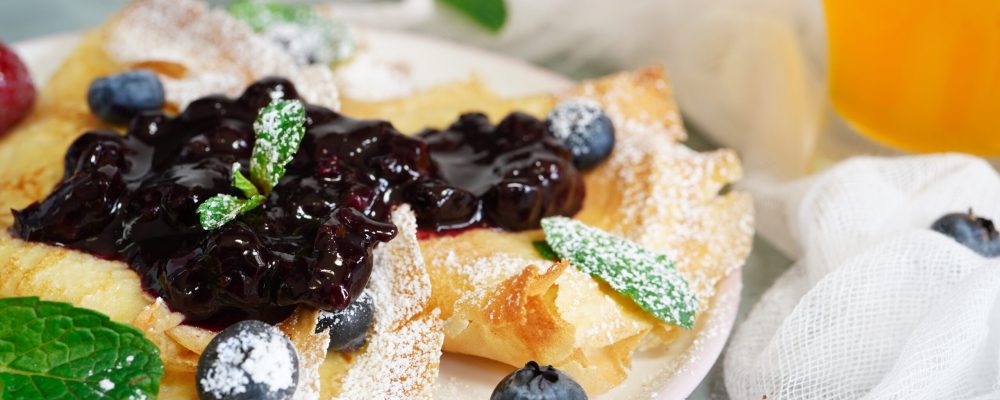
Delicate French Crepes with Berry Compote

Healthy Fact of the Day

While crepes are a treat, the berry compote provides antioxidants and vitamin C. You can make them healthier by using whole wheat flour and reducing sugar in the compote.

Ingredients


For the Crepes:

  • 1 cup all-purpose flour
  • 2 large eggs
  • 1 cup milk
  • 1/4 cup water
  • 2 tbsp unsalted butter, melted
  • 1/4 tsp salt
  • 1 tsp vanilla extract
  • Butter for cooking


For the Berry Compote:

  • 2 cups mixed berries (strawberries, raspberries, blueberries)
  • 1/4 cup sugar
  • 1 tbsp lemon juice
  • 1 tsp vanilla extract


For Serving:

  • Whipped cream
  • Powdered sugar
  • Fresh mint leaves


Instructions

  1. In a blender, combine flour, eggs, milk, water, melted butter, salt, and vanilla. Blend until smooth. Refrigerate batter for 30 minutes.

  2. For the compote, combine berries, sugar, and lemon juice in a saucepan. Simmer over medium heat for 10 minutes. Remove from heat and stir in vanilla. Let cool.

  3. Heat a non-stick skillet over medium heat.

  4. Lightly butter the surface.

  5. Pour about 1/4 cup of batter into the center of the skillet, tilting to spread evenly.

  6. Cook for about 2 minutes until the bottom is lightly golden.

  7. Flip and cook for another 30 seconds to 1 minute.
    Repeat with remaining batter.

  8. To serve, fold crepes into quarters and top with berry compote.

  9. Garnish with whipped cream, a dusting of powdered sugar, and fresh mint leaves.

Take a bite of these delicate crepes, let the sweet berry compote melt on your tongue, and close your eyes – you might just find yourself transported to a charming Parisian café! Whether it’s for a special breakfast or an elegant dessert, these crepes bring a touch of French sophistication to your table, proving that sometimes the simplest pleasures are the most délicieux!


Recent Recipes

Quiche Stuffed Bagels

  • August 15, 2026
  • 12 min read

Five Things Your Blender Can Do That

  • August 15, 2026
  • 4 min read

The End of Summer Reading List: Books

  • August 15, 2026
  • 10 min read

Crispy Cast Iron Skillet Pizza

  • August 15, 2026
  • 6 min read

Krispy Kreme Is Dropping a Pokémon Doughnut

  • August 14, 2026
  • 3 min read

The Olive Oil Harvest: Why the Freshest

  • August 14, 2026
  • 11 min read

Taco Hashbrown Casserole

  • August 14, 2026
  • 6 min read

Aldi’s August Finds Are Stacked — And

  • August 13, 2026
  • 5 min read

Bushwacker

  • August 13, 2026
  • 12 min read

The Cookout That Nobody Forgets: Building an

  • August 13, 2026
  • 12 min read

Tip of the Day

“Always let your meat rest before slicing.”

Whether you're roasting a chicken, grilling steak, or baking pork tenderloin, letting cooked meat rest for 5–10 minutes before slicing allows the juices to redistribute evenly. This simple step keeps your meat juicy and tender, ensuring every bite is flavorful and moist. Bonus: It gives you a moment to plate your sides or garnish for a perfect presentation!

Our Latest Recipes

Breakfast
Amelia Grace

Quiche Stuffed Bagels

Eggs provide complete protein and choline while green onions contribute vitamin K and antioxidants—making these creative stuffed bagels a genuinely nourishing handheld breakfast that fuels your morning beautifully.

Read More »
Blog
Daily Disher

Five Things Your Blender Can Do That Have Nothing to Do With Smoothies

The blender is one of the best tools for sneaking more vegetables into meals without anyone noticing. Blended soups are the obvious move — a full head of cauliflower or a pound of butternut squash disappears into a velvety texture that feels indulgent without being heavy. But the same principle applies to sauces, dressings, and even smoothies where a handful of spinach or frozen zucchini adds nutrients without changing the flavor in any meaningful way. If eating more vegetables is the goal, the blender is one of the lowest-friction ways to get there.

Read More »
Blog
Daily Disher

The End of Summer Reading List: Books to Cook From Before the Season Turns

Research on food literacy — the understanding of where food comes from, how it is produced, and how to prepare it well — consistently identifies reading about food as one of the most effective pathways to improving dietary behavior. People with higher food literacy consume more whole foods, more vegetables, and fewer processed products than those with lower food literacy — and the gap between the two groups is not primarily explained by income or access but by knowledge and engagement. The investment of a late summer afternoon in genuinely good food writing is, in measurable terms, one of the most effective nutritional interventions available to any reader willing to make it.

Read More »

Get your daily dose of delicious!

Skip to content












