
There is a category of flavor pairing that I think of as the quiet revelations—the combinations that sound unpromising in description, that you approach with mild skepticism, and that produce, on the first taste, the specific reaction of wondering why you haven’t been doing this all along. Tahini and banana is one of those combinations, and I am going to argue that it is one of the best ones.
Tahini—ground sesame paste, earthy and slightly bitter, with a distinctive nuttiness that no other nut butter quite replicates—and ripe banana, which is all natural sweetness and floral fruit fragrance and soft, yielding sweetness—appear to have nothing in common. They operate in entirely different flavor registers. They come from entirely different culinary traditions. They have no obvious precedent as a pairing in pastry or in savory cooking that would make their combination seem natural or inevitable.
And yet. The tahini’s slight bitterness—the same slight bitterness that makes it so effective at balancing sweetness in halva and in sesame caramel—does something specific and wonderful to ripe banana: it makes the banana taste more intensely of banana. The sesame’s earthiness provides a darker, more complex backdrop against which the banana’s natural sweetness and fragrance register more vividly than they do when the banana simply sits in a bowl of plain almond milk and oats and is asked to carry the whole preparation alone. The tahini is not competing with the banana; it is amplifying it, in the same way that salt amplifies sweetness and coffee amplifies chocolate. This is a flavor relationship, and it produces a jar that is specifically, memorably delicious in a way that neither ingredient achieves independently.
─────────────────────────────────────────
The Inspiration Behind This Recipe
The inspiration was halva—the ancient sesame and honey confection that appears across the Middle Eastern, Mediterranean, and South Asian culinary traditions in dozens of regional variations but always with the same fundamental character: tahini’s nuttiness transformed by sweetener into something that is richer, smoother, and more cohesive than either ingredient alone. Halva’s texture—dense, slightly crumbly, melting slowly—is the result of crystallized sugar suspending tahini throughout a fat-and-sugar matrix, and the flavor is one of the most specifically beautiful in the confectionery world.
What mashed banana does to tahini in overnight oats is structurally analogous to what honey does to tahini in halva, and that analogy is what made this jar worth developing. The banana’s natural sugars—fructose, glucose, and sucrose in a ratio that shifts progressively toward sweeter and more complex as the banana ripens—interact with the tahini’s fat and protein in the overnight resting period in a way that produces a more cohesive, more specifically flavored jar than tahini stirred with plain sweetener would achieve. The banana’s natural pectin also contributes to the jar’s thickening, producing a base that is denser and creamier than the same oat-to-liquid ratio would produce with only almond milk and chia seeds as thickening agents.
The chia seeds complete the thickening architecture. In a standard overnight oat jar, chia seeds expand into their gel form during the refrigerator rest and contribute the primary body to the preparation. In a jar that already contains mashed banana—with its pectin content adding a second thickening mechanism—the chia gel interacts with the banana’s natural thickeners to produce a jar whose consistency is remarkably close to a well-set pudding: spoonable, rich, and specifically satisfying in a way that thinner overnight oat preparations are not.
─────────────────────────────────────────
A Brief History of Tahini in Sweet Preparations
Tahini’s role in sweet preparations is one of the oldest in the culinary history of the Mediterranean and Middle East—a role that predates its contemporary association with hummus and savory dips by centuries and that reflects the sesame seed’s original status as a luxury ingredient in the ancient world. Sesame oil was among the most valuable commodities traded in ancient Mesopotamia, Egypt, and the Indus Valley civilization, prized for its stability, its flavor, and its versatility across cooking and preservation applications. Ground sesame paste in sweet preparations appears in ancient Egyptian food records, in medieval Arab confectionery texts, and in the Ottoman court cooking tradition that produced many of the sweet sesame preparations—tahin helvası, sesame halvah—that still appear across the Middle East and eastern Mediterranean today.
The specific pairing of sesame with fruit in sweet preparations has deep roots in the same traditions. In Lebanese cooking, dibs w tahini—grape molasses stirred together with tahini into a sweet paste eaten with bread or fruit—is a preparation with documented history stretching back centuries and a flavor that is precisely the tahini-and-natural-sugar combination that makes this overnight oat jar so compelling. In Moroccan cooking, sesame and honey appear together in simsim confections; in Greek cooking, sesame honey brittle pairs the two ingredients in a caramelized form; in Israeli cuisine, silan (date syrup) and tahini are a beloved contemporary pairing that has deep historical roots.
The overnight oat jar as a vehicle for tahini is a thoroughly contemporary innovation, but it participates in a flavor tradition that is thousands of years old: sesame’s earthy nuttiness balanced against and amplified by natural sweetness, in a format that is as practical and nourishing as it is specifically, memorably delicious.
─────────────────────────────────────────
Why This Preparation Method Works for Meal Prep
The mashed banana is the most specific preparation decision in this recipe, and the ripeness of the banana matters as much as the mashing technique. A very ripe banana—spotted, soft, deeply yellow to black at the skin—has undergone the maximum conversion of its starch content to simple sugars through the action of naturally occurring amylase enzymes. This conversion produces a banana that is significantly sweeter, more intensely flavored, and more aromatic than a firm, pale yellow banana, and whose pectin content is in a more soluble, more thickening-effective form. A very ripe banana mashed into an overnight oat jar produces a noticeably more cohesive, more banana-forward result than a barely-ripe one—and the difference is perceptible in every spoonful across every day of the storage window.
The tahini should be fully stirred before measuring—tahini separates in the jar with oil pooling at the surface and dry paste at the base, and unstirred tahini produces an inconsistent fat distribution through the oat mixture that results in some areas being oily and others being dry. A thoroughly stirred, fully recombined tahini produces an even, smooth integration into the oat-and-banana base that holds its consistency through the refrigerator rest and through the full storage window.
The overnight resting period—a minimum of four hours, ideally eight—is where the jar’s specific character develops. During this resting period, three simultaneous processes occur: the chia seeds absorb liquid and expand into their gel form; the banana’s pectin interacts with the tahini’s protein and the chia’s gel to produce the jar’s characteristic pudding-like density; and the tahini’s fat-soluble aromatic compounds—the same sesame-seed aldehydes and furans that are responsible for tahini’s distinctive smell—distribute through the banana’s natural moisture and the almond milk to produce a jar that is evenly and fully sesame-flavored throughout rather than having the tahini concentrated at specific areas where it was stirred. Time is the ingredient that makes this jar specifically excellent rather than merely pleasant.
─────────────────────────────────────────
Flavor Profile: What to Expect
These jars are rich, naturally sweet, and warmly complex—a flavor profile that is more interesting than either primary ingredient suggests individually:
- Rich, nutty tahini depth – The background note that makes everything else more interesting: earthy, slightly bitter, and specifically sesame in a way that is immediately distinguishable from any other nut butter—distributed through every spoonful and most perceptible as a warm, roasted aftertaste that lingers after the banana’s sweetness has registered
- Ripe banana sweetness and fragrance – The foundational flavor of the jar: honeyed, faintly floral, and intensely banana in a way that only a very ripe fruit achieves—made more complex and more vivid by the tahini’s earthy backdrop
- Caramel-toned maple – The added sweetener’s characteristic depth—slightly smoky, faintly caramelized, more interesting than plain sugar—present as a supporting note that rounds the banana’s natural sweetness into something more cohesive
- Warm vanilla – Threading through every other flavor with its bakery-like softness, making the whole jar feel composed and intentional
- Chia and oat body – The textural foundation: the chia’s gel and the oat’s slight resistance together produce the jar’s characteristic thick, pudding-like consistency that makes each spoonful satisfying from the first to the last
The tahini’s aromatic compounds and the banana’s natural sugars continue to integrate throughout the refrigerator rest and into subsequent storage days. A jar eaten on day one is delicious; a jar eaten on day two is noticeably more cohesive, with the tahini and banana having had additional time to find their specific flavor equilibrium. These jars peak between days two and three.
─────────────────────────────────────────
Tips for Making the Best Tahini Banana Overnight Oat Jars
A few specific choices produce a noticeably superior jar:
- Use very ripe bananas — the more spotted, the better – This is the single most important quality variable in the recipe. A very ripe banana has more natural sugar, more intense flavor, more soluble pectin, and a softer texture that mashes more completely into the oat mixture. A firm, barely-ripe banana produces a jar that is mildly banana-flavored and structurally thinner; a deeply ripe one produces a jar that is intensely banana and pudding-dense. Do not compromise on ripeness.
- Mash the banana very thoroughly – Unmashed banana chunks in an overnight oat jar are both texturally and visually unappealing after a refrigerator rest—they brown and soften into an uneven mass. A fully mashed banana incorporates completely into the oat mixture and distributes its flavor and pectin thickening evenly throughout the jar. Use a fork and press firmly until no visible chunks remain.
- Stir tahini fully before measuring – Consistency in the finished jar depends on consistency in the tahini. Measure from a fully recombined jar, not from the separated oil-pool at the top or the dry paste at the bottom.
- Taste and adjust sweetness before jarring – The banana’s natural sweetness varies significantly by ripeness and variety. Taste the mixture before dividing into jars and add a small additional drizzle of maple syrup if the balance feels off—the tahini’s bitterness requires adequate sweetness to be in proper relationship.
- Use wide-mouth jars for easy stirring – Overnight oat jars settle and separate slightly during refrigeration—the denser components sink and the liquid rises. A brief stir before eating restores the jar’s uniform consistency, and a wide mouth makes this stirring easy without requiring a long utensil.
- Rest for the full overnight if possible – Four hours produces a set jar; eight hours produces a significantly more cohesive one in which the tahini’s flavor has fully integrated and the chia gel has reached maximum expansion. The extra hours are worth planning for.
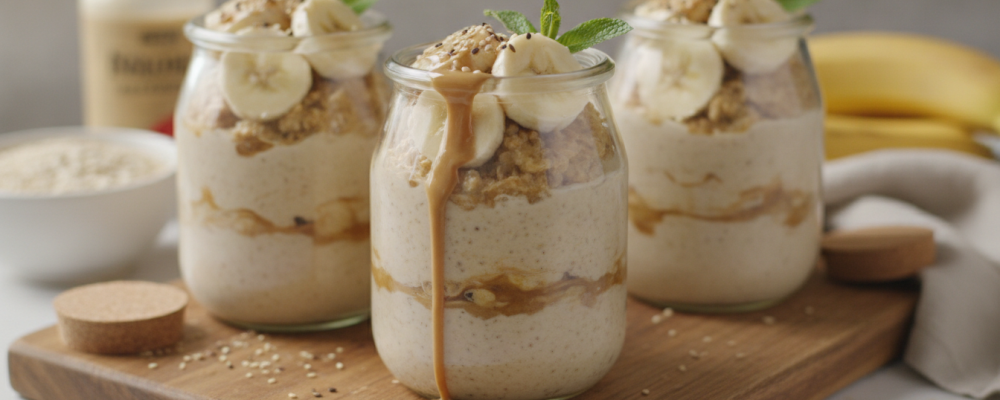
Optional: A thin drizzle of additional tahini over the surface of the jar before sealing—drawn into a swirl pattern with the tip of a spoon—creates a beautiful visible spiral of darker sesame paste against the lighter oat base that makes these jars as visually distinctive as the matcha jars, in a warmer, more golden register.
─────────────────────────────────────────
Portioning and Container Suggestions
This recipe fills four jars perfectly — one per day for a four-day breakfast rotation, or five days when the recipe is scaled by a quarter for a fifth serving. Wide-mouth 16-ounce mason jars are the ideal vessel for the same reasons they suit any overnight oat preparation: the wide opening allows easy stirring and eating, the glass allows the jar’s warm, golden-beige color to be visible through the walls, and the standard lid seals tightly enough to prevent any cross-contamination of flavor with neighboring refrigerator contents.
The visual of these jars is warm and specifically beautiful — the tahini and banana together produce a deeper, more golden color than plain overnight oats, and the chia seeds create a fine speckled texture throughout that makes the jar look more intentional and more considered than its five-minute prep time would suggest. The optional tahini swirl adds a decorative layer that transforms a functional meal prep jar into something that looks like it belongs in a café display case.
For toppings — which the recipe invites — sliced banana pressed into the surface immediately before eating adds fresh fruit character that contrasts with the overnight-mellowed banana incorporated in the base; a scattering of sesame seeds reinforces the tahini theme with a textural crunch; and a small drizzle of honey at the surface adds a floral sweetness that pairs naturally with both primary flavors. Any or all of these add under sixty seconds of morning effort and produce a jar that looks genuinely composed.
─────────────────────────────────────────
Storage, Reheating, and Shelf Life Tips
- Refrigerator storage: Sealed jars keep for up to 4 days. The tahini and banana flavors integrate more fully through days two and three — the flavor peak of this jar. The banana may develop a slightly darker color at the surface through oxidation — normal, purely cosmetic, and easily stirred back into the mixture.
- Banana browning: The natural enzymatic browning of banana accelerates once it is mashed and exposed to air. To slow this in storage, a small squeeze of lemon juice — no more than half a teaspoon per jar — stirred into the mixture before refrigerating significantly delays browning without affecting the flavor balance perceptibly at this concentration.
- Consistency on day four: By day four, the chia and banana pectin continue absorbing the mixture’s liquid, producing a very thick jar. Stir in a tablespoon of almond milk before eating to restore the original creamy consistency.
- Freezer storage: Not recommended for assembled jars — the banana’s cell structure collapses on freezing and produces a grainy texture that does not recover on thawing. The dry oat-chia mixture can be pre-portioned and frozen in individual bags, with tahini, banana, and almond milk added the night before eating.
- No reheating required: These jars are a cold breakfast by design. The tahini’s flavor is most forward and the jar’s pudding-like consistency most pleasing served directly from the refrigerator.
- Topping timing: Any crunchy toppings — sesame seeds, chopped nuts, granola — should be added immediately before eating to preserve their texture. Added to the sealed jar in advance, they absorb moisture from the oat base and soften entirely by serving time.
─────────────────────────────────────────
Why This Recipe Deserves a Spot in Your Meal Prep Rotation
The practical case for this jar is as clean as it gets: five minutes of Sunday assembly, four days of refrigerator stability, zero morning effort, and a nutritional profile — tahini’s healthy fats and protein, banana’s natural energy and potassium, oat fiber’s beta-glucan, chia’s omega-3s — that makes each jar genuinely, specifically nourishing alongside being genuinely, specifically delicious.
But the case I want to make is the flavor one, because it is the more interesting argument. Tahini and banana together produce a jar that tastes like something you have never had for breakfast before and immediately want to have again — the specific quality of a flavor combination that turns out to be a revelation rather than just a pleasant surprise. A breakfast rotation that includes this jar has something in it that is specifically itself, that could not be confused with any other overnight oat preparation in the collection, and that makes the morning genuinely worth opening the refrigerator for. That quality — the specific desire for a particular jar rather than the general need for any breakfast — is what keeps a recipe on the Sunday prep list indefinitely. This jar earns it. Make it.
─────────────────────────────────────────
Meal Prep Pairing Suggestions
Tahini Banana Overnight Oat Jars pair most naturally with overnight oat preparations that offer genuine contrast in flavor character and primary aromatic — ensuring the week’s no-cook jar mornings feel varied rather than returning to the same warm, nutty register every day. Our Peach Ginger Overnight Oat Jars are the natural companion within the overnight oat category — both are cool, creamy, fruit-forward no-cook jars, but peach-ginger’s floral stone-fruit brightness and warming ginger note occupy a completely different flavor register from tahini-banana’s rich, earthy, sesame-nuanced depth. The two jars share a format and a philosophy without sharing a single flavor note.
For a complete three-jar overnight oat rotation, our Coconut Matcha Overnight Oat Jars provide the vivid, earthy, visually dramatic third option — jade-green where the tahini jar is golden-warm, matcha-forward where this is banana-sweet, coconut-tropical where this is sesame-nutty. Three overnight oat jars covering warm-and-nutty, fruity-and-gingered, and earthy-and-floral: three genuinely distinct cold breakfast experiences, assembled across the same fifteen minutes of Sunday prep, and delivering a week of no-effort mornings that are each, specifically, worth looking forward to. That is what a well-designed overnight oat rotation looks like at its best. These three jars achieve it.
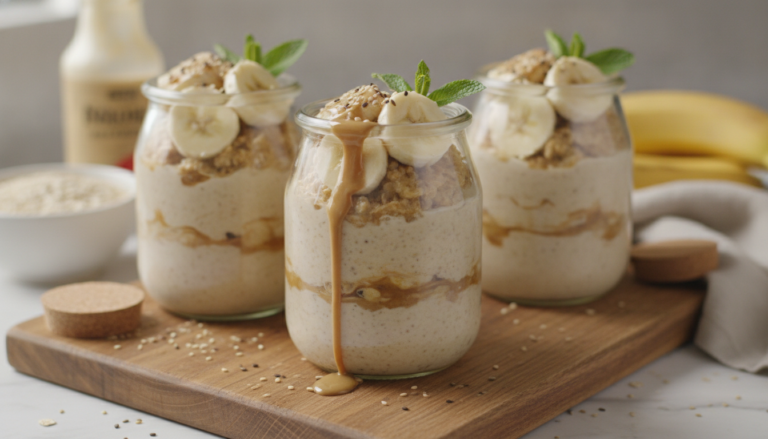
Tahini Banana Overnight Oat Jars
These Tahini Banana Overnight Oat Jars combine the natural sweetness of ripe mashed banana with the nutty, slightly bitter depth of tahini into a creamy, naturally thick overnight oat base that is both more interesting and more sustaining than any single-flavor overnight oat jar has a right to be.
4
servings30
minutes40
minutes300
kcal1
hour10
minutesIngredients
2 cups rolled oats
2 cups almond milk
2 tablespoons tahini
2 tablespoons maple syrup
2 large bananas, ripe
1 teaspoon vanilla extract
1 pinch salt
1 tablespoon chia seeds
Directions
- In a large bowl, combine rolled oats, almond milk, tahini, maple syrup, and vanilla extract.
- Mash the bananas and add to the oat mixture, stirring until fully combined.
- Add chia seeds and a pinch of salt, and mix well.
- Divide the mixture evenly into four jars or containers.
- Refrigerate overnight or for at least 4 hours.
- Serve chilled as is or with your choice of toppings like nuts or fruit.
Nutrition Facts
- Total number of serves: 4
- Calories: 350kcal
- Cholesterol: 0mg
- Sodium: 620mg
- Potassium: 400mg
- Sugar: 8g
- Protein: 6g
- Calcium: 60mg
- Iron: 2mg
About This Author

Aurora Wright
Pastry Chef & Dessert Editor
Aurora is the sweet side of Daily Dish. A trained pastry chef and dessert stylist, she’s responsible for our mouth-watering cakes, cookies, and confections. She brings precision, artistry, and a touch of whimsy to every recipe she creates — and taste-tests more chocolate than she’ll admit.
Favorite dish: Flourless dark chocolate torte.
Kitchen motto: “Life’s too short to skip dessert.”