
I want to make an argument for the date in this recipe that goes beyond its flavor contribution, because the date’s role here is structural as much as it is sensory, and understanding what it does to a baked cluster—specifically, what it does that honey alone cannot—is what makes this preparation more interesting than a standard spiced pepita cluster would be.
Honey in a baked cluster functions as the primary binding agent: its sugars caramelize around the seeds under heat, concentrate as their water content evaporates, and set into a glass-like matrix as they cool. This is the mechanism that makes any honey cluster hold together, and it produces a specific result: a crunch-dominant cluster with a clean, sweet, slightly caramelized coating at the surface of each seed.
A chopped date added to that same cluster does something additional and different. Dates—which are approximately 70% natural sugar by weight and contain significant amounts of pectin and fiber alongside that sugar—partially break down under oven heat at 325°F, releasing their moisture and natural sugars into the surrounding honey-spice coating while their fiber and pectin content adds viscosity to the binding matrix that honey alone does not provide. The result is a cluster where some of the binding is honey-caramel and some of it is concentrated date-caramel—two different types of caramelized sugar, at slightly different temperatures and with slightly different aromatic profiles, binding together into a cluster that is both crunchier at the seed-surface edges and chewier at the date-pocket centers than a honey-only preparation would be.
This textural complexity—crunchy pepita, chewy date, caramelized coating that is specifically neither—is what makes these clusters specifically worth eating rather than generically pleasant. The date is not a sweetener standing in for additional honey. It is a second binding agent and a textural variable that makes each cluster more interesting from the first bite to the last.
─────────────────────────────────────────
The Inspiration Behind This Recipe
The inspiration was an honest and straightforward one: autumn is the season that produces the most specific and the most beloved baking fragrance available, and pumpkin spice is the blend that encodes that fragrance—cinnamon’s warm sweetness, nutmeg’s faintly sharp depth, ginger’s citrusy warmth, allspice’s earthy complexity, cloves’ slightly medicinal intensity. All five of those aromatic compounds are fat-soluble, which means they require a fat phase to distribute effectively—and the coconut oil in this recipe’s coating provides exactly that fat phase, carrying every compound from every spice in the blend into contact with every seed and date surface before the baking process begins.
Pepitas were chosen as the seed base specifically for their flavor compatibility with pumpkin spice—a compatibility that is not coincidental. Pepitas are pumpkin seeds, and pumpkin spice was developed specifically to complement pumpkin’s mild, slightly earthy sweetness. Applying pumpkin spice to pumpkin seeds is, in the most literal sense, designing a flavor combination that was always meant to exist together. The pepita’s mild nuttiness and its slightly chewy, substantial texture provide the ideal backdrop for the spice blend’s aromatic complexity.
Medjool dates were the specific date variety that made the recipe work best during development, and they are worth specifying here rather than simply calling for “dates.” Medjool dates have a higher moisture content and a more caramel-forward natural sugar profile than smaller, drier varieties like Deglet Noor—they break down more completely during baking, releasing more of their concentrated sugar into the coating matrix and creating more pronounced date-caramel pockets within the finished cluster. Drier date varieties produce a less integrated result; the Medjool’s specific moisture and sugar composition is what produces the chewy-and-crunchy textural complexity this recipe is built around.
─────────────────────────────────────────
A Brief History of Pumpkin Spice
The pumpkin spice blend—cinnamon, nutmeg, ginger, allspice, and cloves—is an American creation with deep historical roots, developed in the mid-20th century by spice companies as a pre-mixed blend specifically designed for the spiced pumpkin preparations that had been a fixture of American autumn cooking since the colonial period. American pumpkin pie—itself a descendant of English spiced pumpkin preparations brought to the New World by early colonists—had relied on this specific combination of spices for centuries before it was formalized into a blend, and the blend’s commercial introduction simply codified what American bakers had already been using by instinct and individual preference for generations.
The individual spices in pumpkin spice each carry their own rich history within that colonial-era culinary tradition. Cinnamon arrived from Ceylon (modern Sri Lanka) through the British East India Company’s trade networks; nutmeg came from the Dutch-controlled Banda Islands of what is now Indonesia, where its value was so extraordinary that it drove one of the most violent episodes of the colonial spice trade; ginger traveled from South Asia through the Arab and Mediterranean trading networks; allspice is one of the few spice trade ingredients native to the Americas, discovered by Spanish colonizers in Jamaica and introduced into European and eventually American cooking through the Caribbean trade. Pumpkin spice is, in its ingredient composition, a map of the global trade networks that shaped colonial-era American cuisine.
The contemporary cultural significance of pumpkin spice—its association with autumn comfort, its enormous commercial presence as a seasonal flavor marker—reflects the deep emotional resonance of the spice combination itself: a blend that smells like warmth, like baking, like the specific indoor-fragrant quality of early autumn that is culturally understood as comfort across multiple generations of American culinary experience. That resonance is real, and it is why this cluster produces the response it produces when the oven opens.
─────────────────────────────────────────
Why This Cooking Method Works for Meal Prep
The 325°F baking temperature is the precise calibration for a cluster that contains both honey and date sugars as binding agents. Standard honey clusters bake effectively at 350°F because the single sugar phase concentrates and caramelizes at a predictable rate. A cluster with dates requires a lower temperature because dates’ fructose content—which makes up approximately half of their natural sugar—caramelizes at a lower temperature than glucose and sucrose, and begins to produce bitter browning compounds above 340°F before the honey caramelization has completed. At 325°F, both sugar sources caramelize at compatible rates: the honey concentrates gradually and the dates soften and release their sugars into the coating matrix without reaching the temperature at which they would burn at the edges.
The chopped date preparation—not whole, not pureed—is the format that produces the optimal cluster texture. Whole dates in a cluster bake unevenly—the exterior softens while the interior remains dense and under-caramelized. Pureed dates disperse completely through the coating and produce a uniformly sticky cluster without distinct date pockets. Finely chopped dates maintain enough structural integrity to create identifiable pockets of concentrated date-sweetness within the cluster while breaking down enough at their surfaces to release their sugars into the surrounding coating matrix. The chop is a textural and flavor specification, not simply a size preference.
Stirring the mixture halfway through the baking window serves the same redistributive function it serves in any cluster preparation—moving the more exposed peripheral pieces toward the center and the less-exposed interior pieces toward the edges—but is particularly important in a date-inclusive cluster because the date pieces at the pan’s edges are exposed to direct heat from both above and from the metal surface, and are at greater risk of burning before the cluster’s center has caramelized properly. A single deliberate stir at the midpoint of the baking window produces a batch where every component has developed equivalent caramelization depth.
─────────────────────────────────────────
Flavor Profile: What to Expect
These clusters are warmly aromatic, specifically autumnal, and texturally layered in a way that makes each cluster feel different from a simple spiced seed preparation:
- Warm, complex pumpkin spice – The defining aromatic of the entire cluster: the five-spice blend’s combined aromatic profile—cinnamon’s warmth, nutmeg’s depth, ginger’s brightness, allspice’s earthiness, cloves’ intensity—carried through the coconut oil’s fat phase and distributed through every element of the cluster in a way that makes the fragrance and the flavor inseparable
- Caramel-dark Medjool date – The textural and flavor surprise of each cluster: concentrated, deeply sweet, slightly sticky date pockets where the fruit has caramelized during baking into something closer to a soft, chewy confection than a piece of fruit—providing the chewiness that contrasts with the pepita’s crunch and the honey coating’s snap
- Honey caramel sweetness – The cluster’s primary binding medium: caramelized at the pepita surfaces into a clean, amber sweetness that is distinct from the darker, more complex date caramel adjacent to it—two types of caramelized sugar producing two slightly different textural events in the same cluster
- Toasted, mild pepita – The seed’s slightly grassy, mildly nutty character—deepened by the oven’s heat into something more specifically toasted—providing the crunchy structural element that the softer date and coating cannot provide
- Vanilla warmth – Threading through the entire coating with its bakery-like depth, amplifying the cinnamon’s sweetness and the date’s natural caramel character into something more cohesive and more intentional
- Flaky sea salt finish – Present in the coating as a contrast note that makes the sweet taste sweeter and the spice taste more complex—the balance element that prevents the cluster from reading as simply very sweet
The pumpkin spice’s fat-soluble aromatic compounds continue distributing through the coconut oil and date-caramel matrix during the cooling and subsequent storage periods. Day-two clusters are noticeably more aromatic and more evenly spiced than freshly cooled ones—the volatile compounds having had time to reach every surface rather than concentrating where the coating was most recently applied.
─────────────────────────────────────────
Tips for Making the Best Pumpkin Spice Pepita & Date Clusters
The date preparation and the temperature control are where this recipe rewards the most careful attention:
- Use Medjool dates – The moisture content and sugar composition of Medjool dates is specifically what produces the chewy, caramel-pocket texture this recipe is built around. Drier varieties produce a less integrated result with less pronounced date character in the finished cluster.
- Chop dates into approximately half-inch pieces – Larger pieces don’t break down sufficiently during baking and produce hard, under-caramelized inclusions; smaller pieces dissolve almost completely and lose their textural identity. Half-inch pieces are the size that produces the optimal balance of structural presence and surface caramelization.
- Coat very thoroughly before spreading – The pumpkin spice blend must reach every surface of every pepita and date piece before the pan goes into the oven. A full sixty seconds of tossing ensures complete coverage; spot-coated pepitas bake unevenly and produce a batch with inconsistent spice intensity.
- Watch the final five minutes carefully – Date sugars brown faster than honey alone and can cross from deep golden to burned in under two minutes at the end of the baking window. Check the clusters at the twenty-minute mark and remove when the pepitas are deep gold and the date pieces are darkened but not charred at the edges.
- Cool fully before breaking – This is consistent across all cluster preparations but is particularly important here because the date-caramel phase takes longer to set than honey-caramel alone. A minimum of fifteen minutes—twenty is better—allows both sugar phases to harden into their final structure. Clusters broken before full cooling will be sticky and will not hold their shape.
- Store at room temperature in a sealed container – The date’s hygroscopic nature makes these clusters sensitive to refrigerator humidity; refrigeration softens both the honey-caramel and the date-caramel phases within twenty-four hours. A sealed room-temperature container maintains both phases in their firm, handleable state.
Optional: A very light dusting of additional pumpkin spice over the cooled clusters before storing adds an extra aromatic layer at the surface that intensifies the fragrance when the container is opened — the first sensory impression of these clusters should be specifically and wonderfully of pumpkin spice, and the additional dusting ensures it.
─────────────────────────────────────────
Portioning and Container Suggestions
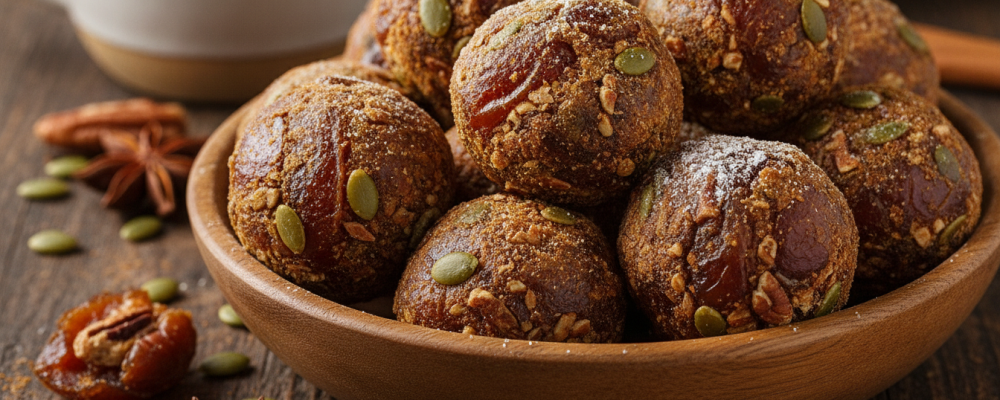
A standard batch yields approximately sixteen to twenty clusters of varying size depending on how generously the mixture is spooned — three to four clusters per serving as a satisfying snack, or one to two as a smaller treat alongside something else. The irregular, hand-broken shape of each cluster is one of its most appealing visual qualities: the visible pepita seeds and the darker date pieces distributed throughout produce a cluster that looks genuinely artisan — the kind of thing sold in small paper bags at very good farmers’ market booths for considerably more than it costs to make.
These clusters store best in a sealed glass jar or airtight tin at room temperature — away from direct sunlight and away from any moisture source. A glass jar on a counter or pantry shelf, its contents golden-green from the pepitas and dark-caramel from the date pieces, is one of the more beautiful snack storage visuals in the collection. It is also one of the more reliable indicators that a week is going to go reasonably well — a jar of something this specific and this good waiting on the counter makes Tuesday afternoon considerably easier to navigate.
For an entertaining presentation — and these clusters are absolutely appropriate for a host gift, a holiday tin, or an autumn gathering snack — arrange in a shallow bowl alongside a dusting of additional pumpkin spice over the surface and a small pile of additional pepitas for visual context. The warm gold of the toasted seeds against the darker date caramel and the orange-brown of the pumpkin spice is an immediately autumnal visual that requires no additional decoration.
─────────────────────────────────────────
Storage, Reheating, and Shelf Life Tips
- Room temperature storage (required): Keeps in a sealed airtight container for up to 7 days. The pumpkin spice aromatics deepen and the date-caramel phase becomes more cohesive through days two and three—the flavor peak of this preparation.
- Refrigerator storage: Not recommended. The date’s hygroscopic character makes these clusters sensitive to humidity; refrigeration softens the caramelized phases within twenty-four hours and produces sticky, unhandleable clusters. Room temperature in a sealed container is the only correct storage method.
- Re-crisping: If clusters have softened due to humidity exposure, spread on a parchment-lined baking sheet and warm at 300°F for four to five minutes. Cool completely before returning to storage—both the honey-caramel and date-caramel phases will re-harden as they cool and restore the original snap-and-chew texture.
- Freezer storage: Freeze well for up to 2 months in an airtight bag separated by parchment paper. Thaw at room temperature for twenty minutes—both caramelized sugar phases return to their original texture within this window.
- No reheating required: These are a room-temperature snack. The pumpkin spice aromatics and the date-caramel character are most forward at room temperature rather than when refrigerator-cold.
- Spice intensity over time: Pumpkin spice’s fat-soluble compounds continue distributing through the coconut oil and caramel phases during storage. A cluster on day three is more evenly and more deeply spiced than one on day one. This is an improvement rather than a degradation—plan for it.
─────────────────────────────────────────
Why This Recipe Deserves a Spot in Your Meal Prep Rotation
There are snack preps that belong in every season—the hummus cups, the energy bites, the roasted chickpeas that appear year-round with appropriate adjustments—and then there are snack preps that belong specifically and urgently to a particular moment in the calendar. These clusters belong to autumn. Not metaphorically, not approximately—the pumpkin spice blend is one of the most specific seasonal aromatic signatures in American culinary culture, and these clusters deliver it in a format that is portable, preservable, and genuinely delicious in the way that a pumpkin-spice-flavored coffee or a pumpkin-spice-scented candle can only aspire to.
They also earn their practical credentials: seven days at room temperature, two months in the freezer, a preparation time of under thirty minutes, and a flavor complexity—the interplay of honey-caramel and date-caramel, the pumpkin spice distributed evenly through coconut oil’s fat phase—that exceeds what the ingredient list suggests is possible from a single bowl and a baking sheet. That combination of seasonal specificity, genuine flavor complexity, and practical efficiency is the recipe for a snack that earns a permanent slot in the autumn prep rotation rather than being made once and photographed and forgotten. Make these. Make them every week that pumpkin spice still feels appropriate. The jar on the counter will tell you when to stop.
─────────────────────────────────────────
Meal Prep Pairing Suggestions
Pumpkin Spice Pepita & Date Clusters pair most naturally with snack preparations that offer contrast in flavor temperature and texture while sharing the same artisan-cluster format or the same seasonal snack character. Our Smoked Paprika Roasted Almonds & Dried Cherry Clusters make the ideal companion within the baked cluster category — both are honey-glazed, oven-baked clusters with a specific and considered flavor identity, but the paprika clusters’ smoky-savory-tart profile is the tonal opposite of these clusters’ warm, spiced, autumnal sweetness. Together they give a week’s snack rotation the full range of what a baked cluster can be — indulgently sweet and warmly spiced on one end, boldly savory and smoke-fruity on the other.
For a broader snack spread that extends the seasonal snacking category in a different direction, our Sunflower Seed & Date Protein Bites make a natural companion — both feature Medjool dates as a primary ingredient and both deliver the dates’ specific caramel depth and natural sweetness as a central flavor element, but the protein bites are no-bake and chewy-dominant where these clusters are baked and crunch-and-chew-complex. Two date-forward snack preparations covering different preparation methods, different textures, and different spice profiles give the week’s snacking a unified ingredient theme with enough variety in format and flavor to remain genuinely interesting every day it appears.
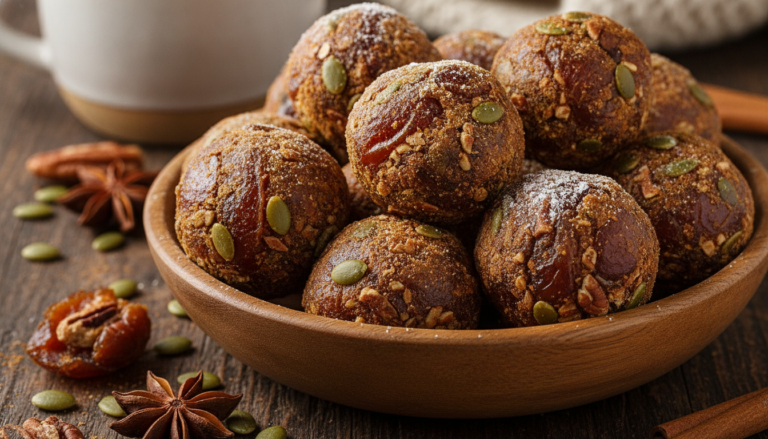
Pumpkin Spice Pepita & Date Clusters
These Pumpkin Spice Pepita & Date Clusters are a warmly spiced, oven-baked snack that uses dates as both a flavor ingredient and a second binding agent alongside honey—producing a cluster with a more complex, chewier texture and a deeper, caramel-date sweetness than a honey-only preparation can achieve.
10
servings15
minutes25
minutes180
kcal40
minutesIngredients
2 cups pepitas
1 cup dates, pitted and chopped
1 tsp pumpkin spice mix
2 tbsp honey
1 tbsp coconut oil, melted
1 tsp vanilla extract
1 pinch salt
Directions
- Preheat oven to 325°F (163°C).
- In a large bowl, combine pepitas and chopped dates.
- In a separate bowl, mix pumpkin spice, honey, melted coconut oil, vanilla extract, and salt.
- Pour the spice mixture over pepitas and dates; toss until well coated.
- Spread mixture evenly on a baking sheet lined with parchment paper.
- Bake for 20-25 minutes until golden brown, stirring halfway through.
- Let cool completely for 15 minutes before breaking into clusters.
Nutrition Facts
- Total number of serves: 4
- Calories: 180kcal
- Cholesterol: 0mg
- Sodium: 620mg
- Potassium: 400mg
- Sugar: 8g
- Protein: 6g
- Calcium: 60mg
- Iron: 2mg
About This Author

Aurora Wright
Pastry Chef & Dessert Editor
Aurora is the sweet side of Daily Dish. A trained pastry chef and dessert stylist, she’s responsible for our mouth-watering cakes, cookies, and confections. She brings precision, artistry, and a touch of whimsy to every recipe she creates — and taste-tests more chocolate than she’ll admit.
Favorite dish: Flourless dark chocolate torte.
Kitchen motto: “Life’s too short to skip dessert.”