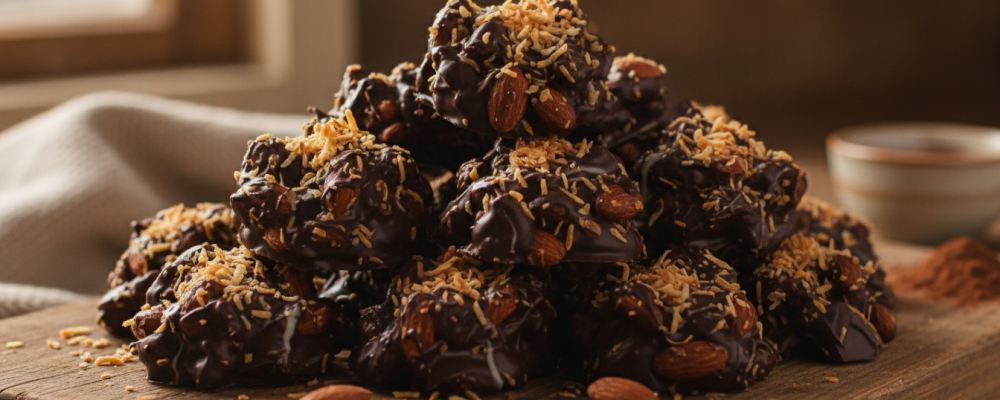

There is a case to be made — and I am making it — that the chocolate cluster is the most satisfying confection in the category of things that can be made in a home kitchen in under twenty minutes. Not the most impressive. Not the most technically demanding. The most satisfying, in the specific sense of producing the highest ratio of genuine pleasure to effort invested. A properly made chocolate cluster delivers everything: the snap of good dark chocolate, the crunch of toasted nuts, the chew of caramelized coconut, the finish of sea salt that makes the chocolate taste more fully of itself. It is a complete sensory experience in a spoonful-sized piece, and the fact that it requires a microwave and a baking sheet and fifteen minutes of a Sunday afternoon to produce is one of cooking’s more cheerful secrets.
What separates a good chocolate cluster from a mediocre one — and there are many mediocre chocolate clusters in the world — is the toasting. Raw almonds in chocolate taste exactly like what they are: raw almonds in chocolate. Almonds that have spent ten minutes at 350°F developing the Maillard reaction products that only heat can produce — the deep, slightly smoky, specifically roasted nuttiness that makes a toasted almond taste categorically more interesting than an untoasted one — taste like an entirely different ingredient. The same is true of the coconut flakes. Untoasted coconut in chocolate is mild and sweet and faintly tropical; toasted coconut in chocolate is golden and caramelized and specifically, memorably nutty-sweet in a way that makes the finished cluster taste as though someone with professional chocolate training put it together.
Someone with professional chocolate training did put this together. That person is recommending that you make it yourself on Sunday, because it is that easy.
─────────────────────────────────────────
The Inspiration Behind This Recipe
The inspiration was a chocolate shop — specifically the almond bark and chocolate cluster case at a very good chocolate shop that I have visited more times than I have any professional justification for. What those clusters had that most homemade chocolate preparations lack is textural dimension: the snap of chocolate that has been properly cooled, the specific crunch of a whole toasted almond against it, and the slightly chewy, caramelized resistance of toasted coconut that sits between the two. Each textural event arrives at a slightly different moment in the eating, which is what makes the cluster genuinely interesting from the first bite to the last rather than simply chocolate with things in it.
Recreating that textural dimension at home requires two things: toasting the inclusions before the chocolate meets them, and using coconut oil alongside the dark chocolate chips. The toasting I have already argued for extensively; the coconut oil deserves its own explanation. Coconut oil added to melted chocolate acts as a tempering agent — not in the strict technical sense of temperature-curve chocolate tempering, but in the practical sense of producing a chocolate coating that sets firmer and snaps more cleanly than chip chocolate melted alone. Chocolate chips contain stabilizers that produce a dull, soft set without the assistance of additional fat; coconut oil’s saturated fat structure integrates into the chocolate’s fat phase and promotes a more crystalline set that is visually glossier and texturally snappier than the raw chip result.
The sea salt at the finish is not decorative. It is the ingredient that makes the dark chocolate taste more fully of dark chocolate — the same principle that makes salted caramel more compelling than unsalted, or that makes a pinch of salt in any sweet preparation produce a result that is both sweeter and more complex than the unsalted version. Salt suppresses bitterness and amplifies sweetness simultaneously; at the concentration of a light surface pinch over dark chocolate, it produces a finishing note that registers as more chocolate rather than as salt. It is the detail that separates a cluster that is very good from one that makes people ask where you got it.
─────────────────────────────────────────
A Brief History of Chocolate Confections
Chocolate in its solid, confection form has a surprisingly recent history relative to the cacao plant’s ancient culinary use. The Olmec, Maya, and Aztec civilizations consumed cacao as a beverage for centuries — bitter, spiced, and cold — long before European contact transformed it into the sweetened, solid confection that defines contemporary chocolate culture. The addition of sugar and the development of the conching process that produces smooth, shelf-stable solid chocolate are both 19th century European innovations; the first chocolate bar as we recognize it was not produced until 1847 by the British company Fry’s.
The chocolate cluster — chocolate used as a binder and coating for nuts, dried fruits, and other inclusions — emerged as a confectionery format in the early 20th century alongside the broader commercialization of the chocolate industry. The combination of roasted nuts with chocolate was understood by chocolatiers from the earliest days of solid chocolate production: nuts’ fat content creates a natural affinity with chocolate’s own fat phase, producing a flavor and textural integration that no other inclusion material quite matches. The almond specifically — its buttery, mildly bitter roasted character — was identified early as an ideal chocolate companion, appearing in some of the oldest commercially produced chocolate confections and remaining one of the most popular inclusions in artisan chocolate production today.
The addition of coconut to the nut-and-chocolate cluster format reflects the 20th century expansion of the confectionery palette to include tropical ingredients as European and American chocolate makers gained access to global supply chains. Toasted coconut’s specific caramelized sweetness and chewy texture added a new dimension to the nut cluster format — providing a textural intermediary between the almond’s firm crunch and the chocolate’s smooth coating — and the combination became a staple of artisan chocolate shops across the latter half of the century. This recipe is the home kitchen translation of that tradition: the same three principal ingredients, the same fundamental technique, and the same specific satisfaction that has made the chocolate-almond-coconut cluster one of the most enduring confections in the artisan chocolate canon.
─────────────────────────────────────────
Why This Preparation Method Works for Meal Prep
The refrigeration-set method — spreading the chocolate cluster mixture onto parchment and refrigerating rather than baking or tempering — produces a result that is specifically well-suited to a weekly prep context because the cold sets the chocolate into a stable, handleable form that maintains its structural integrity at refrigerator temperatures through the full storage window. A properly refrigeration-set cluster will hold its shape cleanly when picked up, not leaving chocolate on the fingers at the temperatures of a climate-controlled environment, and will have the snap-and-yield texture that makes each bite specifically satisfying.
Toasting the almonds before adding them to the chocolate is the preparation decision that makes the biggest flavor difference and is most often skipped in convenience-focused recipes. At 350°F for ten minutes, the almond’s surface proteins and sugars undergo the Maillard reaction and produce dozens of new flavor compounds — specifically roasted, slightly smoky, and deeply nutty — that do not exist in the raw almond and that the chocolate cannot produce through its own melting and setting process. A toasted almond in chocolate tastes like an intentional combination; a raw almond in chocolate tastes like ingredients that happen to be in contact.
The coconut flakes used here should be toasted as well — this is not specified in the recipe directions but is a technique upgrade worth making. Spread coconut flakes alongside the almonds on the same sheet pan for the final four to five minutes of the almond’s toast, until they are pale golden and fragrant. The difference between raw coconut flakes in chocolate and toasted coconut flakes in chocolate is as dramatic as the almond difference — the raw flakes are mild and sweet; the toasted ones are caramelized, nutty, and specifically, beautifully golden in the finished cluster.
─────────────────────────────────────────
Flavor Profile: What to Expect
These clusters operate in a rich, specifically indulgent register — a flavor profile that is immediately, unambiguously of a very good chocolate shop:
- Bittersweet dark chocolate – The coating and binding medium: deep, complex, slightly bitter, and rich with the specific flavor compounds that distinguish high-quality dark chocolate from milk or semisweet — present as the flavor that arrives first and lingers longest
- Caramelized toasted almond – The crunch event: roasted, slightly smoky, and nutty in the specifically satisfying way that only a toasted almond is — providing both the textural anchor of the cluster and a flavor that amplifies the chocolate’s depth
- Golden toasted coconut – The chewy, caramelized middle note: mild, slightly sweet, and tropical in a way that is most perceptible as warmth and nuttiness rather than overt coconut flavor — the textural element that makes each bite more complex than a simple chocolate-nut cluster
- Coconut oil smoothness – Present in the chocolate’s fat phase as a promoter of a cleaner, more crystalline set — contributing a very faint tropical richness to the chocolate’s finish that is more perceptible as texture than as flavor
- Sea salt revelation – The surface finish that transforms the experience: suppressing the chocolate’s bitterness, amplifying its sweetness, and producing a final note that registers as specifically, completely chocolate — the detail that makes the cluster taste like something made by someone who knew what they were doing
The cluster’s flavor is at its most vivid within twenty-four hours of setting, when the chocolate’s crystalline structure is freshest and the toasted almonds’ aromatic compounds are most present. It remains excellent through the full week; the almonds’ crunch is stable and the chocolate’s flavor holds without significant degradation in a properly sealed, refrigerated container.
─────────────────────────────────────────
Tips for Making the Best Toasted Coconut Dark Chocolate Almond Clusters
The toasting and the sea salt application are where this recipe rewards the most care:
- Toast the almonds until genuinely golden – Pale, under-toasted almonds have developed only partial Maillard reactions and lack the deep, roasted nuttiness that makes the cluster worth making. The almonds should be visibly darker, fragrant when the oven is opened, and slightly shiny at the surface from the emerging oils. Watch them in the final two minutes — the difference between properly toasted and burned is narrow.
- Toast the coconut flakes as well – Spread coconut flakes on the same baking sheet for the final four to five minutes of the almond’s toast. Watch them carefully — coconut flakes toast significantly faster than almonds and can go from golden to burned in under sixty seconds. Pull them when they are pale gold and fragrant.
- Use good dark chocolate – The chocolate is the majority ingredient and the carrier of every other flavor in the cluster. Chocolate chips made with cheap cacao produce a flat, waxy cluster; good-quality dark chocolate chips or chopped bar chocolate with 60 to 70 percent cacao content produces a cluster with genuine depth. The quality difference is immediately perceptible.
- Let the chocolate cool slightly before adding inclusions – Very hot melted chocolate can cause the toasted almond’s surface oils to separate and produce a greasy, uneven coating. Allow the melted chocolate to cool for two to three minutes before stirring in the almonds and coconut — the mixture should be fluid but not steaming.
- Apply sea salt immediately after dropping – Flaky sea salt pressed lightly onto the surface of each cluster while the chocolate is still wet adheres and partially dissolves into the surface, producing a more integrated salt presence than salt pressed onto set chocolate. Timing matters; the window is approximately sixty seconds after dropping.
- Refrigerate until fully set – A minimum of thirty minutes in the refrigerator produces a cluster that is set but still slightly pliable; sixty minutes produces the firm, clean-snapping cluster that is the intended result. Do not attempt to peel clusters from the parchment before full setting — they will tear and lose their shape.
Optional: A very thin drizzle of additional melted white chocolate over the set clusters — drawn back and forth in fine lines across the surface — adds a visual elegance that transforms a home-kitchen preparation into something that looks genuinely artisan. It takes two minutes, requires melting a small amount of white chocolate separately, and produces a result that justifies every second of the effort.
─────────────────────────────────────────
Portioning and Container Suggestions
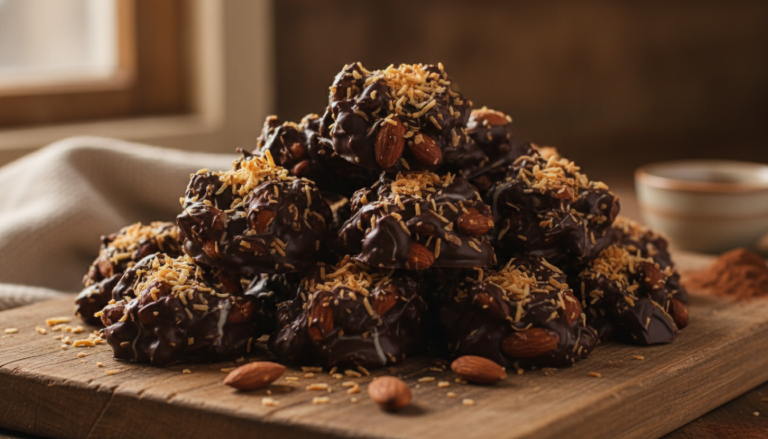
A standard batch yields approximately sixteen to twenty individual clusters depending on spoonful size — two to three clusters per serving as a snack, or one as a small dessert after a meal. The irregular, drop-formed shape of each cluster is one of its most appealing visual qualities: no two are quite the same size or profile, and the golden coconut flakes and toasted almonds are visible at different angles and ratios in each piece, making the collection look genuinely handmade in the way that pressed or molded chocolates never quite achieve.
These clusters store best in a sealed container in the refrigerator, where the dark chocolate maintains its snap and the toasted almonds’ crunch is preserved through the full week. At room temperature above 70°F, the chocolate will begin to soften and the clusters will lose their structural integrity — delicious but messy and no longer cleanly handleable. A cold cluster picked up cleanly from its container and eaten with a satisfying snap is the intended experience.
For an entertaining presentation — these clusters belong on a dessert board, a holiday tin, or a gift box as much as in a weekly snack rotation — arrange on a board or platter with a few additional toasted almonds scattered alongside, a small pile of sea salt flakes, and any of the optional white chocolate drizzle if prepared. The visual of dark, glossy clusters studded with golden coconut and almond against the white of flaky sea salt is one of those naturally beautiful confectionery compositions that requires no additional garnishing skill.
─────────────────────────────────────────
Storage, Reheating, and Shelf Life Tips
- Refrigerator storage: Keeps in a sealed airtight container for up to 2 weeks — one of the longest snack shelf lives in the collection. The chocolate maintains its snap and the toasted inclusions maintain their crunch across the full storage window.
- Room temperature storage: Acceptable in a cool kitchen (below 68°F) for up to 5 days. Above this temperature, the coconut oil’s lower melting point causes the chocolate coating to soften. The clusters remain edible but lose their snap and become difficult to handle cleanly.
- Freezer storage: Freeze exceptionally well for up to 3 months in an airtight container with parchment paper between layers. The chocolate’s crystalline structure is stable at freezer temperatures and returns to full snap after thirty minutes of thawing at room temperature.
- No reheating required: These are a cold or room-temperature confection. Heat would melt the chocolate coating and destroy the cluster’s structure entirely.
- Bloom note: If the clusters develop a pale, slightly dusty surface coating during refrigerator storage — particularly after temperature fluctuation — this is chocolate bloom: fat or sugar crystals migrating to the surface as the chocolate’s crystalline structure shifts. It is purely cosmetic and does not affect flavor. A brief return to room temperature or a gentle polish with a clean finger restores the gloss.
- Humidity note: Chocolate absorbs moisture readily, which accelerates bloom and can make the surface tacky. A sealed container is essential; a food-safe silica gel packet inside the container extends the glossy surface through the full storage window in humid climates.
─────────────────────────────────────────
Why This Recipe Deserves a Spot in Your Meal Prep Rotation
I want to make an argument that I have made before in this collection and that I believe more firmly every time I make it: a snack rotation that does not include something genuinely, unambiguously, specifically indulgent will eventually fail. Not because the practical, nutritious snacks are insufficient — they are not — but because the human appetite for genuine pleasure is a legitimate dietary consideration, and a prep rotation that does not account for it will be abandoned in favor of whatever chocolate is most conveniently available at the moment of wanting it. These clusters account for it. They are the indulgence that is already made, already portioned, and already better than anything you would impulsively reach for instead.
They are also, practically speaking, an outstanding snack investment: five ingredients, fifteen minutes of active preparation, two weeks of refrigerator life, three months of freezer life, and a per-cluster cost that is a fraction of what a comparable quality chocolate shop cluster would cost. The return on the Sunday afternoon investment is compounded over two weeks of access to something genuinely luxurious at the moment it is most wanted. That is the calculation that makes this recipe not just worth making but worth making every two weeks indefinitely — the math of pleasure and convenience arriving at the same excellent answer at the same time.
─────────────────────────────────────────
Meal Prep Pairing Suggestions
Toasted Coconut Dark Chocolate Almond Clusters pair most naturally with sweet snack preparations that offer genuine contrast in texture, format, and flavor register. Our Smoked Paprika Roasted Almonds & Dried Cherry Clusters make a compelling companion within the roasted nut cluster category — both are nut-based cluster snacks with a specific, carefully chosen flavor complexity, but the paprika clusters’ smoky-sweet-savory-tart profile occupies a completely different register from these clusters’ pure chocolate luxury. Together they give the week’s cluster snacking two genuinely different experiences — indulgent chocolate confection and bold sweet-savory roasted nut — that feel designed rather than repeated.
For a broader sweet snack ecosystem that covers different textures and satisfaction levels alongside the clusters’ pure chocolate richness, our Peanut Butter Oat Energy Squares provide the chewy, protein-forward option that sustains between meals in a way that a small chocolate cluster — however excellent — does not aspire to do. Three snack options covering pure chocolate luxury, sweet-savory roasted clusters, and chewy protein-dense squares means the week’s snacking has something for every appetite, every craving, and every hour of the afternoon. All three made on Sunday. All three genuinely worth eating. That is, by any honest measure, a very good snack week.
Toasted Coconut Dark Chocolate Almond Clusters
These Toasted Coconut Dark Chocolate Almond Clusters are a five-ingredient, no-bake chocolate confection that delivers the specific, irreplaceable pleasure of a good chocolate shop’s artisan cluster—homemade, in fifteen minutes, for a fraction of the cost.
12
servings15
minutes10
minutes210
kcal25
minutesIngredients
1 cup almonds
1 cup dark chocolate chips
0.5 cup toasted coconut flakes
1 tbsp coconut oil
0.25 tsp sea salt
Directions
- Preheat oven to 350°F (175°C) and line a baking sheet with parchment paper.
- Spread almonds evenly on the baking sheet and toast in preheated oven for about 10 minutes, stirring halfway through.
- Melt dark chocolate chips with coconut oil in a microwave-safe bowl or over a double boiler.
- Add toasted almonds and coconut flakes to the melted chocolate, stirring to coat completely.
- Drop spoonfuls of the mixture onto a lined baking sheet, sprinkle with sea salt, and refrigerate until set.
Nutrition Facts
- Total number of serves: 4
- Calories: 210kcal
- Cholesterol: 0mg
- Sodium: 620mg
- Potassium: 400mg
- Sugar: 8g
- Protein: 6g
- Calcium: 60mg
- Iron: 2mg
About This Author

Aurora Wright
Pastry Chef & Dessert Editor
Aurora is the sweet side of Daily Dish. A trained pastry chef and dessert stylist, she’s responsible for our mouth-watering cakes, cookies, and confections. She brings precision, artistry, and a touch of whimsy to every recipe she creates — and taste-tests more chocolate than she’ll admit.
Favorite dish: Flourless dark chocolate torte.
Kitchen motto: “Life’s too short to skip dessert.”