
I want to begin with an argument, because I feel strongly about it and I think it deserves to be made explicitly before we proceed to the recipe: a roasted strawberry is a categorically different ingredient from a fresh strawberry, and the difference between using one versus the other in a baked preparation is the difference between a pleasant cup and a genuinely extraordinary one.
A fresh strawberry in a muffin or a baked oat cup releases its water content during baking — the cell walls break down under heat and moisture escapes, leaving you with pale, slightly shrunken pieces of former strawberry that are still identifiably fruit-flavored but have lost most of what made them specifically strawberry. The surrounding batter often absorbs this released moisture and develops a slightly gummy texture at the points of contact. It is a known and accepted trade-off of baking with fresh berries, and most recipes account for it by managing expectations.
A roasted strawberry — hulled and quartered, tossed in honey, and subjected to twenty minutes at 375°F — has already undergone this transformation before it enters the batter. The water has already evaporated. The natural sugars have already caramelized against the hot pan surface. The honey has concentrated and lacquered the strawberry’s cut surfaces into something jammy, slightly sticky, and specifically, intensely flavored. What remains when you fold a roasted strawberry into a batter is not a water bomb waiting to detonate — it is a concentrated, caramelized piece of something that has been coaxed into its fullest possible expression of strawberry flavor. It holds its shape. It deepens the batter around it with its caramelized juices rather than waterlogging it. And in the finished cup, it appears as a jewel-toned, jammy pocket that is the most beautiful thing in the bite.
The extra twenty minutes of roasting time is not optional. It is the reason this cup exists.
─────────────────────────────────────────
The Inspiration Behind This Recipe
The inspiration was the specific experience of eating a roasted strawberry for the first time as a deliberate preparation rather than an accident — spreading fresh strawberries on a sheet pan for a different recipe and returning to find them twenty minutes later transformed: collapsed, slightly charred at the caramelized edges, swimming in their own concentrated ruby-red juices that smelled of warm honey and something almost floral that the raw fruit never produces.
The mascarpone was the obvious partner. Mascarpone — Italian fresh cream cheese, made by acidifying heavy cream into a smooth, silky, luxuriously fatty paste — is the dairy that the pastry world has always known belongs alongside cooked strawberries. It appears in tiramisu and in panna cotta and in the composed strawberry desserts of northern Italian patisserie because its mild, slightly sweet, extraordinarily rich creaminess is the perfect counterpoint to strawberry’s brightness — amplifying the fruit’s flavor rather than obscuring it, providing a creaminess that lighter dairy cannot match. A dollop of mascarpone pressed into each oat cup before baking creates a cream-filled pocket at the cup’s center that softens further during baking — becoming warm, slightly molten, and distributed through the surrounding oat crumb in a way that makes each bite that reaches it specifically luxurious.
The cinnamon and vanilla in the oat base are the flavor decisions that tie the roasted strawberry and the mascarpone into a coherent whole. Cinnamon’s warm, slightly sweet spice amplifies strawberry’s fragrant character in the same way it amplifies apple — making the fruit taste more specifically of itself by providing a background warmth against which the fruit’s brightness registers more vividly. Vanilla’s bakery depth rounds every other flavor into something cohesive and familiar and deeply pleasant. Together they make the oat base an active flavor component rather than merely a structural one.
─────────────────────────────────────────
A Brief History of Mascarpone in Pastry
Mascarpone is one of Italy’s most luxurious and most versatile dairy products — a fresh cream cheese produced by acidifying heated heavy cream with tartaric acid or citric acid, then allowing the curds to drain into the impossibly smooth, silky, high-fat paste that distinguishes it from every other fresh cheese available. Its origins are in the Lombardy region of northern Italy, where it has been produced since at least the late Renaissance — some food historians place its first documented references in the 16th century, where it appears in the dairy preparation records of the region’s agricultural estates as a luxury product made from the cream skimmed from the richest milk of the season.
Mascarpone’s extraordinary fat content — typically 60 to 75 percent — is what makes it behave differently from every other fresh cheese in a baked or cooked context. Unlike ricotta, which coagulates firmly under heat and produces a set texture, mascarpone’s high fat content prevents full coagulation at moderate baking temperatures — it softens and spreads rather than setting, creating the warm, creamy pocket in each baked cup that is this recipe’s most distinctive quality. This behavior also makes mascarpone one of the most effective flavor carriers in pastry — its fat phase absorbs and distributes surrounding flavors with a completeness that lower-fat cheeses cannot match, which is why every bite of a baked cup that reaches the mascarpone pocket carries more concentrated roasted strawberry and cinnamon character than the surrounding oat crumb.
The pairing of mascarpone with strawberry specifically has deep roots in Italian pastry tradition — fragole con mascarpone, a simple preparation of fresh strawberries with a spoonful of mascarpone sweetened with sugar and lemon, is one of the most classic and most beloved Italian spring desserts. This baked oat cup is the meal-prep-friendly transformation of that tradition: the same essential flavor logic — strawberry’s brightness against mascarpone’s luxury — translated into a format that preps on Sunday and delivers its pleasure all week.
─────────────────────────────────────────
Why This Cooking Method Works for Meal Prep
The two-stage preparation — roasting the strawberries first, then baking them into the oat cups — is the method that makes this recipe perform significantly better than a single-step approach across the meal prep window. The pre-roasting step removes the vast majority of the strawberries’ water content before it can interact with the oat batter, which means the finished cups have a more consistent, less gummy texture than cups made with fresh berries — and that texture advantage is compounded over the storage window, because cups with drier, more caramelized fruit components hold their structural integrity through refrigeration and reheating more reliably than those with moisture-releasing raw fruit embedded in them.
The mascarpone placement — pressed into the center of the raw batter rather than folded through it — is the assembly decision that creates the creamy pocket rather than a uniformly mascarpone-flavored cup. Mascarpone folded through the entire batter distributes its fat through every part of the mix but creates no specific textural event; mascarpone pressed as a distinct dollop into the center of each cup remains a coherent, identifiable pocket during baking, softening and spreading gently through the adjacent oat crumb while maintaining enough distinction that bites encountering it are specifically, luxuriously creamier than the surrounding cup. That textural surprise — the specific moment of reaching the mascarpone — is what makes this recipe worth making rather than simply worth eating.
The roasted strawberries used as a topping — the half reserved for the surface of each cup — caramelize further against the cup’s surface during baking, creating a burnished, slightly sticky top layer that is visually beautiful and specifically flavored: more concentrated and more complex than the strawberries folded into the batter, which have been somewhat protected from direct heat by the surrounding oat matrix.
─────────────────────────────────────────
Flavor Profile: What to Expect
These cups are warm, fruity, and indulgently creamy — a flavor profile that is simultaneously more complex than a standard baked oat cup and more immediately satisfying:
- Caramelized, jammy roasted strawberry – The defining flavor of the entire cup: intensely fruity, slightly sticky, with the specific complexity that caramelization adds to strawberry’s natural brightness — present in both the embedded fruit pockets and the burnished surface layer
- Honey depth – The roasting honey concentrates and caramelizes alongside the strawberries, contributing a floral sweetness that is more complex and more specifically flavored than sugar and that carries the strawberry’s aromatic character throughout the cup
- Warm mascarpone creaminess – The textural and flavor event at the cup’s heart: mild, slightly sweet, extraordinarily rich, and distributed through the adjacent crumb in a way that makes every bite that encounters it luxuriously different from those that don’t
- Warm cinnamon spice – The aromatic backdrop that amplifies the strawberry’s fragrance and gives the oat base a specifically warm, bakery character rather than a neutral grain flavor
- Soft vanilla warmth – Threading through every component and rounding the mascarpone’s richness and the strawberry’s brightness into something cohesive, comfortable, and specifically of a well-made baked thing
- Wholesome oat body – The mild, slightly grassy structure that gives the cup its satisfying weight and its nutritional substance without competing with the more specific flavors above it
The roasted strawberry’s caramelized character and the mascarpone’s cream both deepen and integrate more fully with the oat crumb overnight. Day-two cups are measurably more cohesive in flavor than freshly baked ones — the cup’s components having had time to establish a more unified flavor conversation that makes each bite taste more specifically of the whole preparation.
─────────────────────────────────────────
Tips for Making the Best Roasted Strawberry Mascarpone Baked Oat Cups
The roasting step and the mascarpone placement are where this recipe rewards the most careful attention:
- Roast strawberries until genuinely caramelized – Twenty minutes at 375°F is the minimum for proper caramelization. The strawberries should be soft, slightly collapsed, and visibly darker at the cut surfaces with caramelized honey pooling around them on the parchment. Underroasted strawberries still contain too much water and will make the finished cup gummy at the contact points.
- Use the roasting juices – The caramelized honey and strawberry juice that accumulates on the parchment during roasting is flavor-concentrated liquid that should be folded into the batter along with the strawberries. Discard it and you discard some of the most intensely flavored liquid in the recipe.
- Use full-fat mascarpone at room temperature – Cold mascarpone is stiff and will sit as a hard, unmelted disc in the center of the cup rather than softening and spreading during baking. Room-temperature mascarpone is pliable, integrates with the surrounding oat crumb during baking, and produces the warm, creamy pocket this recipe is built around.
- Press the mascarpone gently but deliberately – The dollop should be pressed just below the surface of the batter — not resting on top — so it is enclosed by the oat matrix on all sides during baking. Surface mascarpone can brown or separate; enclosed mascarpone softens into a cream-filled pocket that is the cup’s defining quality.
- Reserve exactly half the strawberries for the top – The surface roasted strawberries caramelize further during baking and become the cup’s most visually striking element. Too few and the surface looks sparse; the even half-and-half split produces the generous, jewel-studded surface that makes these cups so visually compelling.
- Cool in the tin – Mascarpone cups need ten minutes of rest before removal. The mascarpone pocket is still warm and slightly liquid immediately out of the oven; cooling firms it into a set, sliceable creaminess that holds the cup’s structure cleanly.
Optional: A drizzle of additional honey over the warm cups immediately after baking — before the surface strawberries have fully set — creates a glossy lacquer over the caramelized fruit that is as beautiful as anything in this collection and adds a final concentrated sweetness at the first bite.
─────────────────────────────────────────
Portioning and Container Suggestions
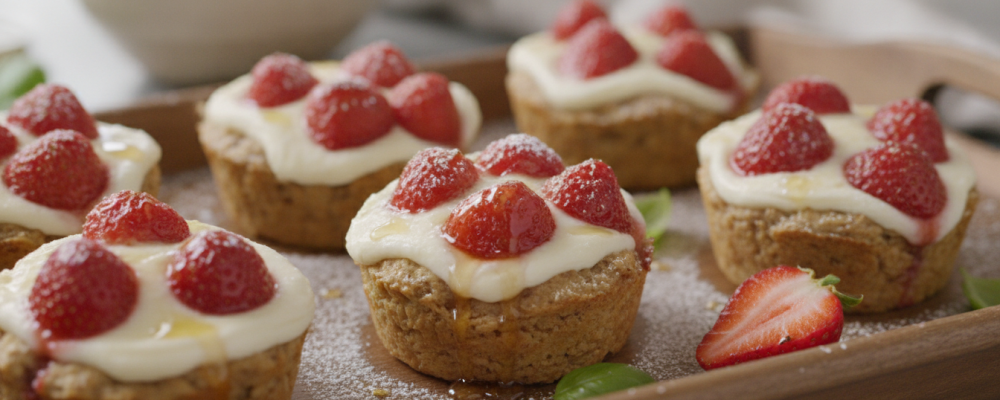
This recipe produces eight individual cups — two to three per serving as a breakfast portion, or one as a dessert. The cups’ visual appeal is exceptional: golden-domed surfaces with caramelized strawberry pieces visible and slightly burnished, occasionally a glimpse of the mascarpone-warmed crumb where the cup’s surface has opened slightly during baking. A container of four of these in the refrigerator is one of the most appealing meal prep sights in the collection.
Store in a wide, flat airtight container with parchment paper between layers. The mascarpone pocket’s residual moisture makes these cups slightly more fragile than standard baked oat cups, so the parchment separation between layers is essential for preventing surface adhesion and protecting the caramelized strawberry topping from compression damage. Keep liners on through the storage window — they support the cup’s structure during handling and prevent moisture absorption at the sides.
For a brunch presentation worthy of the cups’ visual quality, arrange on a board dusted with powdered sugar, with a few additional fresh strawberries halved alongside and a small pot of additional mascarpone for spooning. The composition is simple, requires thirty seconds, and produces something that looks as though it arrived from a very considered patisserie counter. The roasted strawberries on top have already done all the visual work.
─────────────────────────────────────────
Storage, Reheating, and Shelf Life Tips
- Refrigerator storage: Keeps in an airtight container for up to 4 days. The roasted strawberry and mascarpone flavors integrate more fully through days two and three — the peak flavor window. The mascarpone pocket firms in the refrigerator but softens again beautifully with gentle reheating.
- Freezer storage: Freeze well for up to 2 months. Cool completely, keep liners on, and wrap each cup in plastic wrap before transferring to a labeled bag. The mascarpone’s high fat content is freeze-stable; the roasted strawberries retain their jammy character after thawing.
- Oven reheating (strongly recommended): Place on a baking sheet at 325°F for 8–10 minutes from refrigerated. This method warms the mascarpone pocket back to a soft, creamy state and releases the strawberry and cinnamon aromatics in a way that makes each reheated cup smell as good as it did when first baked. The surface strawberries regain a slight shine under oven heat.
- Microwave reheating: Wrap in a damp paper towel and microwave at 50% power for 45–60 seconds. Lower power prevents the mascarpone from overheating and separating; the damp towel prevents the cup’s surface from drying. The oven method produces a significantly better result for this recipe specifically.
- Room temperature serving: These cups are genuinely beautiful at room temperature — the mascarpone’s creaminess is most forward when not cold, and the roasted strawberry’s flavor is most vivid without refrigerator suppression. Bring to room temperature for twenty minutes before eating for the most luxurious version of this cup.
- Mascarpone note: If the mascarpone pocket appears to have separated or become grainy in storage, this indicates the cheese was heated too aggressively. Low-and-slow oven reheating prevents this; full-power microwaving can cause it. The oven is always the correct reheating method for any cup containing mascarpone.
─────────────────────────────────────────
Why This Recipe Deserves a Spot in Your Meal Prep Rotation
I make the case for indulgence in meal prep whenever the opportunity presents itself, because I believe — genuinely and professionally — that a breakfast rotation without something genuinely luxurious in it is a breakfast rotation that eventually gets abandoned. The Roasted Strawberry Mascarpone Baked Oat Cup is the luxury entry in any week it appears, and it earns that designation honestly: the roasted strawberry technique requires twenty extra minutes on Sunday that produce a categorically better ingredient; the mascarpone adds a richness and a textural event that makes breakfast feel like something worth slowing down for; and the finished cup is beautiful in a way that makes opening the refrigerator a small pleasure rather than merely a practical act.
It also earns its place on every practical ground: four days of storage, a freezer life of two months, a protein return from the egg and mascarpone that exceeds most baked oat preparations, and a preparation that — including the strawberry roasting time — takes under an hour from start to oven. But the reason to make it every week is not the practicality. The reason to make it every week is the mascarpone pocket, warm from the oven on a Sunday morning, and the specific quality of a breakfast that tastes like someone understood that mornings deserve something genuinely good. These cups understand that. They are genuinely good. Make them.
─────────────────────────────────────────
Meal Prep Pairing Suggestions
Roasted Strawberry Mascarpone Baked Oat Cups pair most naturally with baked breakfast preparations that offer genuine contrast in fruit character and dairy base — ensuring the week’s warm breakfasts feel varied rather than returning to the same strawberry-cream register every day. Our Blackberry Lavender Baked Ricotta Oat Cups are the natural companion within the fruit-and-fresh-dairy-cheese baked oat category — both are warmly spiced baked oat cups with a specific, beautiful fruit and a fresh-dairy-cheese pocket at their center, but lavender-blackberry’s cool, floral, dark-berry depth is completely distinct from these cups’ warm, jammy, cream-rich strawberry character. Together they give the baked fruit-and-cheese oat cup format two different seasonal and flavor identities across the same week.
For a complete three-breakfast rotation, our Golden Milk Baked Oat & Almond Cups round out the week with a spiced, nut-forward baked oat cup in a turmeric-and-almond direction — completely dairy-free and less fruit-forward than either of the fresh-cheese cups, providing a nutritionally different and aromatically distinct breakfast for the days when something lighter and more warmly spiced is the right morning call. Three baked oat cups — roasted strawberry and cream, blackberry and lavender, golden turmeric and almond — assembled across one Sunday baking session and delivering the most beautiful, most varied, and most genuinely indulgent baked breakfast rotation in the collection. A week with all three is, by any honest reckoning, a very good week.
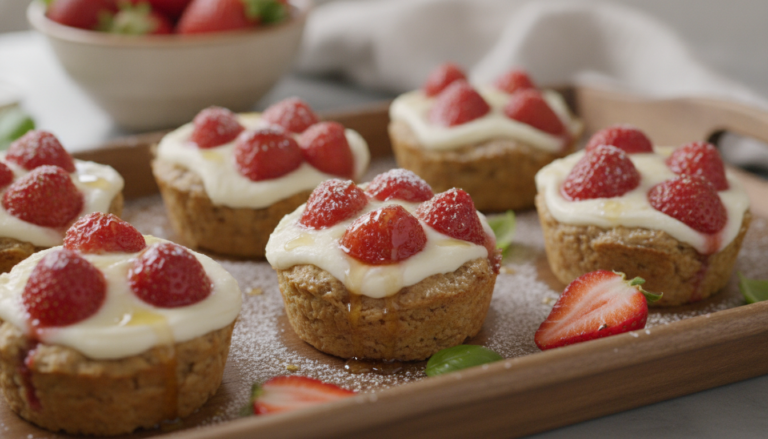
Roasted Strawberry Mascarpone Baked Oat Cups
These Roasted Strawberry Mascarpone Baked Oat Cups begin with strawberries slow-roasted in honey until caramelized and jammy, then fold them into a cinnamon oat batter with a dollop of mascarpone pressed into each cup—producing a baked breakfast that is simultaneously wholesome and genuinely indulgent.
8
servings20
minutes30
minutes250
kcal50
minutesIngredients
1 cup strawberries, hulled and quartered
2 tablespoons honey
2 cups rolled oats
1 teaspoon baking powder
1/2 teaspoon ground cinnamon
1/4 teaspoon salt
1 cup milk
1 large egg
1 teaspoon vanilla extract
1/2 cup mascarpone cheese
Directions
- Preheat the oven to 375°F (190°C). Line a baking sheet with parchment paper.
- Toss the strawberries with honey and spread on the prepared baking sheet.
- Roast strawberries for 20 minutes, stirring halfway through, until soft and caramelized.
- In a large bowl, combine oats, baking powder, cinnamon, and salt.
- In another bowl, whisk together milk, egg, and vanilla extract.
- Pour the wet ingredients into the dry and mix until combined.
- Fold in half of the roasted strawberries along with any juices.
- Grease a muffin tin and divide the oat mixture evenly among 8 cups.
- Add a dollop of mascarpone cheese to each cup, gently pressing it down.
- Top with the remaining roasted strawberries.
- Bake for 25-30 minutes or until the tops are golden and firm.
- Allow to cool before removing from the tin. Serve warm or at room temperature.
Nutrition Facts
- Total number of serves: 4
- Calories: 250kcal
- Cholesterol: 0mg
- Sodium: 620mg
- Potassium: 400mg
- Sugar: 8g
- Protein: 6g
- Calcium: 60mg
- Iron: 2mg
About This Author

Aurora Wright
Pastry Chef & Dessert Editor
Aurora is the sweet side of Daily Dish. A trained pastry chef and dessert stylist, she’s responsible for our mouth-watering cakes, cookies, and confections. She brings precision, artistry, and a touch of whimsy to every recipe she creates — and taste-tests more chocolate than she’ll admit.
Favorite dish: Flourless dark chocolate torte.
Kitchen motto: “Life’s too short to skip dessert.”