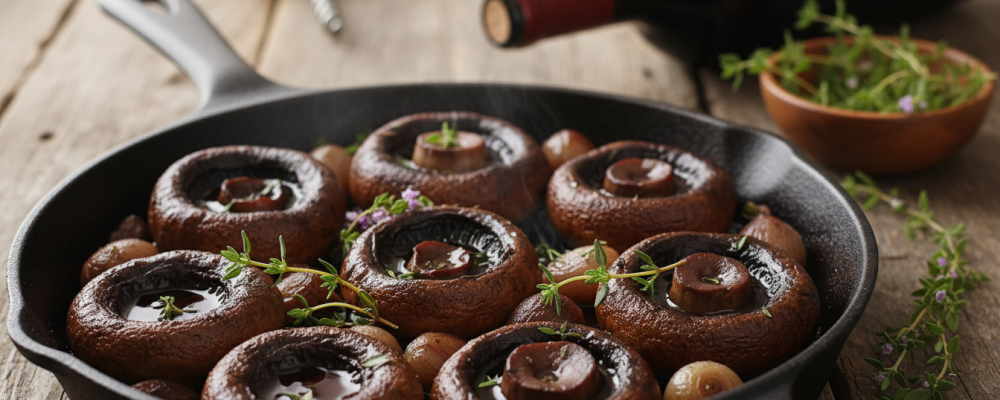

There’s something genuinely remarkable about what red wine does to a portobello mushroom in the oven. What begins as a simple preparation—brushed with garlic olive oil, drenched in wine, scattered with thyme—transforms over 20 minutes into something that tastes far more complex and luxurious than the sum of its parts. The wine reduces into the mushroom’s deep gills, concentrating its flavors while the mushroom releases its own juices, creating a symbiotic sauce that’s earthy, aromatic, and deeply satisfying. This is cooking that trusts ingredients to do the work.
From a culinary science perspective, what’s happening here is fascinating. Portobello mushrooms are essentially flavor sponges—their porous, gill-covered caps absorb liquids readily while releasing their own moisture during cooking. The red wine’s acidity breaks down cell walls slightly, helping the mushroom become more tender while the wine’s tannins, fruit compounds, and color pigments permeate the flesh. Roasting in a hot oven accelerates evaporation, concentrating the wine and mushroom juices into a glaze that coats each gill with intensity. The garlic softens and caramelizes, the thyme’s essential oils bloom in the heat, and everything comes together in that small ceramic dish with remarkable efficiency.
What makes portobello mushrooms particularly interesting as a culinary ingredient is their exceptional umami content. They’re rich in glutamates—the compounds responsible for the savory, mouth-coating quality we associate with meat, aged cheese, and fermented foods. When you add red wine (also rich in certain flavor compounds that trigger savory perception) and allow them to roast together, you’re creating a layered umami bomb that satisfies in ways that vegetables rarely do. This is why portobello mushrooms work so well as a meat substitute—not because they taste exactly like meat, but because they trigger similar satisfaction responses.
From a wine pairing standpoint, mushrooms are among the most wine-friendly vegetables in existence. Their earthy character echoes the terroir-driven qualities of certain wines, particularly Pinot Noir, which often exhibits mushroom and forest floor notes naturally. Cooking with red wine creates a direct bridge to drinking it—the same compounds appear in both the dish and the glass, creating a harmonious conversation rather than a conversation with two people talking past each other.
─────────
The Inspiration Behind This Recipe
This recipe draws from French and Italian traditions of cooking vegetables in wine—specifically the French approach to champignons au vin and Italian preparations where mushrooms are braised with wine and herbs. Both culinary traditions recognize that wine doesn’t just add flavor; it fundamentally transforms ingredients through its acidity, alcohol, and aromatic compounds. The portobello mushroom, while a relatively modern cultivar (developed commercially in the 1980s from brown crimini mushrooms), fills the role of the large, meaty mushrooms that Mediterranean cooks have prepared with wine for centuries. Fresh thyme connects this recipe to both French and Italian herb traditions, where the herb’s aromatic, slightly floral character complements earthy vegetables beautifully. Together, these elements create a dish that feels deeply rooted in European cooking while remaining refreshingly simple.
─────────
A Brief History of Portobello Mushrooms
The portobello mushroom has a surprisingly recent culinary history despite its current status as a gourmet staple. It’s actually the fully mature form of the crimini mushroom (Agaricus bisporus), allowed to grow to 4-6 inches in diameter rather than harvested young. While these large brown mushrooms existed in nature, they were largely ignored commercially until the 1980s when a savvy marketing campaign rebranded them from “overgrown criminis” to “portobello mushrooms”—a name that evoked Italian sophistication and commanded premium prices. The strategy worked brilliantly, transforming an overlooked ingredient into a gourmet staple. Their meaty texture and robust umami flavor made them ideal for vegetarian preparations during the 1990s health-food movement, and they’ve remained beloved ever since. The practice of cooking mushrooms with wine, however, dates back centuries in European cuisine, where wine’s preservative and flavor-enhancing properties made it a natural cooking medium.
─────────
Why This Cooking Method Works
The science behind the technique:
- Gill-side up positioning: Allows wine to pool in the mushroom’s natural cup, maximizing absorption and flavor infusion
- Garlic-oil brushing: Fat carries garlic’s fat-soluble flavor compounds into mushroom flesh while promoting browning
- Red wine acidity: Breaks down cell walls slightly, tenderizing mushrooms while providing flavor
- Oven roasting at 375°F: Gentle enough to cook mushrooms through without burning wine sugars; allows even moisture evaporation
- Wine reduction: As liquid evaporates, flavors concentrate exponentially, creating intensely flavored glaze in the gills
- Mushroom moisture release: Portobellos release significant moisture during cooking, which combines with wine to create sauce
- Thyme aromatics: Roasting releases essential oils from thyme that permeate the dish
- Maillard reaction on edges: Mushroom edges caramelize during roasting, adding complexity
- Stem removal: Creates deeper cup for wine pooling and more even cooking surface
─────────
Flavor Profile: What to Expect
Earthy • Savory • Wine-Forward • Aromatic • Umami-Rich
These portobello mushrooms deliver deep, complex flavors that exceed their simple preparation. The mushrooms become deeply tender with concentrated, intensely earthy character. The red wine reduces into their gills, creating a savory, slightly fruity sauce that’s simultaneously rustic and sophisticated. Caramelized garlic adds sweet, nutty depth, while fresh thyme provides aromatic, slightly floral brightness that lifts the earthiness. The overall effect is remarkably meat-like in its satisfaction—substantial, savory, and deeply flavored without being heavy. A slight acidity from the wine keeps everything balanced and vibrant. Whether eaten alone or alongside other dishes, every bite delivers complex, layered flavor that makes these portobellos genuinely memorable.
─────────
Tips for Making the Best Portobello Mushrooms with Wine and Thyme
Mushroom selection and preparation:
- Choose large, firm portobellos with intact caps and deep, dark gills
- Avoid mushrooms with slimy texture or strong, unpleasant odor
- Clean with a damp paper towel rather than rinsing—mushrooms absorb water and can become waterlogged
- Remove stems by pushing them gently sideways until they snap off cleanly
- Save stems for stocks, soups, or finely chopped into stuffings
- Score the cap surface lightly with a knife for better flavor penetration if desired
Maximizing flavor:
- Use red wine you’d actually drink—the flavor concentrates significantly during roasting
- Choose a medium-bodied wine that won’t overpower (Pinot Noir, Côtes du Rhône, Merlot)
- Don’t skimp on garlic—it mellows and sweetens beautifully during roasting
- Fresh thyme is preferred over dried—the difference in aromatics is noticeable
- Be generous with salt—mushrooms can handle and need more seasoning than you might expect
- Allow the wine to pool generously in the gills; don’t worry about overflow into the baking dish
Baking technique:
- Use a snug baking dish where mushrooms fit closely together
- This prevents wine from spreading too thin and ensures proper braising
- Don’t cover the dish—you want evaporation and concentration, not steaming
- Check at 15 minutes—smaller caps cook faster than large ones
- Mushrooms are ready when completely tender when pierced with a knife and wine has reduced to a glossy glaze
- For extra richness, add a pat of butter to each mushroom in the final 5 minutes
Serving versatility:
- As a main: Serve on toasted sourdough or polenta with the pan juices spooned over
- As a side: Pair alongside grilled or roasted proteins
- As a starter: Slice and fan on a plate, drizzle with reduced pan juices
- As a topping: Slice and serve over pasta, risotto, or grain bowls
─────────
Wine Pairing Guide
Perfect pairings for Portobello Mushrooms with Wine and Thyme:
Pinot Noir (Burgundy or Oregon) ★ Best Match The classic mushroom pairing—Pinot Noir naturally exhibits earthy, mushroom, and forest floor notes (sous bois) that create extraordinary harmony with portobello’s umami richness. The wine’s bright acidity complements the red wine in the sauce, while its delicate tannins won’t overpower. Burgundian Pinot offers more earthiness and restraint; Oregon Pinot brings riper fruit with similar elegance.
Côtes du Rhône Grenache-based blend with red fruit flavors, herbal notes, and earthy character that echoes both the mushrooms and the thyme. The wine’s medium body and soft tannins make it wonderfully food-friendly, while its rustic character feels authentic with this simple, honest preparation.
Barbera d’Alba High acidity and bright cherry fruit with earthy undertones make this Italian red a natural match for wine-braised mushrooms. The wine’s acidity cuts through the richness of the garlic oil while complementing the concentrated wine reduction.
Merlot (Cooler Climate) Plum and black cherry flavors with subtle earthy notes and soft tannins. Cooler-climate styles (from Washington, France’s Right Bank, or Chile) offer more herbaceous, earthy character that resonates with portobello’s depth. The wine’s smoothness makes it crowd-pleasing without sacrificing food-friendliness.
Grenache (Various) Medium-bodied with red fruit, herbal notes, and subtle spice. The grape’s naturally low tannins make it gentle with vegetables while its fruit depth complements both the mushrooms and the wine used in cooking.
Alternative pairing: For white wine lovers, a full-bodied Chardonnay (lightly oaked, Burgundian style) provides enough weight and complexity to complement mushroom umami while adding a different dimension to the pairing—buttery notes contrasting earthy mushrooms in interesting ways.
─────────
Serving Suggestions and Side Pairings
Beautiful presentations:
- Vegetarian main: Serve over creamy polenta or toasted sourdough, spoon pan juices over generously, add shaved Parmesan
- Elegant starter: Slice on the bias, fan on plates, drizzle with reduced pan juices, scatter fresh thyme
- Rustic side dish: Serve whole from the baking dish alongside grilled protein
- Over pasta: Slice and toss with pasta, pan juices, and extra olive oil for quick weeknight dinner
Ideal accompaniments:
- Garlic Rosemary Focaccia Muffins: Perfect for soaking up the wine-infused juices
- Creamy polenta: Classic pairing that absorbs pan juices beautifully
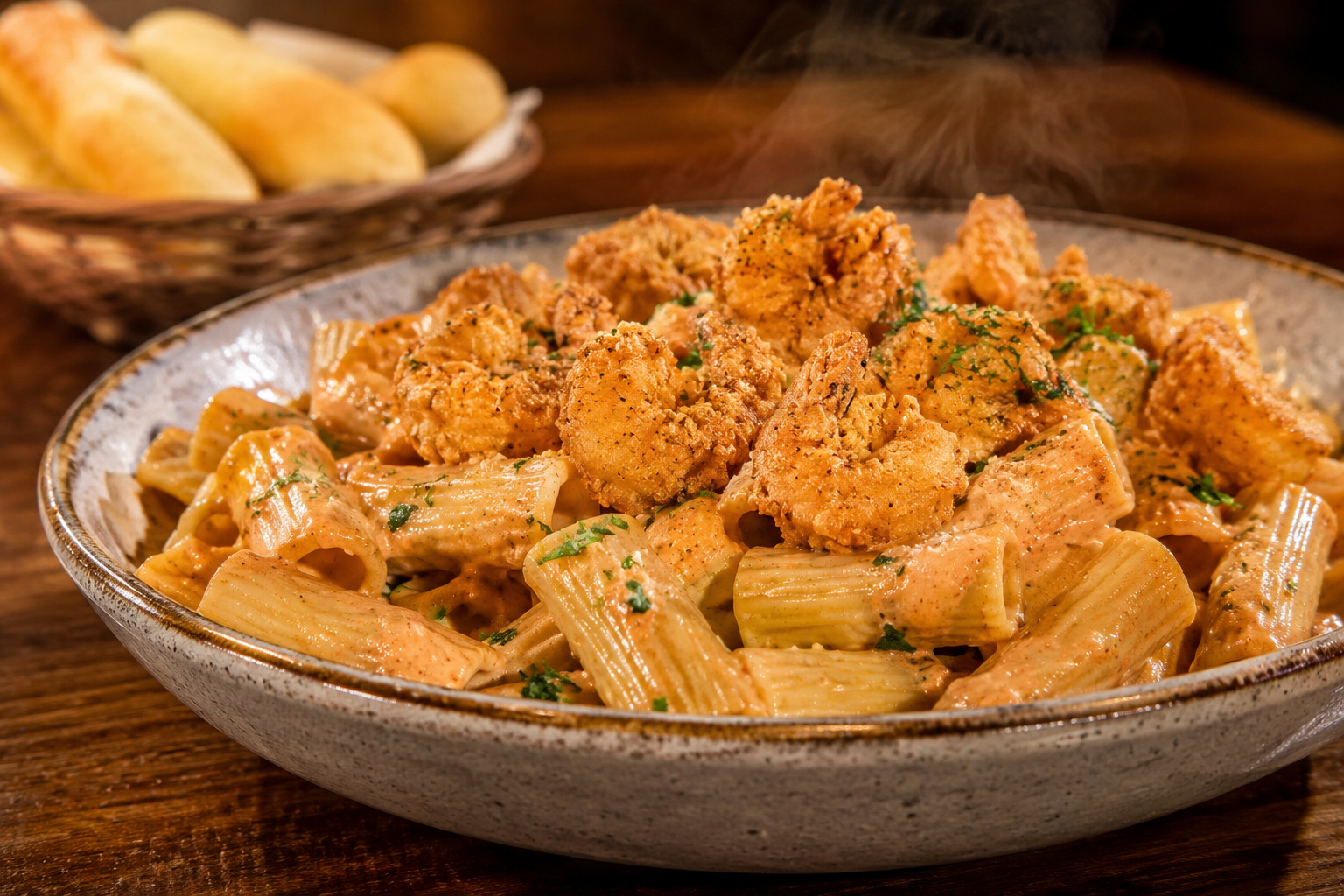
- Garlic Cream Bucatini: Toss sliced mushrooms with pasta for complete meal
- Simple arugula salad: Peppery greens with lemon vinaigrette provide refreshing contrast
- Filet Mignon with Shrimp and Lobster Cream Sauce: Serve as elegant side to complete steakhouse experience
- Roasted vegetables: Complement with roasted asparagus, green beans, or zucchini
For a complete Wine Wednesday spread: Create a sophisticated vegetarian dinner: start with a simple bruschetta or cheese board, serve these wine-roasted portobellos as the main over polenta with a simple salad, and finish with dark chocolate and red wine for dessert. Offer multiple Pinot Noirs to explore how different regions (Burgundy vs. Oregon vs. California) interact with the mushroom’s earthy character. Add Garlic Cream Bucatini for a complete plant-forward menu that showcases the depth and elegance of vegetarian cooking.
─────────
Storage, Reheating, and Make-Ahead Tips
Storage:
- Refrigerate cooked mushrooms with their pan juices in an airtight container for up to 3 days
- Store whole or sliced depending on intended use
- Pan juices solidify slightly when cold but return to liquid when reheated
Reheating:
- Oven (best method): Reheat at 325°F for 10-12 minutes until warmed through
- Stovetop: Warm gently in a covered pan over medium-low heat with pan juices
- Microwave: Heat in 1-minute intervals, covering to retain moisture
- Add a splash of wine or broth during reheating if mushrooms seem dry
Make-ahead strategies:
- Clean and stem mushrooms up to 1 day ahead; store covered in refrigerator
- Make garlic oil mixture several hours ahead; store at room temperature
- The dish can be fully assembled (brushed, wine added) and refrigerated up to 4 hours before baking
- For entertaining, bake just before serving—the 20-minute cooking time is manageable even for company
Versatile leftover ideas:
- Slice cold over salads—mushrooms are excellent at room temperature
- Chop into pasta sauce with pan juices for instant depth
- Add to risotto during the final stirring for earthy, wine-forward flavor
- Layer in sandwiches with fresh mozzarella, arugula, and balsamic glaze
- Dice into scrambled eggs or omelets for elevated weekend breakfast
─────────
Why This Recipe Deserves a Spot in Your Wine Wednesday Rotation
Portobello Mushrooms with Wine and Thyme prove something important: that sophistication in cooking doesn’t always require proteins, complex techniques, or long ingredient lists. This dish achieves remarkable depth through the intelligent combination of a few quality ingredients and a cooking method that allows their natural characters to shine. In an era when we’re all thinking more carefully about how we eat, this recipe demonstrates that plant-forward cooking can be just as wine-worthy, just as satisfying, and just as deserving of a beautiful table setting and a well-chosen bottle.
What makes this particularly compelling for Wine Wednesday is the direct relationship between what’s in the dish and what’s in your glass. Cooking portobellos in red wine creates a literal bridge to drinking red wine alongside—the same flavor compounds appear in both, creating resonance rather than conflict. When you drink a Pinot Noir with its earthy, mushroom undertones while eating wine-roasted portobellos, you’re experiencing one of those magical pairings where food and wine speak the same language fluently.
The recipe also demonstrates that vegetarian cooking deserves the same reverence and intentionality we bring to meat preparations. These mushrooms aren’t a substitution or a compromise—they’re a genuinely excellent ingredient that rewards quality wine and thoughtful technique. The umami depth they deliver can stand alongside any protein in the context of wine pairing, making them a versatile addition to any Wine Wednesday rotation.
Most importantly, this recipe proves that impressive Wednesday cooking can be genuinely simple. While other dishes in your rotation demand attention and technique, these portobellos ask only that you clean them properly, season them well, and trust the oven to do its work. Twenty minutes later, you have something that looks beautiful, tastes complex, and pairs magnificently with wine—the perfect reward for a Wednesday well-spent.
So choose a wine you’ll enjoy drinking and cooking with, scatter that thyme generously, and let the oven work its magic. Whether you’re serving these as a main course, an elegant side, or a sophisticated starter, they’ll bring depth and intention to your Wine Wednesday table. Here’s to humble ingredients made extraordinary, to the alchemy of wine and heat, and to treating every Wednesday like it deserves something genuinely special.
Santé!
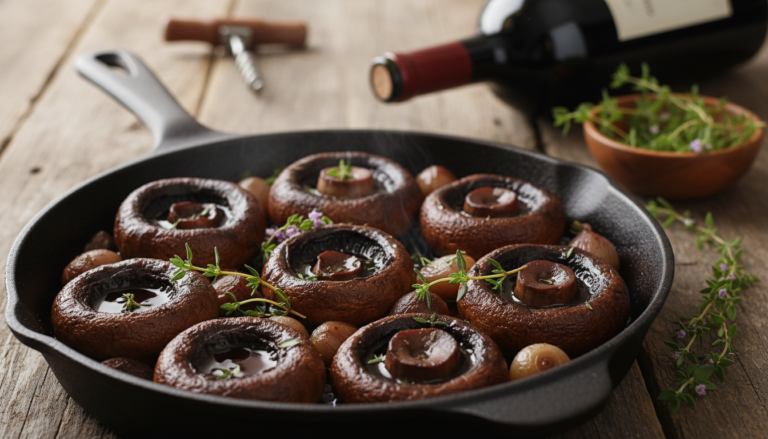
Portobello Mushrooms with Wine and Thyme
Portobello mushrooms roasted in red wine with garlic and fresh thyme—deeply savory, satisfying, and perfectly wine-paired.fort food mashup that’s ready in under 15 minutes.
4
servings15
minutes20
minutes180
kcal35
minutesIngredients
4 large portobello mushrooms
3 tablespoons olive oil
1 cup red wine
2 tablespoons fresh thyme leaves
2 cloves garlic
1 teaspoon salt
0.5 teaspoon ground black pepper
Directions
- Preheat the oven to 375°F (190°C).
- Clean the portobello mushrooms and remove the stems.
- In a small bowl, mix olive oil, minced garlic, salt, and pepper.
- Brush the olive oil mixture on both sides of the mushrooms.
- Place mushrooms in a baking dish, gill side up.
- Pour red wine over the mushrooms and sprinkle with fresh thyme leaves.
- Bake in the preheated oven for 20 minutes or until tender.
- Serve warm alongside your main dish or as a standalone course.
Nutrition Facts
- Total number of serves: 4
- Calories: 180kcal
- Cholesterol: 0mg
- Sodium: 620mg
- Potassium: 400mg
- Sugar: 8g
- Protein: 6g
- Calcium: 60mg
- Iron: 2mg
About This Author

Benjamin Brown
Recipe Developer & Wine Enthusiast
Benjamin is our flavor engineer. A classically trained chef turned recipe developer, he’s obsessed with balancing taste, texture, and creativity. He ensures that every recipe we publish is not only delicious but also reliable, approachable, and repeatable — even for beginners.
Favorite dish: Slow-braised short ribs with red wine reduction.
Kitchen motto: “Cooking is part science, part soul.”