
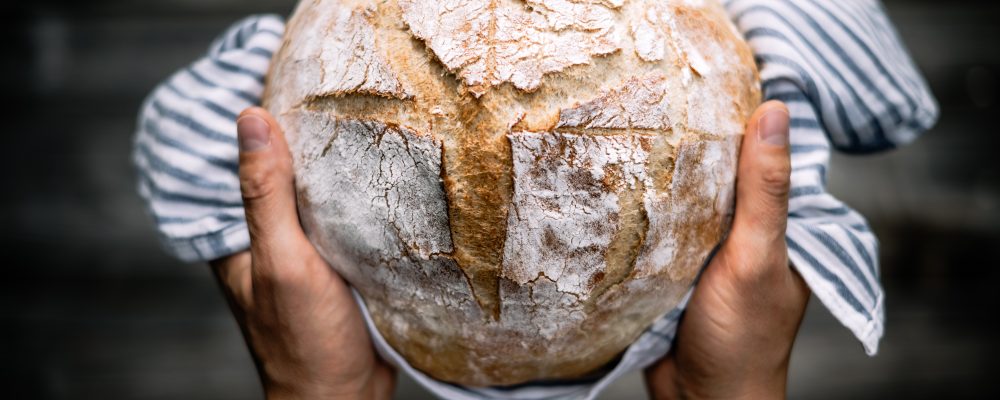

There is an argument to be made that bread is the most consequential food in human history.
Not the most nutritious. Not the most complex. Not the most celebrated in the traditions of fine dining or the most sought-after in the language of culinary ambition.
The most consequential. The food whose existence — whose development, whose spread, whose centrality to the daily diet of civilization after civilization across thousands of years — shaped the course of human history in ways that no other single food can match.
This is not a romantic overstatement. It is a claim supported by archaeology, by anthropology, by the history of agriculture and trade and empire. Bread is where the story of human civilization and the story of food intersect most completely — and understanding that intersection reveals something important about what food is and what it has always been.
The Moment Everything Changed
Approximately fourteen thousand years ago, in the region that now encompasses the eastern Mediterranean and the Middle East, something happened that would alter the trajectory of human existence.
Wild grasses — the ancestors of wheat and barley — began to be harvested and processed deliberately by human communities. The seeds were ground, mixed with water, and cooked. The result was not yet bread as we understand it — it was closer to a flatbread or a gruel, made from ground grain and water, cooked on a hot stone.
But the process that would eventually produce bread had begun.
The significance of this moment was not culinary. It was agricultural and social. The cultivation of grain — the deliberate planting, tending, and harvesting of cereal crops — was one of the primary drivers of the shift from nomadic hunter-gatherer existence to settled agricultural communities. Grain could be stored. It could be accumulated. It could feed a community through seasons when other food was scarce. And its cultivation required a level of collective organization and labor investment that, over generations, produced the social structures — the villages, the hierarchies, the trade networks, the specialization of labor — that we recognize as the foundations of civilization.
Bread did not cause all of this. But the grain that bread is made from was at the center of it — and the processing of grain into bread was the technology that made grain’s full nutritional potential accessible in a form that could be produced, stored, and distributed at scale.
The Discovery of Leavening
For thousands of years, bread was flat — a simple mixture of ground grain and water, cooked quickly on a hot surface. Nutritious, portable, storable, but dense and heavy in ways that limited how much could be eaten comfortably.
At some point — the exact moment is lost to history, but the evidence from Egyptian archaeology suggests it occurred at least five thousand years ago — someone left a mixture of grain and water out long enough for wild yeast and bacteria from the environment to begin fermenting it.
The result, when baked, was something remarkable. The gases produced by fermentation had expanded the dough from the inside, creating a structure of bubbles trapped in the gluten network — a loaf that was lighter, more airy, more digestible, and more flavorful than anything produced before.
Leavened bread had been discovered.
The Egyptians became the first great bread culture — a civilization so dependent on leavened bread that the workers who built the pyramids were paid, in part, in bread, and Egyptian breadmaking was sophisticated enough to include dozens of distinct varieties, different grains, different flavorings, and professional bakers who supplied urban populations that could not produce their own.
The spread of leavened bread from Egypt outward through the Mediterranean world was one of the early examples of a food technology moving along trade routes and being adopted by cultures that encountered it — a pattern that would repeat throughout the history of bread and the history of food more broadly.
Bread and Power
From the moment grain could be stored and accumulated, it became the primary unit of economic and political power in agricultural societies.
Control of the grain supply was control of the population. The ruler who controlled the granaries controlled the ability to feed — and the ability to withhold food — from the people who depended on the harvest. The taxation of grain was the primary mechanism of wealth extraction in agricultural empires from Egypt to Rome to China. The distribution of bread was one of the primary tools of political control in urban societies where the population depended on a centralized supply chain rather than direct agricultural production.
The Roman practice of distributing free grain to the urban poor — the dole that eventually became a distribution of bread — was not charity. It was social management: the recognition that a population that could not eat was a population that would revolt, and that maintaining the bread supply was maintaining the social order.
The phrase “bread and circuses” — Juvenal’s description of the two things Roman emperors provided to keep the urban population compliant — reflects how completely bread had become the baseline of social stability. Not a luxury, not a preference, but the non-negotiable minimum below which society could not be held together.
This relationship between bread and political power persisted through European history in ways that are visible in the major social upheavals of the pre-industrial era. The French Revolution was precipitated, in significant part, by a bread crisis — by harvests that failed and prices that rose beyond what the urban poor could pay, by the particular fury of a population that was not merely hungry but denied access to the food that was the irreducible minimum of their subsistence.
The storming of the Bastille happened against a backdrop of bread riots. Marie Antoinette’s alleged remark about cake — almost certainly apocryphal, but enduring as a symbol — captured the gulf between the aristocracy and a population for whom the absence of bread was not an inconvenience but an emergency.
The Regional Identities of Bread
As bread spread across cultures and centuries, it differentiated. The specific grains available in a region, the specific techniques developed by its bakers, the specific fuel available for its ovens, the specific social and religious functions it served — all of these produced regional bread traditions so distinct from each other that bread became one of the most reliable markers of cultural identity in the pre-industrial world.
The dark, dense, long-keeping rye breads of Scandinavia and northern Germany — developed for climates too cold and wet for wheat to thrive reliably — were fundamentally different from the light, wheat-based breads of the Mediterranean south. The flatbreads of the Middle East and South Asia — lavash, naan, roti, pita — reflected both the grains available and the cooking technologies developed in their regions of origin.
The sourdough traditions of different regions — each culture maintaining its own starter, its own fermentation culture, its own community of wild yeasts and bacteria — produced breads that were as regionally specific as wine or cheese. A San Francisco sourdough acquires its characteristic tang from Lactobacillus sanfranciscensis, a bacteria that thrives in the particular conditions of the Bay Area. A Viennese sourdough, a Parisian sourdough, a bread made in a specific Italian bakery from a starter that has been maintained for decades — each carries the microbial fingerprint of its place of origin.
Bread was not just sustenance. It was identity. The bread of a place told you who had lived there, what they had grown, how they had cooked, and what they had valued.
The Industrialization of Bread and What Was Lost
The Industrial Revolution transformed bread production in ways that made it cheaper, more consistent, and more widely available than ever before — and simultaneously stripped it of most of what had made it interesting.
The introduction of commercial yeast in the late nineteenth century replaced the slow, variable, place-specific process of sourdough fermentation with a standardized, predictable leavening agent that produced consistent results regardless of location, season, or the specific microbial environment of the bakery. The roller milling of grain, which could produce finely sifted white flour at industrial scale, replaced the stone-ground whole grain flours that had provided most of the flavor complexity in traditional bread.
The result was a bread that was uniform, reliably textured, easy to slice, long-lasting, and essentially flavorless — a delivery mechanism for the calories of refined starch, stripped of the complex flavor compounds produced by whole grain and long fermentation.
The industrial white bread that dominated the twentieth century was not a degradation of something that had existed for centuries. It was a new thing — a product of industrial technology and industrial values, optimized for shelf life and consistency rather than for flavor, nutrition, or any of the cultural specificity that regional bread traditions had accumulated over millennia.
The sourdough revival of the late twentieth and early twenty-first centuries — the movement of artisan bakers toward long fermentation, whole grain flour, and traditional techniques — is in large part a recovery project: an attempt to retrieve the flavor, the nutrition, and the cultural specificity that industrialization had displaced.
The Bread We Make Today
The home baker who makes a sourdough loaf today is participating in something that is simultaneously very old and very new.
Old because the technology — wild fermentation, the relationship between flour and water and time, the particular pleasure of a crust that shatters and a crumb that holds — is essentially unchanged from what bakers have been doing for thousands of years.
New because the choice to make it — in a time when factory bread is cheap and universally available — is a deliberate act of recovery, of reconnection with a practice that industrialization made unnecessary and that something in the culture is now, after several generations of absence, reaching back toward.
The bread that a home baker pulls from the oven on a Saturday morning carries more history than most people think about. It carries the history of the grain it was made from, which was first cultivated in the Fertile Crescent fourteen thousand years ago. It carries the history of the fermentation technology that some unnamed baker discovered five thousand years ago when a mixture was left out too long.
It carries the history of every civilization that was built on bread and that fell when the bread supply failed.
And it carries the particular history of its maker — their starter, their technique, their kitchen, their place.
All of that, in a loaf.
The Takeaway
Bread is not just food. It is the food — the ingredient around which more of human history has turned than any other single product of the kitchen.
Understanding that history doesn’t make bread taste better. But it does make eating it more interesting — more connected to the long chain of human experience of which every loaf is a small, particular link.
Make bread. Eat it with attention. And consider, occasionally, the extraordinary thing it is.














