

There is a category of food that sits outside the normal rules of culinary ambition.
It doesn’t appear at restaurants with waiting lists. It doesn’t get photographed with careful attention to light and negative space. It doesn’t inspire the kind of breathless food writing that announces a dish as significant or important or worth traveling for.
And yet it is the food that people reach for when they are sick, when they are sad, when they are celebrating something private, when they want to feel like themselves again after a period of not feeling like themselves.
Comfort food.
The mashed potato. The chicken soup. The grilled cheese. The bowl of pasta with butter and cheese that no one serves at a dinner party but everyone makes alone at midnight when the occasion demands it.
These dishes carry a weight that technically ambitious food rarely achieves — a weight of association and memory and need that makes them simultaneously the most emotionally loaded and the most technically unforgiving category in cooking.
Because here is the paradox: the simpler the dish, the harder it is to make perfectly. And comfort food is almost always simple.
Why Simplicity Is the Hardest Standard
The logic of simplicity as difficulty has appeared in this space before — in the context of professional cooking, in the context of the chef’s eventual return to restraint after years of complexity. But it applies with particular force to comfort food, because comfort food adds a dimension that restaurant food rarely has to contend with.
Memory.
When someone eats mashed potatoes, they are not eating mashed potatoes in the abstract. They are eating their grandmother’s mashed potatoes, or the version they had the first time they felt truly at home somewhere, or the specific preparation that appeared every Thanksgiving for twenty years and became inseparable from what Thanksgiving means.
This is an impossible standard for any cook to meet — not because the food is difficult to make well in objective culinary terms, but because the standard it is being measured against is not culinary. It is emotional. The dish is competing not with other dishes but with a memory, and memory is always more perfect than reality because memory has been edited by time and feeling into an idealized version of itself.
The cook who understands this is freed from an impossible competition. The goal is not to replicate the memory. It is to make something that carries the same quality of care and attention that made the original memorable — to make something genuinely good rather than something that approximates a feeling.
Mashed Potatoes: The Dish That Reveals Everything
Mashed potatoes are, on their surface, among the simplest preparations in cooking. Boil potatoes. Mash them. Add fat and seasoning. Serve.
And yet the gap between forgettable mashed potatoes and genuinely extraordinary mashed potatoes is wide, and every element of the process determines which side of that gap the result falls on.
The variety of potato matters. A high-starch potato — a Russet, a Yukon Gold — produces a fluffy, light mash because its starch granules swell fully during cooking and separate easily under pressure. A waxy potato — a red potato, a fingerling — has a lower starch content and more moisture, and produces a dense, gluey mash that resists lightness regardless of technique.
The cooking method matters. Potatoes boiled in well-salted water — salted enough that the water tastes distinctly seasoned — are seasoned from the inside out during cooking. Potatoes boiled in unsalted water and salted afterward are seasoned only at the surface. The difference is the difference between a mashed potato that tastes fully of potato and one that tastes of potato with salt added to it.
The fat matters. Butter added in generous amounts while the potatoes are still hot melts immediately and coats the starch granules before they have the chance to bond together and create glue. Warmed cream — not cold, which drops the temperature of the potatoes and tightens the starch — adds richness and loosens the texture without making it wet.
The technique of mashing matters. A food mill or a ricer produces a light, airy result because it forces the cooked potato through small holes without overworking the starch. A stand mixer produces a light result if used briefly — and a gluey, wallpaper-paste result if used for more than thirty seconds, because the overworking releases starch that bonds into an adhesive rather than a cloud.
None of this is complicated. All of it matters. The distance between the mashed potato that makes someone close their eyes and the one that is simply adequate is determined by attention to every one of these variables.
Chicken Soup: The Dish That Requires Time
There is a reason chicken soup appears across virtually every culinary tradition as the food of recovery and care.
It is not primarily nutritional — though there is reasonable evidence that the steam, the warmth, and the compounds released from chicken bones during long simmering have measurable effects on congestion and inflammation. It is primarily about time.
A chicken soup that tastes like care takes time to make. The stock needs hours — real hours, not forty-five minutes — for the collagen in the bones to dissolve into gelatin that gives the broth its body and its particular quality of comfort. The vegetables need to be cooked long enough to give up their flavor to the broth without disappearing entirely. The chicken needs to be tender in a way that requires patience rather than speed.
The shortcuts visible in a chicken soup tell the story of how much care was put into it — and care is the thing comfort food is actually delivering. Chicken soup made from a good housemade stock, with real vegetables and properly cooked chicken, delivers something that a soup made from a carton and a rotisserie chicken cannot fully replicate, regardless of how carefully the latter is seasoned.
This is not snobbery. It is an acknowledgment that time and care are the active ingredients in comfort food — that they are what the dish is actually communicating when it succeeds, and what is missing when it doesn’t.
Grilled Cheese: The Dish That Requires Heat
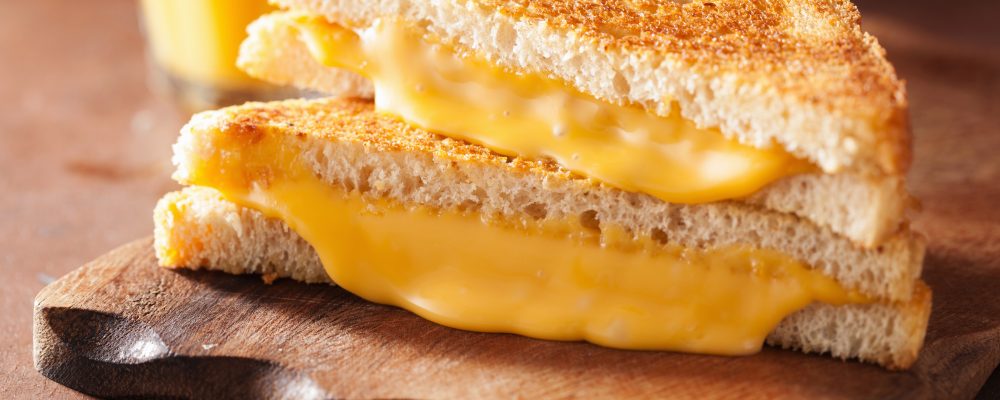
The grilled cheese sandwich is, in theory, among the simplest things a cook can make. Bread, cheese, butter, heat. Four ingredients, ten minutes, done.
And yet the grilled cheese that achieves the specific combination of qualities that makes it genuinely satisfying — a crust that is golden and crisp all the way to the edge without burning, cheese that is fully melted and slightly gooey without being oily, bread that has absorbed enough butter to be rich without being greasy — requires a level of heat management that most home cooks underestimate.
The most common grilled cheese failure is too much heat for too little time — a sandwich that is deeply browned on the outside and cold, unmelted cheese on the inside because the heat moved through the bread faster than it moved through the cheese. The fix is the opposite of instinct: lower heat, more time, a lid placed on the pan for the final minute to trap steam and encourage the cheese to melt from the top while the bottom browns from the pan.
The choice of cheese matters — a cheese that melts smoothly, like Gruyère, young cheddar, or American cheese (which, whatever its other qualities, melts with a perfection that more artisanal cheeses sometimes don’t), versus a cheese that breaks and oils rather than melts.
The bread matters — substantial enough to hold up to the butter and the heat without becoming soggy, with enough structure to maintain its integrity through the cooking process.
And the butter matters — applied to the bread rather than to the pan, which ensures even, edge-to-edge coverage of the surface that will contact the heat.
Four ingredients. Infinite room to do it wrong.
Why Comfort Food Connects
The food scientist and author Gordon Shepherd has written about flavor as a construction of the brain rather than a property of the food itself — the idea that what we taste is produced not just by the compounds in the food but by the context in which we eat it, including our memories, our associations, and our emotional state at the moment of eating.
This framework explains a great deal about comfort food and why it is so difficult to replicate outside its original context.
The food that comforts is not just delivering flavor. It is activating a network of association — memory, safety, care, belonging — that amplifies the experience of eating it in ways that no technique can produce independently. The mashed potatoes that taste extraordinary at a grandmother’s table would taste merely good at a restaurant — not because the recipe is different, but because the context is.
This is simultaneously the difficulty and the gift of comfort food. The difficulty: it is competing with a context that no amount of technique can replicate. The gift: the cook who makes it for someone they care about is not just making food. They are adding a new layer to the association — contributing to the ongoing construction of what this food means to this person — in a way that the most technically accomplished restaurant meal cannot.
The Takeaway
Comfort food is not simple cooking. It is the most demanding category in all of cooking — not technically, but in terms of what it is actually required to deliver.
It must taste good in objective culinary terms. It must be made with the time and care that the dish communicates as much as the recipe does. And it must carry enough genuine quality that it can contribute something to the web of memory and association that makes comfort food what it is.
Make the mashed potatoes with the right potato, the right fat, the right technique. Let the chicken soup take the time it needs. Lower the heat on the grilled cheese and put the lid on.
And make it for someone who needs it.
Because the dish is only half of what comfort food is.
The other half is the person who made it, and the reason they did.














