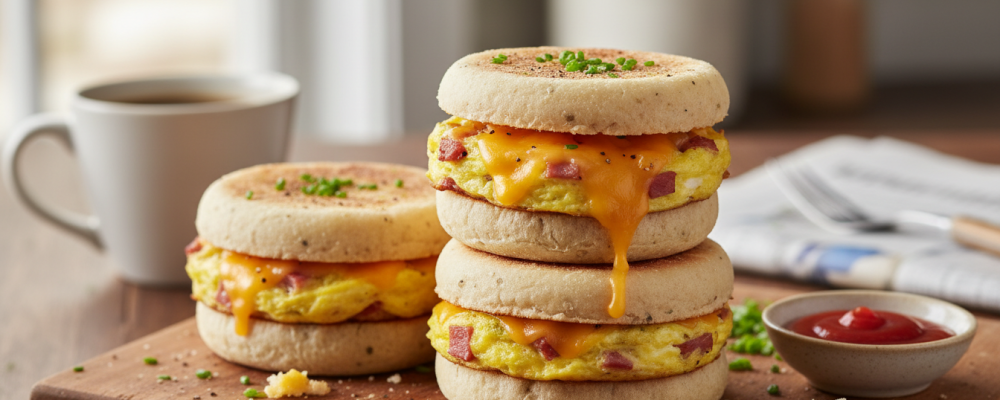

I want to start by acknowledging something that the culinary world occasionally forgets in its pursuit of the elevated and the innovative: the breakfast sandwich is perfect. Not almost perfect. Not perfect for what it is. Just perfect. The ratio of toasted bread to melted cheese to savory protein to egg is a formula that has been arriving at the correct answer for generations, and the Ham & Cheddar Egg Muffin Sandwich is among the finest expressions of that formula available to a home cook with a muffin tin and forty minutes on a Sunday afternoon.
What makes this particular version so satisfying—beyond the obvious answer of ham and cheddar and egg—is the foil-wrap finish. Each assembled sandwich gets wrapped individually in foil and goes into a 350°F oven for ten minutes, which does something genuinely wonderful: it creates a closed, steamy environment that melts the cheese completely into the layers of the sandwich, marries all the flavors together under gentle heat, and produces a result that tastes like it came from a very good diner rather than a very sensible meal prep session. The foil is not a storage convenience. It is a cooking technique dressed up as packaging, and the results are proof.
I spend most of my professional life working on desserts and pastries—precise, layered, often elaborate. And I can tell you that the satisfaction I get from pulling a batch of these sandwiches out of the oven, stacked in their foil parcels on the baking sheet, each one a perfectly contained little package of breakfast, is completely genuine and not at all diminished by the simplicity of the recipe. Some things are just good. These are good.
─────────────────────────────────────────
The Inspiration Behind This Recipe
The inspiration for this recipe, stated plainly, is the fast-food breakfast sandwich—which is simultaneously one of the most universally beloved and most nutritionally dubious morning meals in the American food landscape. The ingredients are right: egg, cheese, ham, a toasted English muffin. The execution is the problem. Commercial breakfast sandwiches are assembled from components that have been held at temperature for indeterminate periods, made from processed ingredients designed for long shelf stability rather than actual flavor, and delivered in a paper sleeve that begins softening the bread before you’ve even made it to the car.
The homemade version solves every one of those problems at once. Real cheddar that melts into the egg rather than sitting on top of it as a separate, slightly congealed layer. Ham that tastes like ham. An egg cooked in butter to the point where the whites are just set and the yolk still has something to say about being involved in the sandwich. An English muffin that was actually toasted before it met the rest of the filling. These are not small improvements. They are the difference between a sandwich you eat because it’s there and one you look forward to from the night before.
The meal prep format—individual foil wraps, oven-finished, refrigerator-stored—takes those quality improvements and packages them into the same grab-and-go convenience that made the fast-food version appealing in the first place. It is, in the most honest sense, an upgrade in every direction: better flavor, better ingredients, better texture, and still ready in under two minutes on a weekday morning. That is the kind of problem meal prep was made to solve.
─────────────────────────────────────────
A Brief History of the Egg Sandwich
The egg sandwich, in its broadest sense, is as old as the meeting of bread and cooked egg—a combination that appears across virtually every food culture in the world that has access to both ingredients. But the specifically American breakfast sandwich—egg, cheese, and meat between two halves of a bread product, assembled hot and eaten on the move—has a more specific and more recent history, rooted in the diner culture of the early 20th century and the urban working-class eating habits that shaped it.
The English muffin, despite its name, is largely an American invention in its modern commercial form. Though it draws on the tradition of British crumpets and griddle cakes, the nooks-and-crannies English muffin as we know it today was popularized in the United States in the late 19th century and became a breakfast staple through the 20th century. Its split, toasted surface—with those characteristic irregular pockets that catch butter and hold up under fillings—makes it structurally superior to most other bread choices for a hot breakfast sandwich, which is why it remains the vehicle of choice for the format to this day.
The foil-wrapped, oven-heated sandwich—the technique at the heart of this recipe—is a home cook innovation that takes its cues from both diner steam-table service and camping cooking tradition. Wrapping a sandwich in foil and applying gentle oven heat produces a result closer to the steam-finish of professional short-order cooking than anything achievable with a microwave alone, and it is precisely this technique that gives these sandwiches their characteristic melted, unified quality that makes them taste like something you’d pay considerably more for at a café counter.
─────────────────────────────────────────
Why This Cooking Method Works for Meal Prep
The two-stage cooking process—stovetop for the eggs, oven for the assembled sandwiches—is what elevates this recipe from a simple make-ahead meal to one that genuinely replicates the experience of a freshly made breakfast sandwich. The stovetop gives each egg a properly cooked white and a yolk that still carries richness; the oven finish, inside the foil wrap, melts the cheese completely and steams the sandwich components into a cohesive whole rather than leaving them as separate layers.
Toasting the English muffins before assembly is a non-negotiable step for meal prep performance. An untoasted muffin absorbs moisture from the egg and ham during the oven finish and refrigerated storage, softening into a texture that is markedly inferior to a toasted one. The brief toast creates a surface barrier on the interior faces of the muffin that resists moisture absorption, preserving a degree of textural integrity through both the initial bake and subsequent reheating that is clearly perceptible in the finished sandwich.
Individual foil wrapping is the storage and reheating strategy that makes this recipe function properly across a full week. Each sandwich wrapped separately means reheating is contained—no moisture escapes to dry out neighboring sandwiches, no flavors transfer between portions. It also means the foil-wrap reheating method can be used directly from the refrigerator: fifteen minutes in a 350°F oven produces a hot, just-melted result that rivals the freshly made version in every meaningful way, and requires zero morning effort beyond remembering to preheat the oven—or, for the microwave path, simply unwrapping and warming.
─────────────────────────────────────────
Flavor Profile: What to Expect
This sandwich is warm, savory, and deeply comforting—a flavor profile that has endured precisely because it is so fundamentally satisfying:
- Toasty, sturdy muffin – The English muffin provides a golden, slightly chewy base with a mild wheaty flavor and the structural integrity to hold everything together through reheating without collapse
- Savory, slightly smoky ham – Ham delivers a clean, salty, cured-meat savoriness that anchors the sandwich and provides the protein depth that makes it genuinely filling
- Melted, sharp cheddar – Cheddar, fully melted by the oven finish, becomes creamy and slightly gooey—its sharpness mellowing under heat into something rich and enveloping that pulls every layer together
- Butter-cooked egg richness – The egg cooked in butter has a gentle richness and a soft, yielding texture that sits between the layers and contributes the mild, yolk-forward flavor that is the heart of every great breakfast sandwich
- Simple, clean seasoning – Salt and pepper on the egg do their quiet work of sharpening every other flavor without competing with any of them
- Unified warmth – The foil-wrapped oven finish creates a steamed interior that merges the flavors of all components into something more cohesive than the sum of its parts—the cheese into the egg, the ham into the cheese, the muffin into all of it
The sandwich is at its most unified and melted immediately after the initial bake and equally satisfying after reheating—the oven-finish technique produces a result that holds its character through the full refrigerator storage window.
─────────────────────────────────────────
Tips for Making the Best Ham & Cheddar Egg Muffin Sandwiches
A few small techniques will produce a noticeably better sandwich than the basic assembly alone:
- Toast the muffins properly – They should be golden and dry on the interior face, not just lightly warmed. A properly toasted muffin is the single biggest factor in preventing a soggy sandwich by day three.
- Cook eggs gently – Medium heat, not high. An egg cooked over high heat develops rubbery whites and an overcooked yolk before the exterior is even properly set. Medium heat gives you full control and produces a tender white that reheats beautifully rather than tightening into a dense disc.
- Cook eggs to just-set whites – Remove each egg from the pan the moment the whites are fully opaque and set. The yolk will continue cooking slightly in the residual heat and during the oven finish—pulling too early is better than pulling too late.
- Layer strategically – Ham directly on the muffin base, then cheese, then egg on top. This order places the cheese between two heat-absorbing layers—the ham below and the egg above—which promotes the most complete melt during the oven finish.
- Wrap tightly in foil – A loose foil wrap allows steam to escape during the oven finish, which reduces the melting effect and allows the muffin edges to dry out. Wrap snugly, crimping the edges firmly, for maximum steam retention.
- Label the foil – A quick marker note on each wrap—day of the week, or simply a check mark—takes five seconds and means the refrigerator is organized from the start. A small habit that makes every morning’s grab slightly more effortless.
Optional: A thin swipe of Dijon mustard or hot sauce spread on the top muffin half before assembly adds a bright, tangy note that cuts through the richness of the cheese and ham and makes the sandwich taste sharper and more complex without adding any additional prep time.
─────────────────────────────────────────
Portioning and Container Suggestions
These sandwiches are their own containers—each one individually wrapped in foil is already portioned, labeled, and ready to go. A batch of four or five sandwiches stacks neatly in a section of the refrigerator or in a dedicated breakfast shelf, where they take up minimal space and remain visually organized across the full week. No additional containers required, no assembly beyond wrapping.
For households where the refrigerator is also the freezer, storing half the batch in the freezer from the start extends the recipe’s usability to two weeks from a single prep session—with the first half pulled from the fridge across the first week and the second half moved from freezer to refrigerator midweek to thaw overnight, ready for the back half of the week.
If adding this sandwich to a broader morning spread that includes fruit, yogurt, or a cold beverage, the foil wrap makes it the easiest element of the whole breakfast to manage—grab it out of the refrigerator, reheat it, and it’s done while everything else is being plated and poured. It brings the efficiency of a fast-food morning to a home breakfast that is, in every measurable way, better than anything the drive-through could offer.
─────────────────────────────────────────
Storage, Reheating, and Shelf Life Tips
- Refrigerator storage: Foil-wrapped sandwiches keep in the refrigerator for up to 4–5 days. The English muffin holds its structure best through day four; by day five it may be slightly softer but still entirely delicious.
- Freezer storage: Wrap each sandwich in foil and then in a layer of plastic wrap before freezing for up to 1 month. Thaw overnight in the refrigerator before reheating.
- Oven reheating (best method): Leave sandwich in foil and place in a 350°F oven for 15 minutes. The foil retains steam and remelts the cheese, producing a result very close to the freshly baked original.
- Microwave reheating: Remove foil entirely, wrap in a damp paper towel, and microwave at 50–60% power for 60–90 seconds. The damp paper towel replaces the steam environment of the foil and prevents the muffin from drying out under microwave heat.
- Do not microwave in foil – Foil in a microwave is a fire hazard. Always remove completely before microwaving.
- Cheese refresh: If the cheese seems less melted than desired after microwave reheating, place the open-faced sandwich halves under a broiler for 60 seconds before closing—this re-melts the cheese quickly and adds a very welcome light browning at the edges.
─────────────────────────────────────────
Why This Recipe Deserves a Spot in Your Meal Prep Rotation
The Ham & Cheddar Egg Muffin Sandwich makes the case for meal prep with complete simplicity: it is a better version of a breakfast you were probably already buying somewhere, made at home in forty minutes, for a fraction of the cost, and ready every morning of the week without any additional effort. The calculus of that exchange is so straightforwardly favorable that it almost doesn’t require an argument—and yet the sandwiches themselves make the argument anyway, every single morning, one foil-wrapped parcel at a time.
What keeps this recipe in the rotation long-term isn’t the novelty—it’s the reliability. A breakfast sandwich that is always there, always hot after two minutes of reheating, always exactly what a busy morning calls for, is a recipe that earns its place not through impressiveness but through the quiet, consistent satisfaction of showing up. In a weekly prep lineup full of vibrant bowls and beautiful snack spreads, the humble foil-wrapped breakfast sandwich is often the recipe that ends up mattering most. That, in my experience, is almost always the mark of a genuinely great recipe.
─────────────────────────────────────────
Meal Prep Pairing Suggestions
Ham & Cheddar Egg Muffin Sandwiches pair most naturally with other prepped breakfasts that offer contrast in format and flavor—ensuring that the week’s mornings feel varied rather than repetitive despite coming from the same Sunday session. Our Smashed Avocado Egg Toast Cups are the ideal egg-based counterpart: both are hand-held, protein-forward, and oven-finished, but where this sandwich is warm, savory, and classically American, the toast cups are bright, citrusy, and Mediterranean-inspired. Rotating between them gives the week two hot egg breakfasts that share no flavor overlap.
For the mornings when something sweet and cool is more appealing than something warm and savory, our Strawberry Coconut Chia Smoothie Bowls offer the perfect tonal opposite—vibrant, tropical, and entirely fruit-forward, requiring nothing more than a thawed base and two minutes of topping assembly. A week with a foil-wrapped sandwich waiting for the fast mornings and a smoothie bowl for the slower ones is a week with every breakfast scenario genuinely covered—and all of it made in a single Sunday afternoon. That kind of comprehensive, effortless morning coverage is exactly what a well-designed meal prep breakfast rotation is supposed to deliver.
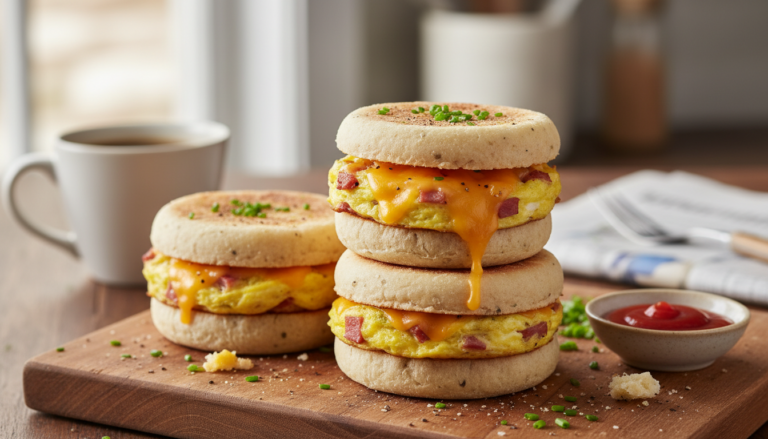
Ham & Cheddar Egg Muffin Sandwiches
These Ham & Cheddar Egg Muffin Sandwiches are the ultimate make-ahead breakfast—individually wrapped, oven-finished to perfectly melted cheese, and ready to reheat in minutes for a hot, satisfying morning sandwich all week long..
4
servings10
minutes15
minutes350
kcal25
minutesIngredients
4 pieces English muffins
4 slices cheddar cheese
4 slices ham
4 large eggs
2 tablespoons butter
to taste salt
to taste pepper
Directions
- Preheat oven to 350°F (175°C).
- Split English muffins and toast lightly in a toaster.
- Heat butter in a skillet over medium heat. Crack eggs individually, cook until whites are set, about 2-3 minutes.
- Place a slice of ham and a slice of cheddar onto the bottom half of each muffin.
- Top with cooked egg, sprinkle with salt and pepper.
- Cover with the top muffin half and wrap each sandwich in foil.
- Place wrapped sandwiches on a baking sheet and bake for 10 minutes to melt the cheese.
Nutrition Facts
- Total number of serves: 4
- Calories: 350kcal
- Cholesterol: 0mg
- Sodium: 620mg
- Potassium: 400mg
- Sugar: 8g
- Protein: 6g
- Calcium: 60mg
- Iron: 2mg
About This Author

Aurora Wright
Pastry Chef & Dessert Editor
Aurora is the sweet side of Daily Dish. A trained pastry chef and dessert stylist, she’s responsible for our mouth-watering cakes, cookies, and confections. She brings precision, artistry, and a touch of whimsy to every recipe she creates — and taste-tests more chocolate than she’ll admit.
Favorite dish: Flourless dark chocolate torte.
Kitchen motto: “Life’s too short to skip dessert.”