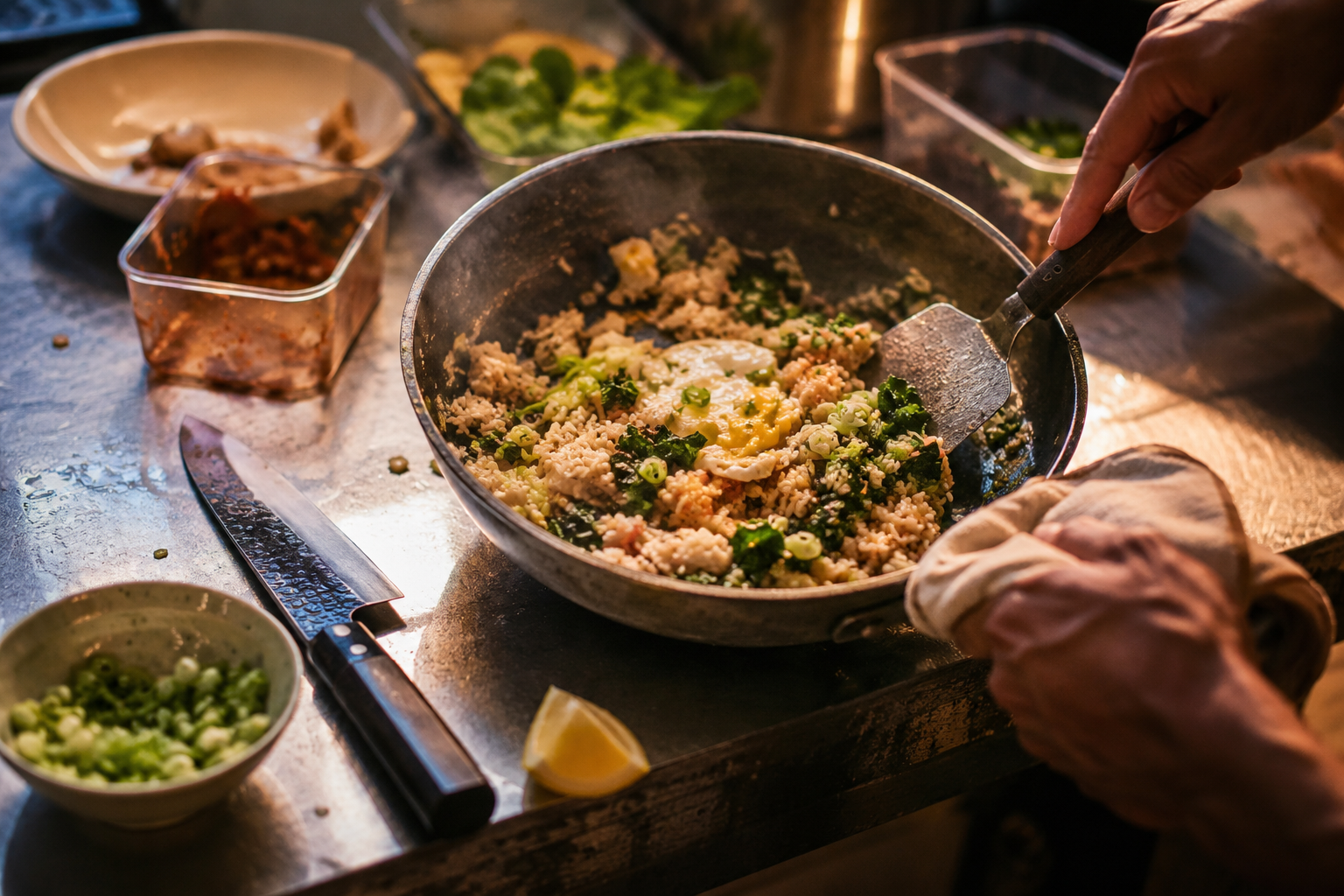

The first year in a professional kitchen is not glamorous.
It is not the food. Not the creativity. Not the plating, the sourcing, the menu development, the relationship with producers, the moment a dish comes together exactly as imagined and goes out to a table where someone is about to be genuinely surprised by what they’re eating.
It is the fundamentals — drilled so relentlessly, under such consistent pressure, in such compressed time that a year of professional kitchen experience builds a foundation that the average home cook, cooking several nights a week with genuine interest and care, might take a decade to approximate.
Not because the home cook is less capable. Because the conditions that accelerate learning in a professional kitchen — volume, repetition, immediate feedback, and the particular pressure of consequence — are almost impossible to replicate in a home environment.
But understanding what those conditions produce can help any home cook build the same foundation more deliberately.
Volume Does What Repetition Alone Cannot
The first thing a professional kitchen provides that home cooking cannot match is volume — the sheer number of times a technique is executed in a compressed period of time.
A line cook on a busy station might break down fifty chickens in a week. They might make the same sauce two hundred times in a month. They might sear the same cut of fish on every service for three months before it rotates off the menu. This volume of repetition produces a depth of familiarity with a technique that is genuinely difficult to achieve any other way.
By the hundredth chicken, the cook is not thinking about the knife angle or the joint position or the sequence of cuts. The technique has been encoded at a level below conscious thought — it is in the hands, not the head. The cook’s attention is free to move to the next layer of understanding: the variations, the adjustments, the way the bird is different today than it was yesterday, the subtle shift in technique that a slightly larger bird or a slightly colder kitchen requires.
This is mastery — and it arrives through volume in a way that occasional repetition cannot replicate.
For the home cook, the implication is specific: choose fewer dishes and cook them more often. The home cook who makes ten different chicken dishes in a month learns less than the home cook who makes the same chicken dish ten times, varying one element each time, building the depth of familiarity that volume produces.
Feedback Is Immediate and Impossible to Ignore
In a professional kitchen, feedback on the quality of a cook’s work arrives immediately and from multiple sources simultaneously.
The chef tastes the sauce and tells the cook exactly what it needs. The expediter calls a ticket and the cook knows instantly whether their timing was right. A plate comes back from the dining room and the cook understands, in real time, that something wasn’t right. The pressure of service means that every decision produces an observable consequence within minutes — sometimes seconds.
This feedback loop is extraordinarily efficient at building skill. The cook makes a decision, sees the result, adjusts, makes the decision again. The cycle repeats dozens of times per service, hundreds of times per week. The learning that this loop generates is compressed in a way that no other cooking environment can match.
Home cooking has almost no feedback loop of this kind. The cook makes decisions, the meal is eaten, and the feedback is vague at best — “it was good,” “it was a bit salty,” “I liked it” — arriving from people who are more invested in being kind than in being accurate. The cook has no way to know which specific decisions produced which specific results. The learning is diffuse.
The home cook who wants to build a tighter feedback loop needs to generate their own. Taste constantly and take mental notes. Cook the same dish again and change one variable deliberately. Ask specific questions of the people eating — not “did you like it?” but “was the sauce too acidic?” or “did the chicken seem overcooked to you?” Create the conditions for real information to return to the cook from the plate.
Consequence Creates a Different Quality of Attention
There is a specific quality of attention that consequence produces that nothing else replicates.
In a professional kitchen, the consequence of a mistake is immediate and social. A dish that goes out wrong affects a guest’s experience, the restaurant’s reputation, the chef’s assessment of the cook, the rhythm of service for everyone at the pass. The consequence is real, visible, and felt immediately.
This consequence produces a quality of attention that is difficult to sustain in its absence. The cook who knows that a poorly seasoned sauce will be tasted by the chef and served to a paying guest is more focused than the cook who knows the sauce will be eaten at home with no further evaluation.
Home cooking has consequences too — but they are softer, more private, more forgiving. The meal that doesn’t come together is still eaten. The poorly seasoned dish still satisfies hunger. The forgiveness of a home meal, which is one of its genuine virtues, is also one of the things that makes the home kitchen a slower learning environment.
The home cook who creates their own consequences — cooking for guests who don’t know each other, hosting occasions where the food actually matters, entering a dish in a local competition, cooking for someone whose opinion they genuinely care about — accelerates their own development by creating stakes that focus the attention in ways that ordinary weeknight cooking doesn’t.
Failure Is Treated as Information, Not Outcome
One of the most significant differences between professional kitchen culture and home cooking culture is how failure is treated.
In a serious professional kitchen, a failed dish is not a verdict. It is a data point. The chef who tastes something that isn’t right doesn’t respond with discouragement — they respond with diagnosis. What went wrong, at which stage, and why? What is the specific adjustment that produces a different result? When can we cook it again?
The culture of a good kitchen treats failure as the most efficient form of education available — because failure is specific in a way that success rarely is. A successful dish can be the result of many things, some of which the cook didn’t control. A failed dish is almost always traceable to a specific decision or a specific moment.
Home cooks tend to treat failure as outcome. The dish didn’t work. The recipe wasn’t right. They’re not good at this. The judgment is general and final rather than specific and correctable.
Building a professional relationship with failure — treating a dish that didn’t work as the beginning of a question rather than the end of an attempt — is one of the highest-leverage mindset shifts a home cook can make. It turns every failed meal into a lesson rather than a loss. And lessons, accumulated over time, are what skill is made of.
Standards Are Non-Negotiable
The last thing a professional kitchen gives a first-year cook that home cooking rarely provides is a non-negotiable standard.
The sauce is either right or it isn’t. The technique is either correct or it isn’t. The plate is either ready or it goes back. There is no partial credit in a professional kitchen, no “good enough for tonight,” no standard that adjusts downward because the cook is tired or the ingredients weren’t perfect or the timing didn’t work out.
This non-negotiability is uncomfortable — particularly in the first year, when the gap between the standard and the cook’s current ability is visible and constant. But it is also the mechanism by which the standard becomes internal. A cook who works to an external non-negotiable standard long enough eventually stops needing the external enforcement. The standard becomes their own.
Home cooks set their own standards — which means the standard tends to adjust to what the cook is capable of rather than to what the dish actually requires. The ceiling rises only when the cook decides to raise it.
Deciding to raise it — setting a standard for a dish, defining what that dish is supposed to be with enough specificity to know whether it’s been achieved, and holding that standard consistently regardless of the conditions — is the home cook’s version of the professional kitchen’s most important teaching tool.
The Takeaway
The first year in a professional kitchen compresses a decade of home cooking experience into twelve months — not because professional cooks are more talented, but because the conditions of the professional kitchen are extraordinarily efficient at building skill.
Volume builds technique past the level of conscious thought. Immediate feedback closes the learning loop. Consequence creates the quality of attention that learning requires. Failure is treated as information rather than verdict. Standards are non-negotiable.
None of these conditions are exclusive to professional kitchens. They can be created, in modified form, in any home kitchen by any cook willing to build them deliberately.
The first year is the hardest. It is also, in any kitchen, the most important.