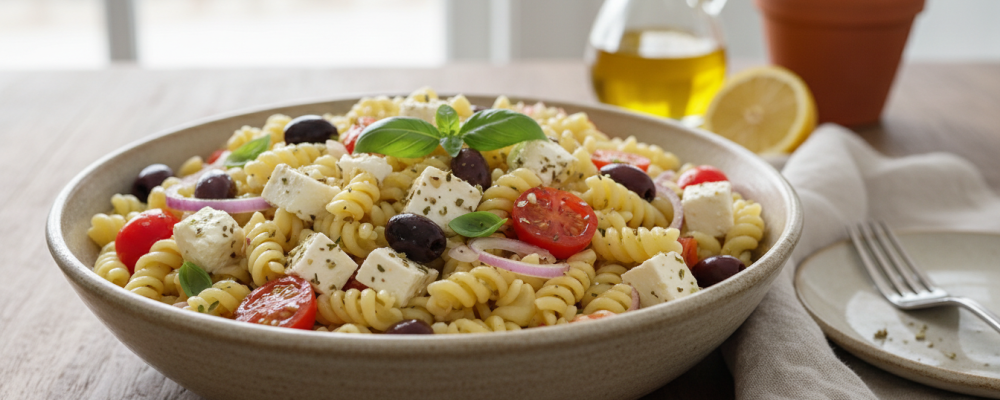

There are recipes that feel like a breath of fresh air the moment you make them, and Greek Pasta with Feta and Olives is exactly that kind of dish. Bright lemon, briny kalamata olives, creamy crumbled feta, fragrant oregano, and fresh parsley tossed with perfectly cooked pasta in a simple olive oil dressing—it’s a recipe that delivers the full, vibrant flavor profile of the Mediterranean table with almost no cooking required. It’s the dish I reach for when I want something that feels genuinely fresh and exciting without turning on the oven.
What I love most about this recipe is its complete lack of pretension. There’s no heavy sauce, no complicated technique, no lengthy ingredient list—just honest, quality ingredients tossed together in a way that lets each one shine. The olive oil and lemon dressing is deceptively simple but deeply effective, coating every piece of pasta with a bright, herbaceous flavor that gets into every corner of the bowl. The feta, crumbled generously and folded in at the end, softens slightly against the warm pasta and creates creamy, salty pockets of flavor throughout that make every forkful genuinely exciting.
It works equally well warm from the pot or chilled after thirty minutes in the refrigerator—a flexibility that makes it one of the most practical, versatile recipes in my entire repertoire.
The Inspiration Behind This Recipe
This recipe was inspired by the simplest and most fundamental principle of Greek cooking: that quality ingredients, treated with restraint and seasoned honestly, produce results that are greater than any complicated preparation could achieve. The Greek culinary tradition has always understood that olive oil, lemon, herbs, and good cheese are not supporting players in a dish—they are the dish, and everything else exists to showcase them.
The combination of kalamata olives and feta is one of the great enduring flavor partnerships of the Greek kitchen, and pairing them with pasta felt like a natural, modern evolution of that tradition—bringing those beloved Mediterranean flavors into a format that’s universally accessible, deeply satisfying, and endlessly adaptable. A squeeze of lemon and a handful of fresh parsley tie everything together with the brightness and freshness that defines great Greek cooking at its best.
It’s also a recipe born from a genuine love of simple, produce-forward cooking that respects the ingredients and trusts that simplicity, done well, is always enough.
A Brief History of Greek Pasta and Mediterranean Flavors
While pasta is most commonly associated with Italian culinary tradition, Greece has its own rich history of pasta-like dishes—from hilopites, the small egg noodle squares beloved throughout Greek home cooking, to kritharaki, the orzo-like pasta shape that forms the base of the beloved baked dish pastitsio. The influence of Italian pasta culture on Greek cooking, particularly in the islands closest to Italy, has created a long and delicious tradition of Greek-inflected pasta preparations that are distinctly their own.
The foundational ingredients of this dish—kalamata olives, feta cheese, olive oil, lemon, and oregano—represent the most essential and iconic flavors of the Greek pantry, each with its own remarkable history and Protected Designation of Origin status that speaks to how deeply rooted they are in the landscape and culture of Greece. Kalamata olives, named for the southern Peloponnese city, and authentic Greek feta—made exclusively from sheep’s milk or a blend of sheep’s and goat’s milk in specific Greek regions—are two of the most globally recognized and beloved expressions of Greek culinary heritage.
Together, these ingredients create a flavor profile that is immediately, unmistakably Greek—and that has made this style of cooking beloved around the world for very good reason.
Why This Simple Preparation Works
The genius of this recipe lies entirely in its restraint. Rather than building a cooked sauce, the dressing here is a simple emulsion of olive oil, lemon juice, garlic, and oregano that coats the pasta while it’s still warm—allowing the heat of the pasta to gently bloom the garlic and oregano into the oil and lemon, creating a dressing that’s far more fragrant and flavorful than it would be applied to cold pasta.
Adding the red onion, olives, and parsley while the pasta is still warm allows those ingredients to soften slightly and release their flavors into the surrounding dressing, creating a more cohesive, integrated flavor experience than a purely cold assembly would produce. The feta, added last and folded gently rather than stirred vigorously, maintains its characteristic crumbled texture while softening just enough against the warm pasta to create those creamy, intensely salty pockets that make every bite so satisfying.
The option to chill for thirty minutes before serving is more than just a temperature preference—it’s a technique that allows all of the flavors to meld and deepen, producing a noticeably more unified, complex flavor profile in the finished dish.
Flavor Profile: What to Expect
This pasta delivers a bright, vibrant, beautifully balanced Mediterranean flavor experience:
Clean, bright lemon acidity that cuts through the richness of the olive oil and feta and keeps every bite feeling fresh and alive
Fruity, briny kalamata olives that add deep, slightly bitter complexity and a distinctly Greek character to every forkful
Creamy, tangy feta with its characteristic salty intensity that creates rich, satisfying pockets of flavor distributed throughout the dish
Fragrant oregano and fresh parsley that provide the herbal backbone of the dressing and deliver that unmistakable Mediterranean aromatic character
Sharp, slightly pungent red onion that softens gently in the warm pasta and adds a clean, bright bite that balances the creaminess of the feta
Good olive oil that ties every element together with its characteristic fruity richness and smooth, lingering finish
The overall effect is bright, satisfying, and deeply refreshing—a pasta dish that manages to feel light and vibrant while still delivering genuine, lasting satisfaction.
Tips for Making the Best Greek Pasta with Feta and Olives
A few thoughtful details make a meaningful difference in the finished dish:
Salt the pasta water generously: Well-seasoned pasta water is the first and most important layer of flavor in any pasta dish. The pasta should taste pleasantly seasoned before it ever touches the dressing.
Dress the pasta while warm: Warm pasta absorbs the lemon and olive oil dressing far more effectively than cold pasta, producing a more flavorful, cohesive result. Toss immediately after draining.
Use good quality olive oil: Since the olive oil is a primary flavor component of the dressing rather than just a cooking medium, its quality is genuinely noticeable in the finished dish. A good extra-virgin olive oil makes a significant difference here.
Use block feta and crumble it yourself: Block feta packed in brine is significantly creamier, more flavorful, and more authentically Greek than pre-crumbled varieties. The extra minute of crumbling is absolutely worth it.
Don’t over-mix after adding feta: Gentle folding rather than vigorous stirring preserves the distinct crumbles of feta throughout the dish, ensuring every serving gets those intensely flavored pockets of cheese rather than a uniform coating.
Taste and adjust before serving: The saltiness of feta and olives varies between brands. Always taste the finished dish and adjust lemon juice, olive oil, salt, and pepper before serving.
Serving Suggestions and Side Pairings
This pasta is wonderfully versatile and transitions easily between multiple roles at the table:
Served warm as a satisfying weeknight main course with warm pita or crusty bread alongside
Chilled as a stunning pasta salad for potlucks, picnics, and summer entertaining where it holds up beautifully for hours
Alongside grilled chicken, lamb, or fish for a complete Mediterranean-inspired dinner spread
Paired with a simple Greek salad and hummus for a light, fresh lunch that feels genuinely satisfying
Served as a side dish alongside grilled proteins for a Mediterranean-themed dinner party that impresses without demanding extra effort
Storage, Reheating, and Make-Ahead Tips
This pasta is one of the most practical make-ahead recipes in any warm-weather repertoire.
Refrigerate in an airtight container for up to 3 days—the flavors deepen and meld beautifully overnight, making this genuinely one of those dishes that’s better the next day.
The pasta will absorb some of the dressing as it sits. A drizzle of fresh olive oil and a squeeze of lemon before serving restores its bright, vibrant character completely.
Add a fresh crumble of feta and a handful of parsley just before serving leftovers to revive the freshness and visual appeal of the dish.
This pasta is ideal for making ahead for entertaining—assembled the morning of a dinner party and refrigerated until serving, it arrives at the table perfectly seasoned and ready to impress.
Why This Recipe Deserves a Spot in Your Rotation
Greek Pasta with Feta and Olives deserves a permanent place in your recipe collection because it delivers a genuinely outstanding flavor experience with almost no effort, no special equipment, and no cooking beyond boiling a pot of pasta. It’s the recipe you reach for when you want something fresh and vibrant on a weeknight, when you need a crowd-pleasing dish for a gathering, or when the simplest possible approach to dinner is also the most satisfying one. Bright, bold, and deeply Mediterranean in every bite—this is the kind of recipe that makes you fall in love with simple cooking all over again.
Once it’s in your repertoire, it becomes the pasta you make on repeat all spring and summer long without ever getting tired of it.
Recommended Drink Pairing
The bright, lemon-forward, herb-infused character of this pasta calls for a wine with clean acidity and a mineral quality that echoes the coastal Mediterranean spirit of the dish. A crisp Greek Assyrtiko is the most inspired and fitting choice—its citrus notes and saline minerality are practically designed for this exact flavor profile. A Pinot Grigio or a crisp Albariño provides a more widely available alternative that works beautifully, its clean fruit and refreshing acidity complementing the lemon and olive oil dressing naturally.
For non-alcoholic options, a sparkling water with lemon and fresh mint, a chilled cucumber and citrus agua fresca, or a lightly sweetened iced green tea with lemon all pair wonderfully with the bright, clean Mediterranean flavors of this dish.
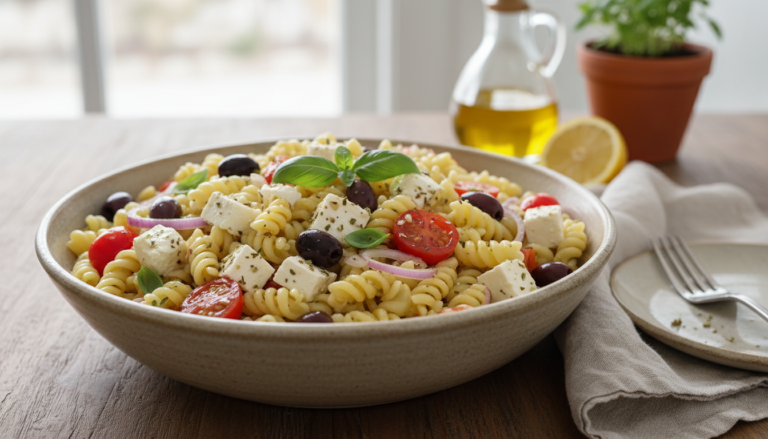
Greek Pasta with Feta and Olives
Bright lemon, briny kalamata olives, and creamy crumbled feta tossed with pasta and fresh herbs—Mediterranean flavor at its most effortless.
4
servings10
minutes15
minutes450
kcal25
minutesIngredients
250 g pasta
100 g feta cheese
100 g kalamata olives
2 tbsp olive oil
1 tbsp lemon juice
20 g red onion, sliced
1 tsp dried oregano
10 g fresh parsley, chopped
1 clove garlic, minced
0.5 tsp salt
0.25 tsp black pepper
Directions
- Cook the pasta according to package instructions until al dente. Drain and set aside.
- In a large bowl, combine olive oil, lemon juice, minced garlic, oregano, salt, and black pepper.
- Add the cooked pasta to the bowl and toss to coat with the dressing.
- Mix in sliced red onion, halved kalamata olives, and chopped fresh parsley.
- Crumble the feta cheese over the pasta and gently mix to combine.
- Serve immediately or chill for 30 minutes to enhance flavors.
Nutrition Facts
- Total number of serves: 4
- Calories: 450kcal
- Cholesterol: 0mg
- Sodium: 620mg
- Potassium: 400mg
- Sugar: 8g
- Protein: 6g
- Calcium: 60mg
- Iron: 2mg
About This Author

Amelia Grace
Editor-in-Chief & Culinary Director
The heart and guiding voice of Daily Dish, Amelia leads our editorial vision and recipe development. With a background in food journalism and over a decade spent in professional kitchens, she has a knack for blending gourmet technique with real-world accessibility. Her goal? To make every reader feel like a confident cook, one dish at a time.
Favorite dish: Creamy lemon risotto with a sprinkle of fresh thyme.
Kitchen motto: “Good food doesn’t have to be complicated — it just has to be made with heart.”