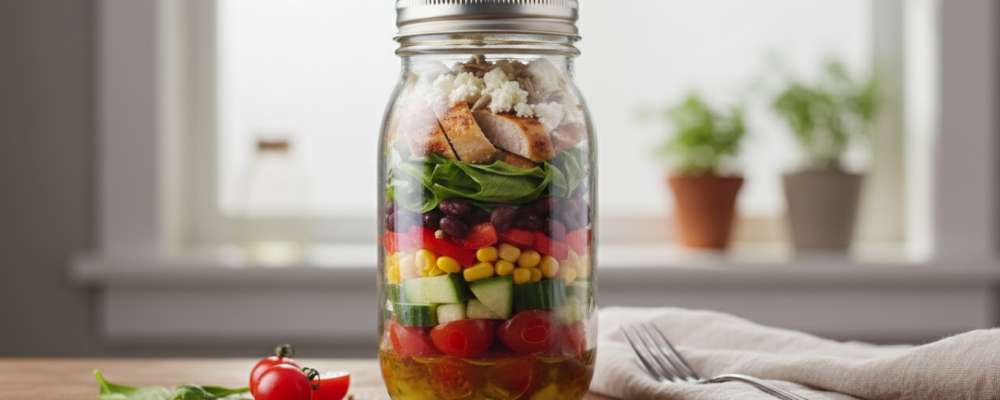

Mason jar salads represent one of the most elegant solutions to a persistent meal prep challenge: how to prepare fresh, crisp salads in advance without ending up with wilted, soggy greens by midweek. The answer lies not in special ingredients or preservation techniques, but in understanding basic physics—specifically, how gravity and strategic layering can be leveraged to keep incompatible elements separated until the moment you’re ready to eat.
The brilliance of this method is its simplicity backed by sound engineering principles. Liquid (dressing) is heaviest, so it goes on the bottom where it stays contained. Sturdy proteins and vegetables form protective barriers in the middle layers, absorbing flavors without compromising structure. Delicate greens, being the lightest and most vulnerable to moisture damage, sit on top where they remain completely dry and crisp. When you’re ready to eat, you simply invert the jar, shake to distribute the dressing, and pour into a bowl. The system works because you’re respecting the natural properties of each ingredient rather than fighting against them.
What makes this particularly effective for meal prep is the temporal dimension. Most salad preparations fail because dressing contacts greens immediately, initiating enzymatic breakdown and cellular damage that leads to wilting within hours. By maintaining complete separation between dressing and greens for 3-5 days, you’re essentially pausing that degradation process. The greens remain in suspended animation—dry, crisp, and fresh—while the heartier ingredients below are actually improving, marinating in the dressing and developing more complex flavors over time.
This represents strategic meal prep at its finest: using container geometry and ingredient characteristics to solve a preservation problem without requiring any special equipment, additives, or complex techniques. It’s food science made practical and accessible, delivering restaurant-quality salads from your own refrigerator days after assembly.
─────────
The Inspiration Behind This Recipe
This recipe emerged from analyzing why commercial salad kits succeed where home meal prep so often fails. Pre-packaged salads keep dressing separate until consumption—typically in a small side packet. But home cooks rarely have the patience to portion individual dressing containers for a week’s worth of salads, and carrying separate dressing bottles to work creates logistical complications. The mason jar method solves this by integrating the dressing into the storage system itself, using the jar’s height to maintain separation through simple gravity.
I developed this specific layering sequence through systematic testing of different configurations. Early attempts with dressing on top (thinking it would drip down when inverted) resulted in greens that were immediately saturated and wilted. Placing cheese directly on dressing caused it to become overly saturated and mushy. Positioning cucumbers too close to greens transferred moisture that led to premature wilting. Each iteration taught me something about how different ingredients interact over time in confined spaces.
The ingredient selection reflects both nutritional balance and practical storage considerations. Grilled chicken provides lean protein that doesn’t release excessive moisture or develop off-flavors during refrigeration. Cherry tomatoes maintain their integrity far better than sliced tomatoes, which would release too much liquid. Cucumbers were chosen over more delicate vegetables like bell peppers specifically because their cell structure stays crisp longer. Red onions add flavor complexity while their natural acidity complements the balsamic vinaigrette. Feta cheese, being a brined cheese, is inherently stable and doesn’t become slimy like fresh mozzarella might. Every component was selected for its ability to maintain quality over extended storage while contributing to a balanced, satisfying meal.
─────────
A Brief History of Salads in Jars and Portable Meal Prep
The concept of portable, self-contained meals has existed for as long as humans have needed to eat away from home—from medieval travelers carrying bread and cheese to Japanese bento boxes designed for beautiful, compartmentalized meals. However, the specific innovation of salads stored in glass jars emerged relatively recently, gaining mainstream attention in the early 2010s as meal prep culture exploded through social media and food blogs.
The mason jar salad phenomenon represents the intersection of several trends: the revival of traditional canning jars for non-canning purposes, the Instagram era’s emphasis on photogenic food presentations, and growing awareness of the environmental and health costs of disposable plastic containers and daily takeout habits. Food bloggers discovered that wide-mouth quart jars provided the perfect dimensions for salad storage—tall enough for distinct layers, wide enough for easy filling and eating, transparent enough to showcase colorful ingredients, and sealable enough to prevent leaks during transport.
What distinguishes modern jar salads from earlier portable meal attempts is the emphasis on systematic layering based on ingredient characteristics rather than random assembly. This methodology reflects contemporary understanding of food science and preservation principles. Earlier generations might have simply thrown salad components together and hoped for the best. The modern approach applies engineering thinking—analyzing each ingredient’s properties, understanding how they interact over time, and designing a system that leverages rather than fights against those natural behaviors. This shift from intuitive to analytical meal prep represents a broader cultural movement toward optimizing domestic efficiency through scientific principles previously reserved for commercial food service.
─────────
Why This Layering Method Works for Meal Prep
The success of mason jar salads hinges on understanding moisture migration and cellular structure integrity. When lettuce leaves contact liquid, osmosis begins immediately—water and dissolved compounds move across cell membranes, disrupting the turgor pressure that keeps leaves crisp. The cells collapse, enzymes activate, and you get wilting. By maintaining complete physical separation between dressing and greens using intermediary layers, you prevent this osmotic process from initiating. The greens remain in their natural state—dry, structurally intact, and crisp.
The intermediary layers serve multiple functions beyond simple separation. The chicken layer directly above the dressing acts as a protein barrier that absorbs and holds dressing close to the bottom, preventing upward migration through capillary action. Chicken’s dense structure and relatively dry surface (when properly cooked and cooled) means it won’t wick moisture upward the way porous bread might. The red onion layer provides additional barrier protection while benefiting from proximity to the dressing—the acidic vinaigrette actually begins a light pickling process that mellows the onion’s sharp bite over time, a positive development that adds complexity.
Cherry tomatoes and cucumber occupy the middle zone where some moisture contact is acceptable and even beneficial. These vegetables have waxy outer skins that protect their interior structure, and their high water content means they’re not susceptible to becoming waterlogged—they’re already primarily water. The balsamic vinaigrette flavors them gradually without compromising their texture. The feta cheese, with its crumbly structure and brined preservation, sits just below the greens where it remains firm and flavorful rather than dissolving into the liquid below.
The vertical orientation is critical to the system’s function. In a horizontal container, even careful layering eventually results in ingredients shifting and mixing during transport or when simply moving the container in the refrigerator. The tall, narrow geometry of a quart mason jar keeps layers stacked vertically where gravity maintains separation. The wide mouth (in wide-mouth varieties) allows for easy filling and pouring without ingredients getting stuck or requiring you to dig them out with utensils. The screw-on lid creates an airtight seal that prevents both leakage and oxidation, maintaining freshness through two mechanisms simultaneously.
─────────
Flavor Profile: What to Expect
This mason jar salad delivers classic Mediterranean-inspired flavors with excellent balance and complexity:
- Tangy and rich from balsamic vinaigrette that provides acidity to brighten the entire salad while adding subtle sweetness
- Savory and substantial from grilled chicken that contributes protein and mild, comforting flavor without dominating
- Sharp and pungent from red onion that adds bite and aromatic complexity, mellowed slightly by the vinegar’s marinating effect
- Fresh and juicy from cherry tomatoes that burst with sweet-tart flavor and provide moisture without making anything soggy
- Cool and crisp from cucumber slices that add refreshing crunch and mild, clean flavor
- Salty and creamy from feta cheese that provides tangy richness and satisfying umami depth
- Fresh and vegetal from mixed greens that contribute volume, fiber, and the essential “salad” quality
The overall composition creates a well-balanced meal where no single element dominates. The balsamic vinaigrette ties everything together with its complex sweet-tart profile, while the chicken provides satisfying substance that prevents this from feeling like “just a salad.” The feta adds richness that would normally come from heavier dressings or cheese, but with more interesting flavor.
Over the course of 3-5 days in the refrigerator, certain flavors develop positively while others remain stable. The chicken absorbs dressing flavors, becoming more savory and complex. The red onions mellow significantly as the vinegar’s acidity begins breaking down their harsh sulfur compounds—day-four onions taste noticeably sweeter and less sharp than day-one onions. The feta softens slightly and its brine mingles with the vinaigrette, distributing salty-tangy flavor more thoroughly. The greens, remaining isolated on top, stay exactly as fresh and crisp as the day you assembled them, providing that crucial textural contrast when you shake everything together just before eating.
─────────
Tips for Making the Best Mason Jar Salads
Precision in assembly and ingredient selection transforms this straightforward concept into genuinely excellent meal prep:
- Use wide-mouth quart mason jars exclusively: The wide mouth (not regular mouth) is essential for easy filling and pouring. Quart size (32 ounces) provides adequate volume for a satisfying lunch without excessive headspace that allows ingredients to shift.
- Add exactly 2-3 tablespoons of dressing: Too little means dry salads; too much risks overflow when shaking. Measure initially until you develop intuition for the right amount.
- Cook and cool chicken completely before assembly: Warm chicken creates condensation inside sealed jars, which promotes bacterial growth and compromises ingredient freshness. Room temperature or chilled chicken is essential.
- Cut ingredients to appropriate sizes: Cherry tomatoes should be halved (whole ones roll around too much), cucumber sliced into quarter-inch rounds, red onion chopped into small pieces that distribute evenly. Size consistency ensures balanced bites.
- Pack greens firmly but not crushingly: The greens should fill the top portion of the jar snugly enough that they don’t shift during transport, but not so tightly that you’re compressing them and damaging cell walls.
- Leave minimal headspace: Air in the jar means oxidation. Fill nearly to the top with greens to minimize oxygen exposure that can cause browning and wilting.
- Seal jars properly: Screw lids on firmly but don’t overtighten. The rubber seal needs to compress slightly to create an airtight barrier, but excessive force can damage the seal or make jars difficult to open.
- Store upright always: Never lay mason jar salads on their side in the refrigerator. This allows dressing to contact greens and defeats the entire purpose of layered separation.
- Shake vigorously before eating: When ready to eat, screw the lid on tightly, flip the jar upside down, and shake for 10-15 seconds. This distributes dressing throughout and mixes all components evenly. Pour into a bowl or eat directly from the jar.
- Use quality balsamic vinaigrette: The dressing provides most of the flavor impact. Cheap, watery vinaigrettes create disappointing salads. Either make your own or invest in a quality bottled version.
The single most critical factor is maintaining the specific layering order: dressing, protein, sturdy vegetables, cheese, greens. Deviating from this sequence—even slightly—compromises the system’s effectiveness and results in wilted, soggy salads.
─────────
Portioning and Container Suggestions
This recipe yields four generous lunch-sized salads when using quart (32-ounce) mason jars and following the ingredient quantities as written. Each jar should contain approximately 4-5 ounces of grilled chicken (about 30-35 grams of protein), 2-3 cups of packed mixed greens, and proportional amounts of vegetables and cheese. This creates a macronutrient balance of roughly 30% protein, 50% vegetables, and 20% fats from cheese and dressing—ideal for satiety and sustained energy.
For optimal results, use only Ball or Kerr brand wide-mouth quart mason jars. Generic or off-brand jars often have inconsistent dimensions or poor-quality seals that can leak during transport. The investment in quality jars—typically $1-2 per jar—pays off through years of reliable use. Wide-mouth is non-negotiable; regular-mouth jars have openings too narrow for easy filling or pouring, making the entire process frustrating and messy.
The quart size strikes the perfect balance for most people’s lunch needs. Pint jars (16 ounces) are too small to feel satisfying as a main meal, while half-gallon jars (64 ounces) are unnecessarily large and awkward to transport. If you have significantly higher or lower caloric needs, adjust by using pint-and-a-half jars (24 ounces) for lighter portions or adding a side like whole grain crackers or fruit to standard quart salads for more substantial meals.
For assembly efficiency, prepare all four jars simultaneously in an assembly-line fashion: line up four jars, add dressing to all four, then chicken to all four, then onions to all four, and so on. This batch approach is significantly faster than completing one jar entirely before starting the next. Total assembly time for four jars should be approximately 15-20 minutes, including washing and chopping ingredients—less than 5 minutes per lunch when amortized across the week.
─────────
Storage, Reheating, and Shelf Life Tips
- Refrigerator storage: Properly assembled mason jar salads maintain excellent quality for 5 days when stored at 40°F or below. The chicken remains safe through day 5, and greens stay crisp when layering is maintained correctly.
- Store upright always: This cannot be overstated—storing jars on their side allows dressing to contact greens and destroys the preservation benefits of layered separation. Dedicate a specific spot in your refrigerator where jars remain upright.
- No reheating necessary: These are designed to be eaten cold. The cold temperature actually enhances the crisp, refreshing quality that makes salads appealing.
- Transport considerations: Mason jars are leakproof when properly sealed, but the glass can break if dropped. Use an insulated lunch bag with padding, or consider silicone jar sleeves that provide cushioning and insulation.
- Freezing absolutely not recommended: Nothing in this salad freezes well. Greens become mushy, chicken texture degrades significantly, and vegetables lose all structural integrity when thawed.
- Dressing separation: Some balsamic vinaigrettes separate over time (oil rises, vinegar sinks). This is normal—the shaking process before eating recombines them perfectly.
- Chicken preparation: Use freshly cooked chicken for maximum shelf life. Leftover chicken that’s already been refrigerated for 2-3 days will have shorter remaining storage time in your salads.
- Greens selection matters: Sturdy greens (romaine, spring mix, baby spinach) last longer than delicate varieties (butter lettuce, arugula). Choose accordingly based on when you plan to eat each jar.
- Quality indicators: Fresh salads smell clean with notes of vinegar and herbs. If chicken develops an off smell or slimy texture, or if you see any mold growth, discard immediately. Properly prepared and stored, these issues shouldn’t occur within 5 days.
- Texture expectations: Greens should be exactly as crisp on day 5 as day 1 if layering was maintained. Chicken stays moist and flavorful. Vegetables retain their structure. Only the onions change noticeably, becoming sweeter and milder—a positive development.
─────────
Why This Recipe Deserves a Spot in Your Meal Prep Rotation
From a systems efficiency perspective, mason jar salads represent optimal resource allocation. The twenty minutes invested on Sunday generates five complete meals—a four-minute per-meal time cost that’s virtually impossible to beat. The economic calculation is equally compelling: five salads cost approximately $15-18 to prepare—roughly $3-3.60 per meal. Comparable nutrition from restaurant salads or prepared meal services typically runs $10-15 per serving, meaning you’re saving $32-57 per weekly batch. Annualized, that’s $1,664-2,964 in savings from a single meal prep strategy.
But the value extends beyond immediate time and cost calculations. This method solves a fundamental behavioral problem: the tendency to skip meals or make poor nutritional choices when healthy options aren’t immediately available. Having five complete, ready-to-eat lunches in your refrigerator eliminates the decision fatigue that often leads to expensive, nutritionally questionable takeout. You’re essentially pre-committing to healthy eating during a moment of clarity and energy (Sunday afternoon) to support your future self when willpower and time are depleted (Wednesday at 12:30 PM when you’re hungry and overwhelmed).
The nutritional architecture delivers comprehensive benefits. The high vegetable content provides fiber for digestive health and satiety, vitamins and minerals for cellular function, and antioxidants for inflammation reduction. The lean protein supports muscle maintenance and creates sustained energy release without blood sugar spikes. The moderate healthy fats from olive oil and cheese support nutrient absorption (many vitamins are fat-soluble) while contributing to meal satisfaction. This macronutrient balance prevents the mid-afternoon energy crash common with carbohydrate-heavy lunches while providing sufficient calories to prevent excessive hunger at dinner—a pattern that often leads to overeating later in the day.
Perhaps most valuable is the psychological benefit of consistency without monotony. These salads provide reliable nutrition through predictable components, but the shaking and mixing process right before eating creates slight variation in how ingredients combine—no two bites are identical. This subtle variation, combined with the gradual flavor development over the week (particularly in the marinating onions and dressing-infused chicken), prevents the exact repetition that often causes meal prep abandonment. You’re eating the same ingredients, but the experience evolves slightly each day, maintaining interest without requiring additional effort or complexity.
─────────
Meal Prep Pairing Suggestions
Mason jar salads function optimally as part of a comprehensive meal prep strategy that covers multiple eating occasions and provides nutritional variety throughout the week. The most logical pairing is with the Chicken Grain Bowls, which use similar proteins and Mediterranean-inspired flavors but offer a warm, grain-based alternative to cold salads. Alternating between cold mason jar salads and warm grain bowls throughout the week prevents palate fatigue while maintaining similar nutritional profiles—some days you’ll crave the crisp, refreshing quality of salad, other days the comforting warmth of a grain bowl sounds more appealing.
For those requiring higher caloric intake or more substantial lunches, pair these salads with complementary sides that don’t require refrigeration—whole grain crackers, a piece of fruit, or a small handful of nuts kept in your desk drawer. This allows you to customize each lunch’s total calories based on morning hunger levels and afternoon activity plans without preparing entirely different meals. The salad provides your vegetable and protein foundation; everything else is flexible supplementation.
From a complete weekly meal prep perspective, combining mason jar salads (lunch) with Breakfast Burritos or Greek Yogurt Parfaits (breakfast) and Sheet Pan Chicken with Vegetables (dinner) creates a food system where Sunday preparation covers all primary eating occasions Monday through Friday. This comprehensive approach maximizes the return on time invested—once you’ve committed to meal prep mode on Sunday, extending that session by an hour to cover breakfast and dinner in addition to lunch provides disproportionate value compared to the incremental effort required.
For snacking strategy, the Tuna Salad Cucumber Bites or Chia Pudding Cups provide options that complement rather than duplicate the salad’s flavor profile and nutritional composition. The cucumber bites offer additional protein and crunch for afternoon hunger without the volume of a full meal. The chia pudding provides something sweet when you need dessert or a morning snack, preventing the feeling of restriction that often undermines healthy eating patterns. This multi-component approach—covering breakfast, lunch, dinner, and snacks—represents optimal meal prep architecture: maximum coverage with minimum repetition, ensuring you always have appropriate options available regardless of hunger level, time constraints, or specific cravings.
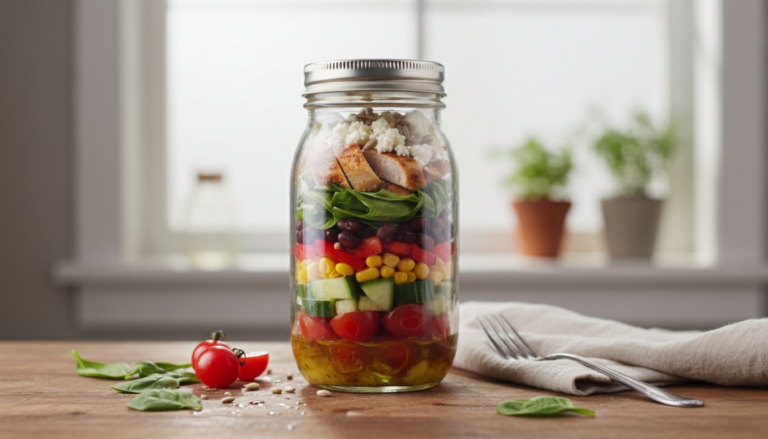
Mason Jar Salad
This mason jar salad recipe uses engineered layering to keep your greens crisp and your proteins fresh for up to five days of grab-and-go lunches that never get soggy.
4
servings30
minutes40
minutes300
kcal1
hour10
minutesIngredients
0.5 cup balsamic vinaigrette
4 cups mixed greens
1 cup cherry tomatoes
1 cup cucumber, sliced
0.25 cup red onion, chopped
0.5 cup feta cheese
1 cup grilled chicken, diced
Directions
- Start by adding the balsamic vinaigrette to the bottom of each mason jar. This prevents the greens from becoming soggy and ensures they stay fresh.
- Layer the diced grilled chicken on top of the vinaigrette. This helps to keep the protein and liquid elements separate from the greens.
- Add the chopped red onion next. These sturdy vegetables form a firm layer above the chicken and absorb flavors from below.
- Place the cherry tomatoes and cucumber slices into the jar. These add a refreshing flavor and vibrant color to your salad.
- Sprinkle the feta cheese on top of the vegetables. This prevents it from getting soggy and adds a creamy texture to the salad.
- Lastly, fill the rest of the jar with mixed greens. Be sure to pack them tightly to prevent them from wilting.
Nutrition Facts
- Total number of serves: 4
- Calories: 350kcal
- Cholesterol: 0mg
- Sodium: 620mg
- Potassium: 400mg
- Sugar: 8g
- Protein: 6g
- Calcium: 60mg
- Iron: 2mg
About This Author

Benjamin Brown
Recipe Developer
Benjamin is our flavor engineer. A classically trained chef turned recipe developer, he’s obsessed with balancing taste, texture, and creativity. He ensures that every recipe we publish is not only delicious but also reliable, approachable, and repeatable — even for beginners.
Favorite dish: Slow-braised short ribs with red wine reduction.
Kitchen motto: “Cooking is part science, part soul.”