
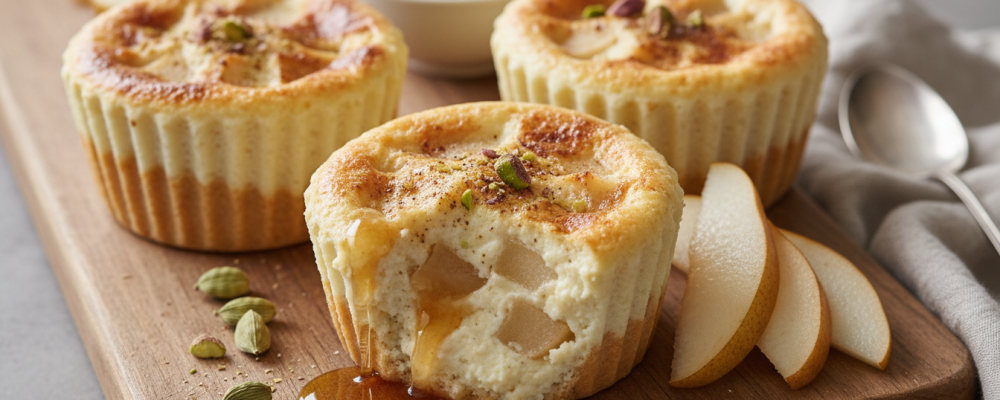

There is a category of dessert that I think of as quietly luxurious—preparations that produce a result that is genuinely elegant and genuinely satisfying without announcing their ambition or requiring specialized equipment or unusual technique. The best examples are the ones where the beauty of the finished dish is simply the honest expression of good ingredients treated with a small amount of care: a perfect tart made from fruit and butter and nothing else, a pannacotta that holds its shape by virtue of good dairy and correct technique, a baked ricotta cup with spiced pears on top.
This recipe belongs to that category. Ricotta, baked gently until its surface is lightly golden and its interior has set to a firm but yielding creaminess—like the best part of a cheesecake, but lighter—is already, by itself, something special. It has the texture of a well-set custard and a clean, milky flavor that accepts the flavors placed on top of it with generosity rather than competition. And placed on top of it, in this preparation, is something that deserves to be appreciated: diced pears cooked in butter with honey and cardamom until they have softened into a warm, fragrant, slightly syrupy compote that smells like the filling of the best possible autumn pastry and tastes like everything that combination promises.
I have plated a great many composed desserts in my professional life that required considerably more steps and considerably more technique than this preparation and produced a less satisfying result. The Cardamom Pear Baked Ricotta Cup is the kind of recipe that reminds you that elegance is not a function of complexity—it is a function of proportion, of ingredient quality, and of the specific, considered choice of what to put next to what. This recipe gets all three right.
─────────────────────────────────────────
The Inspiration Behind This Recipe
This recipe was inspired by the Italian tradition of fresh ricotta as a dessert base—a use that is less familiar to American home cooks than ricotta’s savory applications but far more common in the Italian kitchen, where a bowl of fresh ricotta with honey and fruit is a standard and beloved end to a meal. The lightness of ricotta relative to mascarpone or cream cheese makes it an ideal dessert foundation for preparations that want to feel indulgent without being heavy—and its mild flavor makes it the most receptive possible backdrop for strong aromatics like cardamom, which can overwhelm a richer dairy base but blooms beautifully against ricotta’s clean white canvas.
Cardamom and pear are one of the great underappreciated flavor pairings in pastry. Pear’s delicate, floral sweetness and its tendency to soften gently rather than aggressively under heat make it the ideal companion for cardamom’s complex, slightly medicinal warmth—a spice that needs a subtle fruit to let it come forward rather than a strong one that competes with it. Apples are too assertive; peaches too sweet; plums too tart. Pear gives cardamom the quiet space it needs to be fully itself, and the combination produces a compote that is far more interesting and more memorable than either ingredient would produce with a more conventional spice pairing.
The lemon zest, stirred in at the end of the compote preparation and not cooked with the pears, was the finishing detail that completed the recipe. Its purpose is not to add lemon flavor—the finished cup should taste of cardamom and pear and honey and vanilla, not of lemon—but to add the aromatic brightness of lemon’s essential oils in a quantity too small to register as citrus flavor but large enough to lift and sharpen every other flavor around it. This is one of pastry’s most useful techniques: using a strong aromatic in small enough quantity to function as an amplifier rather than a note.
─────────────────────────────────────────
A Brief History of Baked Ricotta Preparations
Ricotta—whose name translates literally as “recooked,” a reference to the process of heating whey left over from cheese production to precipitate its remaining proteins—has been produced in Italy for at least two thousand years, with references to similar preparations appearing in Roman agricultural texts. The resulting fresh cheese, mild and slightly grainy when young and smooth when well-drained, became a staple of Italian cooking across both sweet and savory applications: in lasagna, in ravioli fillings, in cannoli and sfogliatelle, and in the simple, unadorned form of fresh ricotta with honey and seasonal fruit that remains one of Italy’s most enduring domestic desserts.
The baked ricotta preparation specifically—where fresh ricotta is placed in a ramekin or baking dish and subjected to gentle oven heat until its surface sets and lightly colors—appears throughout the Italian culinary tradition under various regional names and with various toppings. In Sicily, where ricotta and citrus are foundational to the pastry tradition, baked ricotta is commonly sweetened with honey and citrus zest. In the mainland northern regions, where pears and spice are more common autumn pantry ingredients, the combination of pear compote and cardamom with fresh ricotta reflects the northern Italian approach to seasonal, dairy-forward desserts.
The cardamom specifically—a spice with no native Italian culinary tradition—arrived in this recipe through the contemporary pastry world’s enthusiastic adoption of Scandinavian baking influences, where cardamom has been used in combination with pear and vanilla for centuries in the bread and pastry traditions of Sweden, Norway, and Denmark. The meeting of Italian ricotta technique and Scandinavian spice logic in a single small baking cup is the kind of culinary conversation across traditions that produces something new and genuinely better than either tradition offered on its own.
─────────────────────────────────────────
Why This Cooking Method Works for Meal Prep
The two-stage preparation—stovetop compote followed by oven bake—produces a result that is significantly more meal-prep stable than either component alone. Fresh ricotta baked without toppings tends to develop a slightly dry, crumbly texture as it cools and refrigerates, losing the creaminess that makes it appealing. Baked with the pear compote sitting on top, the syrupy pear liquid slowly migrates into the ricotta’s surface during both the baking window and subsequent refrigeration, keeping it consistently moist and adding flavor depth that improves rather than diminishes over the first two days of storage.
The butter-cooked pear compote is more meal-prep stable than a fresh pear topping for a specific reason: the butter and honey cooking process removes the pears’ ambient moisture as steam while concentrating their flavor, producing a compote that is denser, more intensely flavored, and structurally more stable under refrigeration than raw diced pear would be. Raw pear releases its water content in storage and produces a soggy, diluted topping that damages the ricotta’s texture below it; the cooked compote’s concentrated sugars resist further moisture release and maintain a semi-solid, spoonable consistency across the full storage window.
Baking the assembled cups at 350°F for twenty minutes achieves the surface-set without driving the ricotta to the point of dryness or graininess—the temperature is moderate enough to allow the ricotta’s whey proteins to coagulate into a firm but yielding structure without expelling the moisture that makes the texture pleasant. The lightly golden surface is the visual indicator that the correct internal temperature has been reached: the proteins have set, the top has dried enough to color, and the interior remains creamy. This is the same principle that governs the baking of any custard-based preparation, applied to ricotta’s specific protein and moisture composition.
─────────────────────────────────────────
Flavor Profile: What to Expect
These cups are refined and warmly sweet—the flavor of a composed pastry in the package of a simple baked preparation:
- Warm, floral cardamom – The defining aromatic note of the pear compote: complex, slightly medicinal, simultaneously warm and citrusy—the spice that makes this preparation taste specifically and memorably of itself rather than generically spiced
- Honey-glazed pear sweetness – Butter-cooked pear with honey produces a compote that is sweeter and more intensely flavored than fresh pear—concentrated, slightly jammy, with a floral depth that is most perceptible in the first warm bite
- Clean, milky ricotta creaminess – The baked ricotta base is mild, slightly sweet, and yielding under the spoon—a smooth, neutral canvas that lets the compote’s flavors come forward while contributing its own quiet richness
- Warm vanilla depth – Vanilla extract rounds every other flavor in the compote with its characteristic bakery warmth—most perceptible as a fragrance in the cup’s first moments out of the oven
- Aromatic lemon zest lift – Present as a brightening influence rather than a citrus flavor—the zest’s essential oils amplify the cardamom’s florality and the pear’s sweetness without announcing themselves as a distinct note
- Butter richness – The compote’s butter base contributes a quiet, rounded richness that coats the palate and makes the cup feel indulgent in a way that oil-cooked fruit never quite achieves
The flavors integrate measurably overnight as the honey-glazed compote continues to seep into the ricotta surface. A cup eaten warm from the oven is delicious; a cup eaten the following morning—reheated gently or served at room temperature—is noticeably more cohesive and more deeply flavored throughout.
─────────────────────────────────────────
Tips for Making the Best Cardamom Pear Baked Ricotta Cups
The quality of two ingredients determines the quality of this recipe above all else—the ricotta and the pears:
- Use whole-milk ricotta – Part-skim or low-fat ricotta has a higher water content and lower fat content than whole-milk, producing a baked cup that is grainier in texture, less creamy, and more prone to weeping liquid during baking. Whole-milk ricotta produces a smooth, set baked texture that holds its form cleanly through cooling and refrigeration.
- Drain the ricotta if watery – Fresh ricotta varies significantly in moisture content between brands. If the ricotta appears wet or loose when opened, drain it through a fine-mesh sieve or cheesecloth for thirty minutes before using. Excess moisture in the cup prevents the surface from setting and coloring correctly during baking.
- Choose ripe but firm pears – Bartlett, Bosc, and Anjou all work well; avoid pears that are overripe, which dissolve completely during cooking rather than holding their diced shape. Slightly underripe pears are preferable to overripe ones—the butter and honey will soften them sufficiently.
- Add lemon zest off heat – Lemon zest’s essential oils are volatile and begin to dissipate immediately when exposed to heat. Stirring zest in after removing the compote from the heat preserves its aromatic freshness in the finished cup rather than cooking it off during the sauté.
- Fill cups no more than three-quarters – The ricotta doesn’t rise significantly during baking, but the pear compote’s syrup can bubble at the edges if cups are overfilled. Three-quarters capacity leaves enough headroom to contain any bubbling and produces a cup that looks proportioned and intentional when served.
- Cool slightly before serving or refrigerating – The ricotta continues setting as it cools. Served immediately from the oven, it is very soft; after ten minutes of cooling, it is set and spoonable. Fully cooled before refrigerating is the correct approach for meal prep storage—sealing a warm cup traps steam that condenses on the lid and drips back onto the ricotta surface, creating a wet, unappealing top layer.
Optional: A final drizzle of honey and a pinch of additional ground cardamom over each cup immediately before serving adds a glossy, fragrant finishing touch that makes these cups look genuinely restaurant-plated—and costs ten seconds of effort.
─────────────────────────────────────────
Portioning and Container Suggestions
This recipe produces four individual cups—one per serving across a four-day rotation as a breakfast, dessert, or afternoon snack. Individual ramekins or small oven-safe glass containers are the ideal baking and storage vessel: baked directly in the serving vessel, they require no transfer and can be covered with a lid or plastic wrap after cooling and refrigerated as-is. The all-in-one bake-and-store format is one of the most practical qualities this recipe offers, and it produces a particularly attractive refrigerator presentation—four small cups with their amber-golden pear topping visible, lined up and waiting for the week ahead.
For a more deliberately composed presentation—these cups are absolutely appropriate for serving to guests—unmold onto a small plate after brief chilling, top with additional honey, and garnish with a thin slice of fresh pear and a few whole cardamom pods for visual interest. The contrast between the set white ricotta and the warm, caramelized pear topping is visually very beautiful and requires no garnishing skill to achieve—the ingredients do the work.
A drizzle of additional honey kept in a small jar alongside the stored cups means each day’s serving can be finished with a fresh, glossy glaze that makes a refrigerator breakfast feel like something served rather than retrieved. That small finishing detail—ten seconds, one jar—is the kind of thing that keeps a recipe in the rotation by making every serving feel slightly more considered than a typical weekday meal has any reason to be.
─────────────────────────────────────────
Storage, Reheating, and Shelf Life Tips
- Refrigerator storage: Covered cups keep in the refrigerator for up to 4 days. The pear compote continues to integrate into the ricotta surface overnight—day-two cups are measurably creamier and more cohesive than day-one.
- Reheating (oven method, recommended): Place cups in a 300°F oven for 8–10 minutes until warmed through. This method preserves the ricotta’s creamy texture and warms the compote without bubbling or breaking it—the best result of any reheating approach.
- Reheating (microwave): Microwave at 50% power for 45–60 seconds. Full power heats the compote’s sugars too quickly, causing them to bubble aggressively and potentially break the ricotta’s set surface. Low power and a short time produces a gently warmed result.
- Serving temperature: These cups are excellent at room temperature as well as warm—the cardamom fragrance is more pronounced without heat suppression, and the ricotta’s texture is at its most consistent and spoonable at room temperature after fifteen minutes out of the refrigerator.
- Freezer storage: Not recommended. Ricotta’s protein structure changes significantly when frozen and thawed, producing a grainy, separated texture that cannot be restored by reheating. The pear compote alone freezes well for up to two months; fresh ricotta should be purchased and baked when needed.
- Honey freshness: If the honey has crystallized slightly on the compote’s surface during refrigerator storage, a brief microwave warm (30 seconds at full power) returns it to a glossy, liquid state before serving.
─────────────────────────────────────────
Why This Recipe Deserves a Spot in Your Meal Prep Rotation
I want to make an argument that I think gets overlooked in conversations about what belongs in a meal prep collection: indulgence belongs. A rotation built entirely on efficient, nutritionally correct, practically optimized preparations is a rotation that works but doesn’t delight—and a preparation routine that doesn’t include at least occasional delight is one that eventually gets abandoned. These Cardamom Pear Baked Ricotta Cups are the delight category. They are the recipe in the weekly lineup that makes Sunday afternoon feel like an occasion and makes Tuesday morning feel like something to look forward to.
They also happen to be genuinely nutritious—ricotta protein, pear fiber, honey’s antioxidant depth—and genuinely practical: four portions from a single preparation, four days of storage, two minutes of reheating. But the reason to keep them in the rotation is simpler than any of that. It is because cardamom and pear and honey baked over fresh ricotta produces something that is, by any honest assessment, beautiful to eat—and because a meal prep rotation that includes something beautiful is a rotation that sustains not just the body but the specific pleasure of eating well. That, in the end, is what this recipe is for. It does its job with uncommon grace.
─────────────────────────────────────────
Meal Prep Pairing Suggestions
Cardamom Pear Baked Ricotta Cups pair most naturally with other warmly spiced, fruit-forward sweet preparations that offer genuine contrast in texture and preparation method. Our Brown Butter Peach Baked Oat Squares make the ideal companion within the baked sweet category—both are oven-finished, both feature a warm spice as the defining aromatic, and both pair fruit with a rich, dairy-adjacent base—but where the oat squares are dense and crumbly and structured around brown butter’s nuttiness, these cups are creamy and yielding and structured around cardamom’s florality. The two preparations cover different textural and flavor registers within the same warmly indulgent sweet preparation category without any redundancy.
For a complete sweet breakfast rotation that covers warm, cool, and in-between, our Peach Ginger Overnight Oat Jars provide the cool, no-bake counterpart—creamy and fruit-forward like these cups, but cold and jar-based where these are warm and oven-finished. Together with the oat squares, the three preparations cover every sweet breakfast and snack scenario across the week: warm and custard-rich, crumbly and oat-forward, and cool and creamy. All three prepared on Sunday. All three waiting in the refrigerator like small, considered gifts to the mornings ahead. That is, in its most complete and honest form, exactly what a well-designed sweet prep rotation should be.
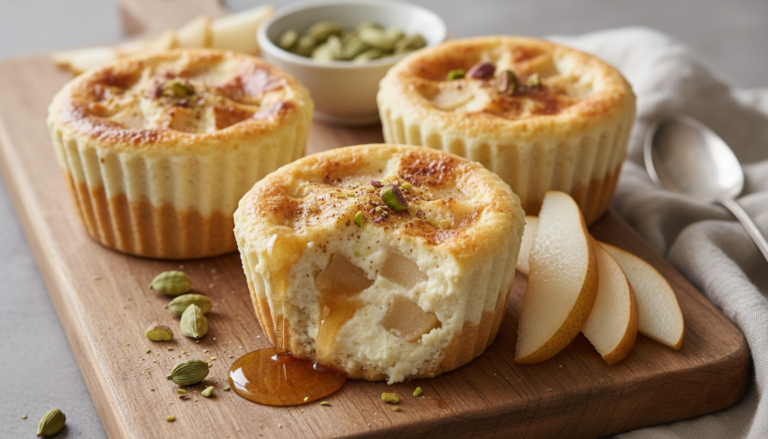
Cardamom Pear Baked Ricotta Cups
These Cardamom Pear Baked Ricotta Cups are a warmly spiced, elegantly simple baked dessert or breakfast that layers honey-glazed cardamom pears over smooth ricotta—a five-ingredient composition that looks and tastes like something from a very good restaurant and requires almost nothing to produce.
4
servings15
minutes25
minutes200
kcal40
minutesIngredients
1 cup ricotta cheese
2 ripe pears
1/4 tsp ground cardamom
2 tbsp honey
1/2 tsp vanilla extract
1 tsp lemon zest
1 tbsp butter
Directions
- Preheat the oven to 350°F (175°C).
- Core and dice the pears into small cubes.
- In a saucepan, melt butter over medium heat.
- Add pears, cardamom, and honey; cook until pears are softened.
- Stir in the vanilla extract and lemon zest, then remove from heat.
- Divide ricotta cheese evenly into four baking cups.
- Top each cup with pear mixture.
- Bake for 20 minutes or until slightly golden on top.
- Allow to cool slightly before serving.
Nutrition Facts
- Total number of serves: 4
- Calories: 200kcal
- Cholesterol: 0mg
- Sodium: 620mg
- Potassium: 400mg
- Sugar: 8g
- Protein: 6g
- Calcium: 60mg
- Iron: 2mg
About This Author

Aurora Wright
Pastry Chef & Dessert Editor
Aurora is the sweet side of Daily Dish. A trained pastry chef and dessert stylist, she’s responsible for our mouth-watering cakes, cookies, and confections. She brings precision, artistry, and a touch of whimsy to every recipe she creates — and taste-tests more chocolate than she’ll admit.
Favorite dish: Flourless dark chocolate torte.
Kitchen motto: “Life’s too short to skip dessert.”















