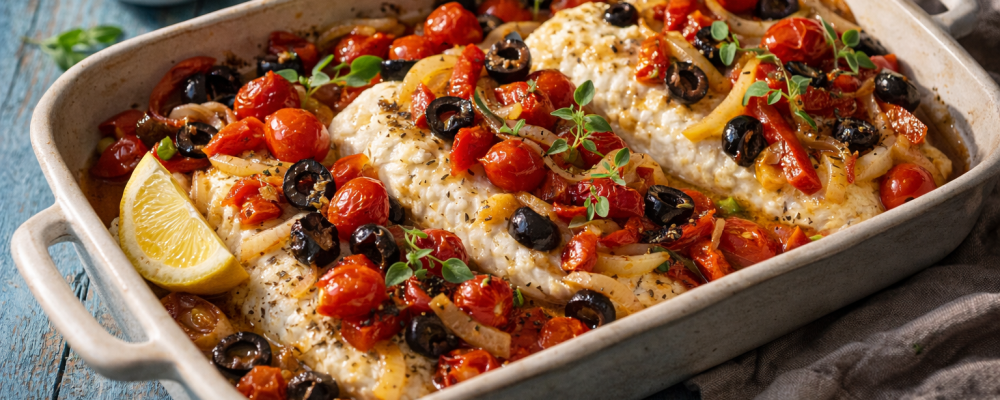

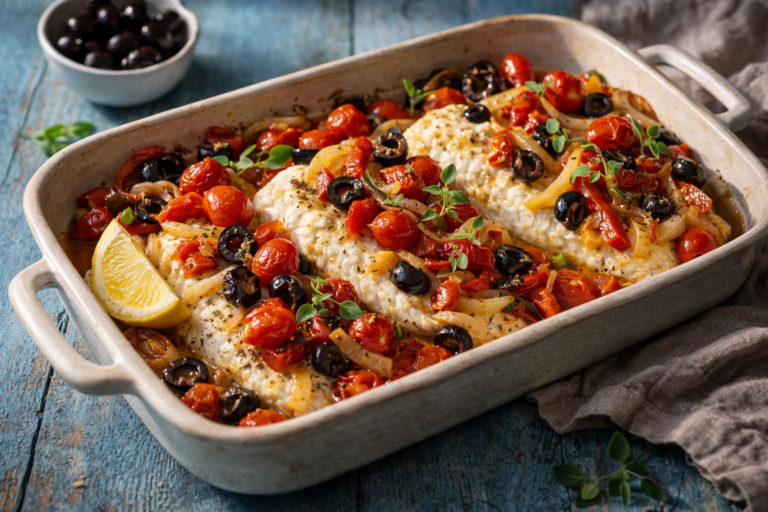
There are dishes that transport you somewhere the moment the pan comes out of the oven, and Mediterranean Baked Fish is one of the most reliably transporting recipes I know. The combination of sweet roasted tomatoes, caramelized onions and peppers, briny olives, fragrant oregano and thyme, and a generous squeeze of lemon over flaky white fish is one of the great flavor combinations of the Mediterranean table—sunny, bright, and deeply satisfying in the way that only honest, ingredient-driven cooking can be. It’s a dish that makes any weeknight feel like a slow afternoon somewhere along the Aegean coast.
What I love most about this recipe is how beautifully it demonstrates the core philosophy of Mediterranean cooking: that quality ingredients, treated simply and cooked with care, produce results that are greater than any complicated technique could achieve. There’s no elaborate sauce, no lengthy marinade, no specialized equipment. Just good olive oil, vibrant vegetables, fragrant herbs, and fresh fish—ingredients that have been finding their way to the same table together for centuries because the combination is simply perfect.
It’s also one of the most practical and versatile recipes in my weeknight repertoire. The vegetable topping comes together in about ten minutes on the stovetop, and the oven does the rest in twenty-five minutes. The whole meal is ready in under forty minutes and manages to look and taste like something that required significantly more effort.
The Inspiration Behind This Recipe
This recipe was inspired by the coastal cooking traditions of the Mediterranean—the way fishing villages from Greece and Turkey to southern France and the Italian coast have been baking whole fish and fillets under blankets of tomatoes, olives, capers, and herbs for generations. It’s a cooking style rooted in abundance and simplicity: whatever came out of the sea that morning, baked with whatever was growing in the garden and preserved in the pantry, seasoned with the herbs that grow wild on every hillside throughout the region.
The specific combination of ingredients in this recipe reflects the Greek island cooking tradition more than any other regional influence—the oregano, the olives, the tomatoes, and the lemon are the defining flavor quartet of the Greek kitchen, and together they create a flavor profile that’s immediately recognizable and deeply evocative of that sun-drenched culinary tradition.
It’s a recipe born from a deep respect for Mediterranean cooking philosophy and a desire to bring its brightest, most beautiful flavors into an accessible weeknight format that anyone can make and everyone will love.
A Brief History of Mediterranean Baked Fish
Baked fish with vegetables and olive oil has been a cornerstone of Mediterranean cuisine for thousands of years, with culinary traditions across the entire region sharing variations of this fundamental preparation. In ancient Greece, fish was one of the most important protein sources in the diet, typically prepared simply with olive oil, herbs, and whatever vegetables were available—a tradition that has remained remarkably consistent across millennia of culinary evolution.
The plaki style of Greek baking—fish baked in a casserole with tomatoes, onions, garlic, olive oil, and herbs—is one of the most beloved and enduring expressions of this tradition, served in tavernas and home kitchens throughout Greece with the kind of consistent, unassuming excellence that defines great regional cooking. Similar preparations appear throughout the broader Mediterranean under different names: acqua pazza in Italy, chermoula-baked fish in North Africa, and herb-roasted fish throughout the French Riviera all share the same essential philosophy of letting quality fish and seasonal vegetables speak for themselves.
This recipe draws on that rich, diverse tradition while adapting it into an approachable, weeknight-friendly format that honors the spirit of Mediterranean coastal cooking.
Why This Baking Method Works
The two-stage cooking process—building the vegetable base on the stovetop before transferring everything to the oven—is the technique that gives this dish its exceptional depth of flavor and ensures the fish cooks perfectly every time. Pre-cooking the onions, bell peppers, garlic, and tomatoes in olive oil on the stovetop does something the oven alone cannot achieve as efficiently: it develops real caramelization and concentration in the vegetables before they ever touch the fish, creating a vegetable topping that’s deeply flavorful rather than simply softened.
Spooning that pre-cooked vegetable mixture over the fish fillets before baking creates a protective layer that keeps the fish moist throughout the entire cooking process, basting the delicate flesh with the flavorful olive oil and vegetable juices from above while the oven heat cooks it through from below. The result is fish that’s perfectly cooked, deeply flavored, and never dry—a result that’s surprisingly difficult to achieve with simpler methods.
The final drizzle of lemon juice added before baking brightens the entire dish and provides the clean, citrusy finish that makes every bite taste unmistakably Mediterranean.
Flavor Profile: What to Expect
This dish delivers a beautifully balanced, sun-drenched Mediterranean flavor experience:
Delicate, flaky white fish that absorbs the surrounding flavors throughout the bake and delivers a clean, mild base that lets the vibrant vegetable topping shine
Sweet, jammy cherry tomatoes that blister and burst during baking, releasing their juices into the dish and creating pockets of bright, concentrated tomato flavor throughout
Caramelized onion and bell pepper that add gentle sweetness and a silky, softened texture that contrasts beautifully with the fresher elements
Fragrant garlic woven through the vegetable mixture that adds savory depth and the warm, aromatic backbone characteristic of Mediterranean cooking
Earthy oregano and gentle thyme that provide the herbal identity of the dish and transport every bite unmistakably to the Mediterranean table
Briny, fruity black olives that add a salty, slightly bitter complexity that deepens the flavor profile and provides those characteristic Mediterranean moments of intensity
Bright lemon juice that ties every element together with a clean citrusy finish that keeps the entire dish tasting vibrant and alive
Tips for Making the Best Mediterranean Baked Fish
A few thoughtful details elevate this already beautiful dish:
Pat the fish dry before placing in the baking dish: Excess moisture prevents the vegetable topping from sitting properly on the fillets and can make the finished dish watery rather than vibrant and flavorful.
Don’t rush the vegetable sauté: The ten minutes of stovetop cooking before the vegetables go over the fish is what produces real caramelization and flavor concentration. Rushing this step produces underdeveloped vegetables that lack the depth the dish needs.
Use good quality olives: Jarred black olives vary enormously in quality and flavor. Kalamata olives or good quality oil-cured black olives make a noticeable difference in the finished dish.
Choose thick, even fillets: Thicker fillets cook more evenly and stay moister throughout the bake. Thin fillets can overcook before the vegetable topping has time to settle and meld.
Check early: Fish can go from perfectly cooked to overdone quickly. Start checking at 20 minutes—the fish is done when it’s opaque throughout and flakes easily with a fork.
Finish with fresh herbs: A scattering of fresh oregano, parsley, or basil added after baking adds a burst of fresh herbal brightness that dried herbs alone can’t provide.
Serving Suggestions and Side Pairings
This dish is versatile and elegant, pairing beautifully with a range of Mediterranean-inspired accompaniments:
Warm crusty bread or pita for scooping up the incredible olive oil and tomato juices from the baking dish
Steamed or roasted couscous for a light, grain-based pairing that absorbs the flavorful pan juices beautifully
A simple Greek salad with cucumber, feta, and red onion for a complete Mediterranean spread
Creamy hummus and warm flatbread alongside as a starter that sets the flavor theme before the main course arrives
Slow Roasted Greek Lemon Potatoes as a hearty, lemon-forward side that complements the Mediterranean flavors of the fish perfectly
Storage, Reheating, and Make-Ahead Tips
This dish is best enjoyed fresh from the oven but handles storage with reasonable grace given the delicate nature of baked fish.
Refrigerate leftovers in an airtight container for up to 2 days—consume promptly for the best quality and texture.
Reheat very gently in a covered baking dish at 300°F for 10 to 12 minutes, or in a covered skillet over the lowest possible heat with a splash of olive oil to prevent drying.
The vegetable topping can be made up to 2 days in advance and refrigerated, making weeknight assembly completely effortless—simply spoon over fresh fish fillets and bake as directed.
Why This Recipe Deserves a Spot in Your Rotation
Mediterranean Baked Fish deserves a permanent place in your weeknight recipe collection because it delivers an elegant, genuinely impressive dinner from a handful of simple pantry and produce staples with almost no technical skill required. It’s light enough to serve in summer, warming enough for cooler evenings, impressive enough for guests, and fast enough for any Tuesday night. It’s proof that the Mediterranean cooking philosophy—quality ingredients, simple technique, honest flavors—produces results that are consistently, reliably extraordinary.
Once it’s in your repertoire, it becomes the recipe you reach for every time you want dinner to feel like a genuine occasion without any of the effort that word usually implies.
Recommended Drink Pairing
The bright, herb-forward, olive oil-rich character of this dish calls for a wine with clean acidity and a mineral quality that echoes the coastal Mediterranean setting of the recipe. A crisp Greek Assyrtiko is the most fitting and inspired choice—its citrus notes, saline minerality, and bright acidity are practically designed for this exact dish. A Vermentino from Sardinia or Corsica also works beautifully, as does a clean, unoaked Pinot Grigio for a more widely available option.
For non-alcoholic options, a sparkling water with lemon and fresh oregano, a chilled hibiscus and citrus iced tea, or a cucumber and mint sparkling water all provide the bright, refreshing contrast this dish calls for in the most fitting way possible.
Mediterranean Baked Fish
Flaky white fish baked under a vibrant blanket of roasted tomatoes, caramelized peppers, olives, and Mediterranean herbs—simple, elegant, and endlessly satisfying.
4
servings15
minutes25
minutes320
kcal40
minutesIngredients
4 fillets white fish
2 tbsp olive oil
1 large onion, sliced
1 large bell pepper, sliced
2 cloves garlic, minced
1 cup cherry tomatoes, halved
1 tsp dried oregano
1 tsp dried thyme
0.5 tsp salt
0.25 tsp black pepper
0.5 cup black olives, sliced
1 lemon juice
Directions
- Preheat oven to 400°F (200°C).
- Place fish fillets in a baking dish.
- In a pan, heat olive oil and sauté onion and bell pepper until soft.
- Add minced garlic and cherry tomatoes to the pan; cook for 2 minutes.
- Stir in oregano, thyme, salt, and black pepper.
- Pour the vegetable mixture over the fish fillets.
- Sprinkle sliced olives on top.
- Drizzle lemon juice over the dish.
- Bake for 20-25 minutes or until fish is flaky.
- Serve immediately and enjoy.
Nutrition Facts
- Total number of serves: 4
- Calories: 320kcal
- Cholesterol: 0mg
- Sodium: 620mg
- Potassium: 400mg
- Sugar: 8g
- Protein: 6g
- Calcium: 60mg
- Iron: 2mg
About This Author

Amelia Grace
Editor-in-Chief & Culinary Director
The heart and guiding voice of Daily Dish, Amelia leads our editorial vision and recipe development. With a background in food journalism and over a decade spent in professional kitchens, she has a knack for blending gourmet technique with real-world accessibility. Her goal? To make every reader feel like a confident cook, one dish at a time.
Favorite dish: Creamy lemon risotto with a sprinkle of fresh thyme.
Kitchen motto: “Good food doesn’t have to be complicated — it just has to be made with heart.”