
Walk into almost any restaurant kitchen and you’ll see the same thing.
Stainless steel pans. Cast iron. Carbon steel. Maybe some copper if the place is fancy.
But nonstick? Almost never.
It’s not snobbery. It’s not tradition. There are actual reasons why the pans most home cooks rely on are nearly absent from professional settings.
And understanding why might change how you think about what’s in your own kitchen.
Heat Is Everything
Restaurant cooking happens fast and hot.
Burners cranked high. Pans screaming. Proteins seared in seconds, not minutes.
Nonstick pans can’t handle that kind of heat. Most start breaking down above 400°F. The coating degrades. It releases fumes. It stops working.
Stainless steel and cast iron don’t have that limitation. You can blast them as hot as you need without worrying about damaging the surface or creating a safety issue.
In a professional kitchen, where speed matters and temperatures run high, that’s not optional—it’s essential.
The Fond Matters More Than You Think
Here’s something most home cooks don’t realize: the brown bits stuck to the pan after searing aren’t a mess to clean up.
They’re flavor.
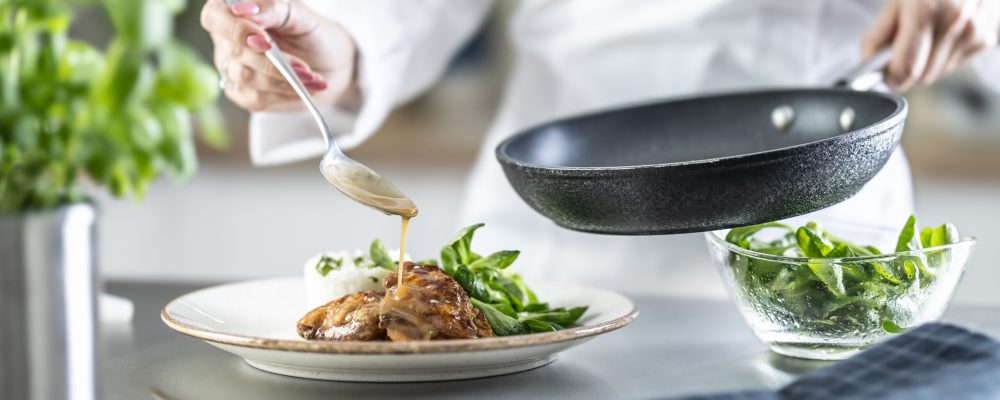
Chefs call it fond, and it’s the foundation of pan sauces, gravies, and reductions. You deglaze the pan with wine or stock, scrape up those bits, and suddenly you have something that tastes like it took hours.
Nonstick pans don’t create fond. Nothing sticks, so nothing builds. You get a clean pan, sure—but you lose all that concentrated, caramelized flavor in the process.
For restaurants, that’s a dealbreaker.
Durability Under Pressure
A busy kitchen might go through hundreds of plates in a night.
Pans get heated, cooled, scrubbed, and heated again. They get banged around. They get handled roughly by multiple cooks under pressure.
Nonstick coatings don’t survive that kind of use. They scratch. They peel. They wear out in months, not years.
Stainless steel and cast iron get better with age. They develop seasoning. They become more reliable. A well-maintained pan can last decades, even in a high-volume environment.
When you’re running a business, that difference in lifespan isn’t trivial—it’s the difference between constantly replacing equipment and investing in tools that pay for themselves.
Metal Utensils Are Non-Negotiable
In professional kitchens, cooks use metal spatulas, tongs, and spoons without thinking twice.
Nonstick pans require gentler treatment. Silicone. Wood. Plastic. Anything metal risks scratching the coating.
That’s fine at home, where you can take your time and use the right tool. But in a restaurant, where everything moves at full speed and there’s no time to baby equipment, metal utensils are the standard.
The pans need to keep up with the workflow, not the other way around.
They Want the Stick
This sounds counterintuitive, but it’s true: chefs often want food to stick—at least initially.
That resistance is how you build a crust on a steak. It’s how you get crispy-edged fish. It’s how you know a protein is ready to release naturally once it’s properly seared.
With nonstick, everything slides around. You lose that feedback. You can’t tell when something’s ready just by how it behaves in the pan.
Experienced cooks rely on that tactile information. It’s part of how they work.
When Nonstick Does Appear
To be fair, nonstick isn’t completely absent from professional kitchens.
Some places keep one around for eggs. Omelets, especially, benefit from a slick surface.
But it’s the exception, not the rule. And even then, it’s treated carefully—lower heat, gentler use, replaced more often.
It’s a tool for specific jobs, not an everyday workhorse.
What This Means for Home Cooks
You don’t need to throw out your nonstick pans.
But it’s worth asking: are you using them because they make you a better cook, or just because they’re easier to clean?
If you’ve been avoiding stainless steel or cast iron because you think they’re too hard to use, it might be worth trying again. The learning curve is real, but it’s shorter than you think.
And once you get comfortable with them, you’ll understand why professionals choose them every single time.
The Takeaway
Restaurant kitchens don’t skip nonstick pans to make cooking harder.
They skip them because other pans perform better under the conditions that matter most: high heat, fast cooking, and building flavor.
You might not be running a professional kitchen. But the same principles apply.
Because sometimes, the pan that’s easiest to clean isn’t the one that makes the best food.